
18th 544.1.2

But John I, and other gasmen as well as Joe Public, are not refering to the gas supply pipe, nor any water supply pipe that feeds that service from the main network into the property, we are refering to the INTERNAL installation of pipework be it gas, water or, as you just mentioned above oil. The electrical regulations, as written would seem to require require the internal installation of metalwork used by those services to be bonded together as near as to the point of entry to the building.
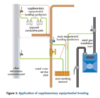
SUP Bond.png
as the above diagram.

Those same regs require central heating pipes to be bonded together also. Not many people have central radiators outside (but there are occasions where drain valves are).

Oh and that other old bone of contention from electricians is where plumbers still insist on linking taps and sinks/baths together with a bit of earth wire. Blame electrical regs again.
 
I think the problem with that recent gas guidance is that it will probably still be misunderstood by many non-electricians'

The "gas law" quoted earlier basically says that main bonding may be required and the installer should advise the responsible person to have it checked out by someone who knows what they are doing. I'm not sure if it needs to be any simpler than that.
 
But John I, and other gasmen as well as Joe Public, are not refering to the gas supply pipe, nor any water supply pipe that feeds that service from the main network into the property, we are refering to the INTERNAL installation of pipework be it gas, water or, as you just mentioned above oil. The electrical regulations, as written would seem to require require the internal installation of metalwork used by those services to be bonded together as near as to the point of entry to the building.
What you may think they 'seem to require' does not alter what the regulations actually require. Pipework which is entirely 'internal' within a property cannot possibly be an extraneous-conductive-part (the clue is in the word 'extraneous') and will never need bonding. It is only when something metal (like a pipe) enters a property from outside of the property that it may (but, as discussed, not necessarily) be an extraneous-conductive-part (in essence, if it has come into contact with the ground, or contact with some other metal that is in contact with ground) which needs bonding.
Oh and that other old bone of contention from electricians is where plumbers still insist on linking taps and sinks/baths together with a bit of earth wire. Blame electrical regs again.
It sometimes still IS required in bathrooms (but not often these days, and not in kitchens). As for all those who continue to do it today when it is unnecessary, you could blame the (I agree silly in parts) last-but-one version of the 'elecrical regs' (which became obsolete in 2008) - or, probably more appropriately, blame those who, 10 years on, have not noticed the electrical regulations changed a long time ago.

Kind Regards, John
 
Last edited:
The "gas law" quoted earlier basically says that main bonding may be required and the installer should advise the responsible person to have it checked out by someone who knows what they are doing. I'm not sure if it needs to be any simpler than that.
True - but wouldn't it be much better if those guidelines actually gave an explanation of when bonding "may (and may not) be required" - particularly given that they quote in full the regs in BS7671 which explain just that?

It seems a bit rotten to require the 'responsible person' (who usually/often will know nothing about either gas or electrical regulations/practices) to pay to "have it checked" because a gas engineer or fitter does not know whether bonding is needed or not, isn't it?

Kind Regards, John
 
The electrical regulations, as written would seem to require require the internal installation of metalwork used by those services to be bonded together as near as to the point of entry to the building.
It might be just poor wording, but they do not require them "to be bonded together at the point of entry"; they require each of them "to be bonded at the point of entry - to the MET".

Those same regs require central heating pipes to be bonded together also.
BUT ONLY if they have become extraneous-conductive-parts by being buried in the ground along their run.
Again - not bonded together but bonded from the point of entry (emergence from the ground) to the MET.

I realise this does bond them together but that is not what the regulations state.

Oh and that other old bone of contention from electricians is where plumbers still insist on linking taps and sinks/baths together with a bit of earth wire. Blame electrical regs again.
To be fair, it probably stems from the time when the electrical regulations required virtually every piece of metal to be bonded.
The only explanation for this can be that those who wrote the regulations then had absolutely no knowledge of what they were doing.
 
It might be just poor wording, but they do not require them "to be bonded together at the point of entry"; they require each of them "to be bonded at the point of entry - to the MET".
Yup agree 100% poor use of words. Simply meant that the services were electrically linked so no Potential Difference could occur between them which would obviously be the case as you say with connection back to main earth terminal
 
because a gas engineer or fitter does not know whether bonding is needed or not

You've already said a good few electricians don't know the actual requirements. I think many gas installers know even less and aren't expected to know anyway. I don't think it is rotten at all if things are highlighted to people which you yourself may not be competent to advise on.
 
You've already said a good few electricians don't know the actual requirements. I think many gas installers know even less and aren't expected to know anyway. I don't think it is rotten at all if things are highlighted to people which you yourself may not be competent to advise on.
The reason why a good few electricians probably misunderstand the regulations is because they have been pretty poorly written, but they have even less excuse than gas people to not make it their business to make sure that they do understand correctly. Two wrongs certainly don't make a right!

In the vast majority of cases it should be quite obvious to anyone who understands the purpose of main bonding whether or not an incoming metal utility pipe needs bonding. It's essentially simply a question of whether or not that pipe, or any other metal with which it has metal-to-metal contact, has any of its route in contact with the ground (which usually means 'buried underground') - and it surely would not be difficult to teach that to people undertaking 'gas installation checks', would it?

I may be wrong, but my concern is that I strongly suspect that the guidance we are talking about will be interpreted by many people in a manner that was probably not intended. By that I mean that if a gas pipe does not appear to be bonded (at all, or 'satisfactorily') many/most will probably automatically conclude that this means that it "may" require bonding, without even attempting to think about whether it actually needs bonding.

Kind Regards, John
 
Yup agree 100% poor use of words. Simply meant that the services were electrically linked so no Potential Difference could occur between them which would obviously be the case as you say with connection back to main earth terminal
Yes, but it's the connection back to the main earth terminal which is the important bit. Even if all the service supply pipes were "electrically linked so no Potential Difference could occur between them" it would still be a potentially lethal situation if they were not all connected to the MET - that is what main bonding is all about.

Kind Regards, John
 
By that I mean that if a gas pipe does not appear to be bonded (at all, or 'satisfactorily') many/most will probably automatically conclude that this means that it "may" require bonding

That is as far as it goes for gas installers, they should defer to the experts. I wouldn't ask my electrician to take a look at my boiler.
 
That does beg the question of why the subject (Main Bonding) is even mentioned on the Gas Safety Check form.
 
Unfortunately, the Wiring Regs still do not say that explicitly. It ought to be apparent to people reading the regs (both current and earlier versions) that, since they state (only) that extraneous-conductive-parts must have main bonding, it is thereby implicit that anything which is NOT and extraneous-conductive part is NOT required to have main bonding - but many people, including a good few electricians, do not seem to have grasped that.

411.3.1.2
.
.

Metallic pipes entering the building having an insulating section at their point of entry need not be
connected to the protective equipotential bonding.​

Seems to me that that final sentence is only for the benefit of people who do not know what an e-c-p is.
 
we are refering to the INTERNAL installation of pipework be it gas, water or, as you just mentioned above oil. The electrical regulations, as written would seem to require require the internal installation of metalwork used by those services to be bonded together as near as to the point of entry to the building.
No they don't.

They just don't.
 

If you need to find a tradesperson to get your job done, please try our local search below, or if you are doing it yourself you can find suppliers local to you.

Select the supplier or trade you require, enter your location to begin your search.


Are you a trade or supplier? You can create your listing free at DIYnot Local

 
Back
Top