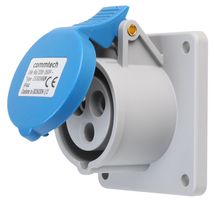
Plugtop!

So on that basis, do I take it you would describe these as an 'outlet connector' and not a socket?
PL14075-40.jpg
PL16277-40.jpg

In Australia, the above types of devices are now "officially" referred to as "Socket Outlets" and "Socket Inlets" respectively.

While previously in Australia "Socket Outlets" were often referred as "General Purpose Outlets" [GPOs] they are now "defined" in the "Wiring Rules" (AS/NZS 3000) as follows:-
1.4.86 Socket-outlet
A device for fixing or suspension at a point, and having contacts intended for making a detachable connection with contacts of a plug. The term "socket-outlet" is deemed to include a cord-extension socket attached to a flexible cord.

also
1.4.85 Socket cord-extension
A device, arranged for attachment to a flexible cord, having contacts whereby a detachable connection may be made with the pins of a plug.

and
1.4.71 Plug
A device intended for insertion into a socket-outlet, cord-extension socket or a plug-socket adapter to make a detachable connection between the contacts of any such accessory and the conductors of a flexible cord or flexible cable.


Clipsal (Schneider) uses these terms in their "Promotional Material" (although retailers/wholesalers may often use other terms, such as "Inlet Socket".)
https://www.clipsal.com/products/industrial-socket-outlets
https://www.clipsal.com/products/detail?CatNo=435VFS15&itemno=435VFS15-WE&tab-document-1=0

(I note that the term "Socket Outlet" is often used by European manufactures [e.g. https://www.dmlights.com/niko_hydro...MI7trZ9Ped8AIV1e3tCh2begEEEAQYAiABEgKmn_D_BwE ]

Because of this, it may be that the terms "Socket Outlet" and "Socket Inlet" are the terms now "recommended" by the IEC and/or the EU.)
 
View attachment 231737Socket inlet and socket outlet, yes I like it. But actually listed as appliance inlet and socket. Both CEE.
NO NO NO NO I don't like it and it's blatently wrong.
How on earth can one junction between 2 devices be with a plug and a socket and another junction between 2 similarly compatible devices be with a socket and a socket????????
 
I feel no such suggestion as to which part is 'on the flex' ...
We obviously differ in our feelings about that - not the least because it would logically lead to confusing/silly statements like "plug it into the plug" (as bad as my asking for "a lamp for my lamp" :-) )
... in fact I can think of examples where a fixed plug is mated with a fixed socket without any flexible part.
I'm not sure that it would called them 'fixed' (since if both were literally 'fixed' it would be difficult or impossible to mate or un-mate them!) - but, yes, there are countless examples of things being connected by plugs and sockets without any 'flexible part' being involved. However, that's a totally different matter.
Yes that is exactly the sort of thing what we say on a regular basis, without mention of the gender. For example 'plug the caravan in'.
That's just circumnavigating the issue, by using a totally different form of words (avoiding the use of the nouns 'plug' or 'socket') - and, indeed, using the verb "plug in" to have a rather different meaning - since, unless one was extraordinarily strong, one could not 'plug a caravan in' to anything in the same sense that one 'plugs' a component on the end of a lead into something!

I think we probably simply have to agree (as I thought we had) is that, in the way the terminology has evolved, the whole thing is a confused, confusing and inconsistent mess :-)

Kind Regards, John
 
... At the end of the day, I don't suppose it matters really what terms are used, we're intelligent enough to know what's being referred to.
Agreed, but there are some situations in which there is potential ambiguity, no matter how intelligent one has. ... and there are, of course, those people who get excited about the use of 'incorrect' terminology, even when it has only become 'incorrect' as a result of some arbitrary decision by someone ('lamps' probably being one of the commonest examples).
I still use the expression 'turn the light on' and I wasn't even around 100 years ago when the term actually meant something.
Indeed, and there are countless similar examples where we have stuck with historical terminology long after technological/whatever change has rendered them 'incorrect' in relation to their original derivation. My grandmother had an 'iron' (for ironing clothes etc.) and my grandfather had an 'iron' (for soldering), both of which were at least partially made of iron (and both of which I still have :-) ), but I doubt that the irons that get used in my house today (for 'ironing' or soldering) have any iron in them at all!

Kind Regards, John
 
Railway trains currently have to stop at terminals yet current flows unhindered through terminals.

( I'll get my coat )
 
I'm not sure that it would called them 'fixed' (since if both were literally 'fixed' it would be difficult or impossible to mate or un-mate them!) - but, yes, there are countless examples of things being connected by plugs and sockets without any 'flexible part' being involved. However, that's a totally different matter.
Not at all a different matter, I have several bits of kit that plug together when in use but split apart for transportation, effectively one has a fixed socket and the other has a fixed plug, the units are brought together and clipped in place, the act of doing so automatically mates the socket and plug. I can't see why those connectors would not be classed as fixed. Equally some of the large control panels I've built are made in sections and simply slot together on site with the fixed plugs and sockets.


That's just circumnavigating the issue, by using a totally different form of words (avoiding the use of the nouns 'plug' or 'socket') - and, indeed, using the verb "plug in" to have a rather different meaning - since, unless one was extraordinarily strong, one could not 'plug a caravan in' to anything in the same sense that one 'plugs' a component on the end of a lead into something!

I think we probably simply have to agree (as I thought we had) is that, in the way the terminology has evolved, the whole thing is a confused, confusing and inconsistent mess :)

Kind Regards, John
I'm totally agreeing the whole thing is a mess. Site temporaries is something I've done over the years and supplying power to any number of vehicles for an event, typically we are provided with a list of requirements before hand and we try to pre-run cables when we can. I'd like to know what words you'd use as a colleague when you ask me to apply the socket end of an extention lead to a caravan or other vehicle as they arrive?
This is a very common thing and I'll happily admit that we commonly say something like "Plug that food truck into that distro" or "Put the ice cream van on that generator" without any mention of an extention lead or a crane despite the fact there may be a number of metres between the distro's outlet and the vehicles inlet. No way would we, or for that matter expect anyone else to, say "socket on the caravan" or to be pedantic a CEE13 outlet on a flex is known as a coupler so "couple(r) on the caravan".

And please don't come up with that horrendous American term.
 
Last edited:
Not at all a different matter, I have several bits of kit that plug together when in use but split apart for transportation ...
Well, the discussion has drifted consdierably, but that is a totally different matter from what I have been trying to discuss - which has related exclusively to connectors attached to the end of flexible cables (and, in terms of this thread, I've never heard of anything other than that referred to as a "plugtop", have you?).
... I'd like to know what words you'd use as a colleague when you ask me to apply the socket end of an extention lead to a caravan or other vehicle as they arrive?
I imagine that I would evade/avoid the issue by not naming the connectors - i.e. I would probably say something like "plug 'it' into the caravan" or "plug the lead {or cable} into the caravan". I don't think I would dream of saying things like "plug the socket into the caravan" or "plug the socket into the plug on the caravan".

Kind Regards, John
 
Well, the discussion has drifted consdierably, but that is a totally different matter from what I have been trying to discuss - which has related exclusively to connectors attached to the end of flexible cables (and, in terms of this thread, I've never heard of anything other than that referred to as a "plugtop", have you?).
I imagine that I would evade/avoid the issue by not naming the connectors - i.e. I would probably say something like "plug 'it' into the caravan" or "plug the lead {or cable} into the caravan". I don't think I would dream of saying things like "plug the socket into the caravan" or "plug the socket into the plug on the caravan".

Kind Regards, John
To be honest the earliest recollections I have of the use of 'plugtop' were by the poorly educated, the sort of people who would say "I aint go(t) no dosh to buy bread, (H)e shood of gone dairn the post office to cash (h)is Giro." as an example.
My gut feeling is; as people from that background became electricians, the term proliferated and ended up in common use.

I'm not really sure what is trying to be discussed as this thread is as confused as the topic.

I don't really see a significant difference between "plug 'it' into the caravan" or "plug the caravan in" as they are both as incorrect as each other, however if you were presented with a trailing socket and either instruction I predict you would have no difficulty in understanding the intent.

I Won't confuse the issue by going into detail of the number of times I've arrived at a food trailer (possibly one containing a row of old fridges) with a socket on a cable to be presented with a socket inlet to connect it to, and they kick up a hell of a fuss when I refuse.
 
My grandmother had an 'iron' (for ironing clothes etc.) and my grandfather had an 'iron' (for soldering), both of which were at least partially made of iron (and both of which I still have :) ), but I doubt that the irons that get used in my house today (for 'ironing' or soldering) have any iron in them at all!
I think that is, as Bernard said, shortened names leading to inappropriate names.
If you used "clothes iron" and "soldering iron", it would be more accurate.

Like Winston's favourite; if he called the item an "iron-core a/c voltage transformer" then he would not think that his shortened name of "transformer" only applied to iron-core a/c voltage devices.

I'm going to watch a film on the "at a distance".
 
Stop buttons marked red and start buttons marked green seem logical enough.

Think of traffic lights.
 
I think that is, as Bernard said, shortened names leading to inappropriate names. If you used "clothes iron" and "soldering iron", it would be more accurate.
Not really. You seem to have completely missed my point - the issue is not the abbreviation but, rather, the word 'iron'.

My grandparents' items were correctly/'accurately' described as a "soldering iron" and "clothes iron" (without abbreviation), since they were both (completely or largely) made of iron. There is nothing 'accurate' about using the words "soldering iron" and "clothes iron" (without abbreviation) to refer to the items I use today, since neither contains much, if any, iron.

We still use the word 'for historical reasons' because, once-upon-a-time, the corresponding items were made of iron, even though that is no longer the case.

Kind Regards, John
 
I don't really see a significant difference between "plug 'it' into the caravan" or "plug the caravan in" as they are both as incorrect as each other...
'Correct' or not, the latter is an example of commonly used expressions (certainly in colloquial language) such as "plugging in the vacuum cleaner" and "plugging in the TV" - but that is different because "plugging in" is there being used as an intransitive verb, so may be acceptable. However, when used transitively, as we have been discussing (e.g. "plug A into B") that to me means to insert A into B (which one could not do if A were a caravan :-) ).

I don't see your problem with the former, unless you don't accept "plug A into B" as being a valid concept at all. I used "it" merely to avoid explicitly saying 'plug' or 'socket'.
... however if you were presented with a trailing socket and either instruction I predict you would have no difficulty in understanding the intent.
Sure - I would 'understand the intent' even if I were asked to "plug the plugtop into X" :-)

Kind Regards, John
 

If you need to find a tradesperson to get your job done, please try our local search below, or if you are doing it yourself you can find suppliers local to you.

Select the supplier or trade you require, enter your location to begin your search.


Are you a trade or supplier? You can create your listing free at DIYnot Local

 
Back
Top