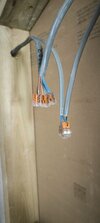
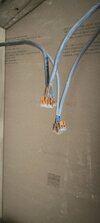
I have joined two cut cables using these wago 221 connectors as shown on photo. I am not convinced they are good for the load especially the sockets circuit. Should i be using the old fashioned screw terminal blocks instead?

You are using an out of date browser. It may not display this or other websites correctly.
You should upgrade or use an alternative browser.
You should upgrade or use an alternative browser.
Are these connectors man enough
- Thread starter akist
- Start date

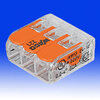

They have 20A marked on the side which is technically enough for a ring circuit.


- Joined
- 17 Aug 2010
- Messages
- 2,888
- Reaction score
- 506
- Country

Interesting. Last time I made that statement, you, JohnW2 and several others stated that the connectors had to match the MCB value.They have 20A marked on the side which is technically enough for a ring circuit.
I thought those were 24 amps
I think that they say 20A on one side and 32A on the other. Different testing standards I believe. Either way they will be ok for a ring circuit although they should be inside an enclosure, a maintenance free enclosure if they are going to be buried in a stud wall. They also appear to be dangling down so they are probably outside a "safe zone". Clip the wires up to the studwork and fix the enclosure to the studwork so that everything remains in a safe zone. As above, slide a bit of green/yellow sleeving over the earths.
I would be rather surprised if I had said that, without qualification. Maybe I said that 'some people would say that', or something like that?Interesting. Last time I made that statement, you, JohnW2 and several others stated that the connectors had to match the MCB value.
The actually answer does not seem to be particularly straightforward. If one wants to be 'pedantic' I would probably say that the 'rating' of the connectors' should be at least as high as the current 'likely to flow' in the cables being connected. The regs say that a ring final circuit should be designed so that 'overloading' (exceeding cable CCC) of any part of the cable is 'unlikely', and also say that the cable has to have a CCC of at least 20A.
If (due to installation method) the CCC were only 20A and if the circuit had been designed correctly, then it would be 'unlikley' that more than 20A would flow, so that 20A-rated connectors would seem OK. However, the CCC of 2.5mm² cable (as installed) is often 27A, in which case all one can say is that (if circuit was correctly designed) the current was 'unlikely to exceed 27A" - in which case a use of a 20A-rated connector might be more questionable.
In other words, and rather 'strangely', the answer might depend upon the installation method of the cable!
Kind Regards, John
Likewise.I would be rather surprised if I had said that, without qualification.
Let us imagine we were allowed to use a cable with the minimum CCC that the ring circuit regulation states (before it contradicts itself).
That is 20A therefore 1.5mm² T&E.
Would then a 20A connector be alright without question?
That is 20A therefore 1.5mm² T&E.
Would then a 20A connector be alright without question?
Splicing connector with levers (221-412) | WAGO GB
Splicing connector with levers; for all conductor types; max. 4 mm²; 2-conductor; transparent housing; Surrounding air temperature: max 85°C (T85); 4,00 mm²; transparent (4050821808435) Online at WAGO GB!
 www.wago.com
Splicing connector with levers (221-412) | WAGO GB
Splicing connector with levers; for all conductor types; max. 4 mm²; 2-conductor; transparent housing; Surrounding air temperature: max 85°C (T85); 4,00 mm²; transparent (4050821808435) Online at WAGO GB!
So up to 450v they are rated at a 32 amps. That drops to 20 amps at 600v.
I am not an electrician, but I find them to be far more convenient than the cheap screw connector blocks. And they take up much less space behind light switches, etc.
Where did you see that? It shows 20A @ 300V.So up to 450v they are rated at a 32 amps. That drops to 20 amps at 600v.
Well, depends. You can get many wires in one connector block.I am not an electrician, but I find them to be far more convenient than the cheap screw connector blocks. And they take up much less space behind light switches, etc.
Follow the hyperlink in @Murdochcat 's post, click on "details" and it shows the respective ratings.Where did you see that? It shows 20A @ 300V.
Well, depends. You can get many wires in one connector block.
On one side:

and on the other side of the same connector:

I do think that they could have made this clearer for the average user.
and on the other side of the same connector:
I do think that they could have made this clearer for the average user.
As opps says, from the web site:

So we have 450V 32A, 600V 20A or 300V 20A. Take your pick.
So we have 450V 32A, 600V 20A or 300V 20A. Take your pick.

DIYnot Local
Staff member
If you need to find a tradesperson to get your job done, please try our local search below, or if you are doing it yourself you can find suppliers local to you.
Select the supplier or trade you require, enter your location to begin your search.
Please select a service and enter a location to continue...
Are you a trade or supplier? You can create your listing free at DIYnot Local


