
Recently had a cellar survey to fix general dampness (humidity around 75%) in a victorian terraced house. Floor has been properly tanked but walls haven' and the main source of dampness is the front where there is also no easy route for air input. The advice was to install a PIV. I just haven't seen any experience of this being used in a cellar where as my 1st thoughts had been to fit a dessicant dehumidifier and extract the moist air out of the rear room where there is a hatch opening. Interested to hear what people think? - thanks in advance.

You are using an out of date browser. It may not display this or other websites correctly.
You should upgrade or use an alternative browser.
You should upgrade or use an alternative browser.

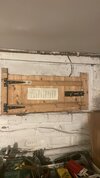
No ventilation st the front but have got a hatch at the back that isnt sealed and lunks with the underneath of some old decking. Checked for leaks such as btoken pipes and it's a general dampness from the front walls. An old coal chute did exist and appears to have been blocked up well, so I believe it's general water pressure most noticeable at the bottom 3 ft across the front of the property. The walls are not tanked. The dividing walls are nice and dry.
The advice
From whom?
Does it have a ceiling or are the floor joists exposed?
Where is external ground level compared to cellar height?
Please show an external photo of the front, including all drains, downpipes and gullies, and the paving or earth level.. Do you think the front used to have ventilation?
Where is external ground level compared to cellar height?
Please show an external photo of the front, including all drains, downpipes and gullies, and the paving or earth level.. Do you think the front used to have ventilation?
Ceiling is plaster boarded and external ground level is slightly above the cellar height, (had wondered about a periscope air brick). The only previous ventilation could credibly be an air brick that sits at the external ground level and height-wise is hidden in the cellar ceiling above where the electric meter is fitted / floor joist level. I'll try to add a photo (just need to get someone who is at home to take one for me).
To ventilate, you need openings on at least two sides so you get a throughflow of air. This can give constant ventilation without mechanical aids. Ducts can often be fitted between exposed joists which it seems you do not have. Periscope vents, or cranked ducting may be needed unless you can see a way to reduce ground level against the house. The original ground level will have been about two bricks below the DPC and the joists pretty sure to have been above ground. Often the level has been increased over the years and needs to be dug out.
If the ground or paving slopes towards the house, it will encourage rainfall to run towards the wall.
Old drains and gullies are almost always cracked or broken and leaking. Luckily replacement is quite a simple job.
Water pipes commonly leak after 50 to 100 years.
If the ground or paving slopes towards the house, it will encourage rainfall to run towards the wall.
Old drains and gullies are almost always cracked or broken and leaking. Luckily replacement is quite a simple job.
Water pipes commonly leak after 50 to 100 years.
Thanks, photos still incoming but ground does slope away from the house.
Happy to remove the plasterboard ceiling to expose joists although I am sure they run side to side which doesn't help much. Sounds like I definitely need to work on that front ventilation. Your view on original ground level, joist position is , I reckon, a good fit with what we have. Any thoughts still on how sensible it would be to consider PIV or is that just a weird proposal? I imagined even with adding ventilation a dessicant dehumidifier would be a good boost??
Btw - I saw after the question regarding who gave this advice, it was a company covering the north West with multiple locations and a host of good reviews. It was a free survey ()
Happy to remove the plasterboard ceiling to expose joists although I am sure they run side to side which doesn't help much. Sounds like I definitely need to work on that front ventilation. Your view on original ground level, joist position is , I reckon, a good fit with what we have. Any thoughts still on how sensible it would be to consider PIV or is that just a weird proposal? I imagined even with adding ventilation a dessicant dehumidifier would be a good boost??
Btw - I saw after the question regarding who gave this advice, it was a company covering the north West with multiple locations and a host of good reviews. It was a free survey ()
IMO PIV is an unnecessary complication. Passive ventilation will work even if there is no electricity, and will not wear out or become noisy.
It does have the disadvantage of costing less to buy and maintain.
Whichever system you use, you'll need to have air coming in and air going out.
Just to check, do you mean the company recommending PIV was a company selling PIV?
Who could have seen that coming?
It does have the disadvantage of costing less to buy and maintain.
Whichever system you use, you'll need to have air coming in and air going out.
Just to check, do you mean the company recommending PIV was a company selling PIV?
Who could have seen that coming?
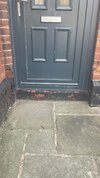
Photos attached. A slim airbrick is just visible painted black at the bottom left of the bay window.
Attachments
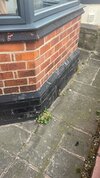
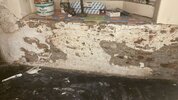
Black paint at the foot of a wall is usually an attempt to hide (it does not cure) persistent damp. In fact, by blocking evaporation, it makes it worse. It looks like you have attractive dense red bricks behind the paint.
The airbrick looks like it might be clogged, and you would benefit from more. One every two metres is common, and as you have a damp problem, more would be better.
Victorian houses with cellars often had ventilators under the front doorstep, I can't see any on yours. Have a look at similar houses in your road to try and work out the original level before the paving.
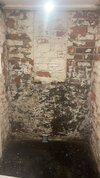
The black part of the cellar wall indicates persistent damp. Its position beneath the bricked up coalhole suggests to me that the old chute might be channeling rainwater towards the wall. It will be difficult to investigate and remedy without taking up the paving.
You could open up the hatch and ventilate with a grill. Start by opening the ventilator in the hatch.
I can't see any guttering, downpipes or gullies. Where are they? The bay should have one.
The airbrick looks like it might be clogged, and you would benefit from more. One every two metres is common, and as you have a damp problem, more would be better.
Victorian houses with cellars often had ventilators under the front doorstep, I can't see any on yours. Have a look at similar houses in your road to try and work out the original level before the paving.
The black part of the cellar wall indicates persistent damp. Its position beneath the bricked up coalhole suggests to me that the old chute might be channeling rainwater towards the wall. It will be difficult to investigate and remedy without taking up the paving.
You could open up the hatch and ventilate with a grill. Start by opening the ventilator in the hatch.
I can't see any guttering, downpipes or gullies. Where are they? The bay should have one.
Bit of excavation then, and yes the blackness certainly below the old chute is damp but it seems at least the blackness is more associated with ingrained coal dust. Guttering is to the right at the junction with the adjacent property. It enters a channel in the wall and runs out to the pavement. It was on our minds if there was an issue there but since the ceiling level of the cellar appears to be considerably drier we have been less concerned with that as a source. There is a house nearby by that has what looks like a powered vent out of the cellar and that's at pavement level where as ours has the additional stepped up section at the front (something they don't have).
The plinth?additional stepped up section at the front
Have a look at the rainwater arrangement as it may be leaking.
I suppose your bathroom and kitchen drains are at the back of the house.
Do you know where the watermain is?
Plinth - I think I'm clarifying the difference between the neighbour with the powered vent in which case yes. The neighbour is not however the same build as most of the road, our terrace has a plinth /raised slab area about 3inches high at a gate from the pavement sloping up to the property.
And yes- correct regarding bathroom and kitchen drains but you lead to a good point, the mains water in, is far right of the property as you face the house from the outside and is entering the cellar. Overall we don't have any worrisome issues with the state of the cellar but we do want to take some measures to improve and manage the humidity. Affordability of next steps is not so easy so was hoping to put something in place that would be of long term benefit whilst planning on heading towards better control at source / fix of the problem. That's going to clearly involve a degree of excavation. Will explore the guttering etc., see if we can enable venting at the front and my thoughts are still towards dessicant dehumidifier..
And yes- correct regarding bathroom and kitchen drains but you lead to a good point, the mains water in, is far right of the property as you face the house from the outside and is entering the cellar. Overall we don't have any worrisome issues with the state of the cellar but we do want to take some measures to improve and manage the humidity. Affordability of next steps is not so easy so was hoping to put something in place that would be of long term benefit whilst planning on heading towards better control at source / fix of the problem. That's going to clearly involve a degree of excavation. Will explore the guttering etc., see if we can enable venting at the front and my thoughts are still towards dessicant dehumidifier..

DIYnot Local
Staff member
If you need to find a tradesperson to get your job done, please try our local search below, or if you are doing it yourself you can find suppliers local to you.
Select the supplier or trade you require, enter your location to begin your search.
Please select a service and enter a location to continue...
Are you a trade or supplier? You can create your listing free at DIYnot Local
Similar threads
- Replies
- 4
- Views
- 2K
