Free standing oven flex?

Joined
14 Mar 2006
Messages
25,110
Reaction score
3,946
Location
Essex coast
Country
United Kingdom
New oven , paperwork states 4mm connection , oven has 3kw max, but none of the setting require more than 1kw except upper lower element when combined , 2kw.
Can I safely use smaller flex ? 2.5mm ?.
 
In the main, we use a cooker supply, and the flex needs to be heavy enough so under fault conditions the protective device will trip before any cable is damaged, so if supplied from a 32 amp RCBO then it needs 4 mm² flex, but if from a 20 amp RCBO then 2.5 mm² is ample. Same if supplied from a BS 1362 fuse, be it in a BS 1363 plug (13 amp) or a fused connection unit.

Cable size, fuses, MCB's and RCBO's are selected under fault conditions, not when all is working OK.
 
Manufacturers in my experience have appalling information regarding any electrical connections.

Is it being plugged in?

What is the CCC of the cable you plan to use?

And as the oven is a fixed load the cable advice above is questionable
 
none of the setting require more than 1kw except upper lower element when combined , 2kw
How certain about this are you? Seems a bit low for an oven. Even my toaster on 1-slice mode is using about 1kW.
 
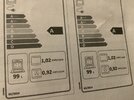
Manual says 1.02kw/cycle for conventional oven and 0.92kw/ cycle for Fan forced ( eco mode).
Of the three ovens we looked at this was the highest rated, others were 2.05kw and 1.05 kw. They are well insulated and A rated for power use, the 1.05 kw understandably had poor review mentioning slow heat up of the oven.
 
Manufacturers in my experience have appalling information regarding any electrical connections.

Is it being plugged in?

What is the CCC of the cable you plan to use?

And as the oven is a fixed load the cable advice above is questionable
That’s what I thought , manuals are often out of date and being from Europe translations aren’t checked.
 
Actually looking at it again the conventional mode refers to top and bottom elements used together so even lower KW than I first thought.
 

Attachments

  • image.jpg
    image.jpg
    434.7 KB · Views: 67
Money saving?, not seen a pre-fitted plug on an oven for a long time.

I had to fit a single built in oven for a customer earlier in the summer. It was supplied with a flex/plug and a connector that pushed into the back of the device. The microwave/combi and induction hob had to be hard wired.
 
Last edited:
Your numbers are the kiloWatt-hours (kWh) consumed and not the ratings of the elements. That kWh is printed on the label you picture.

My lates Neff double oven has similar cycle energy consumed numbers for fan-assisted and conventional heat modes in one oven, but has a 7 kW max possible input figure if both ovens are used in a certain setting iirc.

Make and model of Oven? Then we can read the manual for you.
 
The rating for the oven is not really the question, yes there is a limit, supplying an oven with a 100 amp supply would be silly, but the cable has to withstand the fault current, so to use a 2.5 mm² cable we look for a 20 amp overload in general, be that overload a fuse, MCB, or RCBO does not matter. So plugged in likely 1.5 mm² would be OK in free air or forced ventilated, as 13 amp fuse, but if connected to a 32 amp RCBO/MCB then 4 mm².

It has be a debate for years where ovens internal wiring is 1.5 mm² should they be connected to a 32 amp supply? Since 32 amp has been the standard supply for cookers for years, it is considered unless the manufacturer says otherwise, then 32 amp MCB/RCBO is acceptable, but seen some with a 45 amp MCB going to a double cooker connection unit, this does raise questions.

My stand alone cooker is rated at around the 52 amp mark with everything turned on,
1730799960707.png
but it has been supplied with a 32 amp MCB and when we moved a 32 amp RCBO for many years, and has never tripped the supply. So why any more than 32 amp is required I don't know, but with a 32 amp supply, the flex will need to be 4 mm².

 

If you need to find a tradesperson to get your job done, please try our local search below, or if you are doing it yourself you can find suppliers local to you.

Select the supplier or trade you require, enter your location to begin your search.


Are you a trade or supplier? You can create your listing free at DIYnot Local

 
Back
Top