How to stop rain coming down outside of flu pipe

Joined
8 Feb 2024
Messages
30
Reaction score
2
Country
United Kingdom
So last year, I installed a woodburner in our house. I've done this before and worked with stovefitters in the past, so I have a fair grasp. The issue I'm having is that we are in an exposed area of Scotland, and when it rains with wind, water is coming down the chimney on the outside of the flu liner (not into the fire) and down into the fire opening where it drips down the wall making a real mess. I'm getting some scaffold set up tomorrow so I can take a look at the top. My suspision is the bog standard cowl I have fitted and that the rain is being blown into the gap between the 5" flu liner, and the 6" flu. It's not the flashing or pointing as this has already been done, and the water is only coming down the flu.

My question is how best to seal the flu at the top? Would it be possible to apply some fire cement or mortar in the gap at the top? I will most likely replace the cowl either way a belt and braces approach.

Very much open to any other ideas..

Thanks.
 
I'm not sure why this wasn't sealed originally, but I stuff chicken mesh down the gap between liner and flue and point it up with sand and cement to provide a sort of flaunching.
A cowl with a wide brim on the top may help cast rain away - but if there's wind then it's only a token gesture.
John :)
 
I'm not sure why this wasn't sealed originally, but I stuff chicken mesh down the gap between liner and flue and point it up with sand and cement to provide a sort of flaunching.
A cowl with a wide brim on the top may help cast rain away - but if there's wind then it's only a token gesture.
John :)
Cheers John. So it's not unusual to seal it with mortar then? That sounds like a plan. I'll get up there later today once the scaffold is up and take a good look..
 
Personally I can't see why the join wouldn't ever be sealed......it's obvious that something would get in - if not water then wasps maybe.
I'd go for ordinary mortar, ready mixed stuff if you like as fire clay cement isn't very stable in weather.
Just pack the gap with something to retain the mortar as it sets - I've used chicken wire or stove door rope if the gap is small.
Use a quality cowl with a bird guard, you don't want to be going up there unnecessarily.
Good luck with your project!
Regards
John :)
 
OP,
Typically & traditionally, SS flexi flue liners terminate fixed to a suitable cowl thats inserted into a chimney pot.
Where chimney pots are not used then the SS flexi liners are best fixed to clay chimney stack vents - often called mushrooms.
Chimney pots or independent mushroom vents are bedded in the sand & cement flaunching on top of the stack - the flaunching is bedded on slates or fibre cement pieces.
There should be no need for packing - the flaunching should not have gaps.
Anyway, why not go up & take pics of the stack, & whatever you have on top of the stack - you could then be advised further.
 
From fluesystems.com:
In this ideal situation, the liner comes right up to the top of the pot, where it's cut level.
The cowl then inserts into the liner, and the vertical straps are held to the pot with a large diameter jubilee clip.
Therefore, there's no water ingress, it's as good as it gets.
This is a great firm to buy from, all you need and speedy delivery.
Regards
John :)
 
Yeah, this is the system I have. I plan on getting up today, but we just discovered we have no water in the house. We're on a private water supply and this now takes priority. Oh the joys of running repairs!

When I do get up there I will take some pics
 
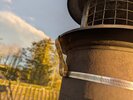
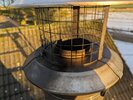
OK, so here's a couple of pics. Looking from below there is a big gap. It's not clear in the pic, but I can get my fingers right under on the left side between the pot and pot hanger, so a 20mm gap or so. When the wind blows badly as it does here (which is when it pours down the chimney), I can imagin the drops being blown under and down the side of the flu before they get chance to drip off. I can't push the cowl any further down as the liner is slightly to long.

Going back to your mortar solution John, do you think I could still put in some wire mesh into the gap? Slightly worried it won't stick to the metel though obviously. But all I need to do is fill that gap somehow.
 

Attachments

  • PXL_20250113_151401875.jpg
    PXL_20250113_151401875.jpg
    242.9 KB · Views: 74
  • PXL_20250113_151356015.jpg
    PXL_20250113_151356015.jpg
    281.4 KB · Views: 75
Aha that’s quite a bit clearer now! Thanks for the pics.
The rain is bleaching through the gap between pot and cowl, I guess?
Theoretically a cowl with a deeper skirt could sort that (the Colt one maybe) or perhaps it could be possible to point up the gap with some stiff mortar.....no metal would be needed here. The deeper skirt should allow the rain to drip out of the way.
I’m wondering though, is the liner a much smaller diameter than the pot, so there’s a large gap between the two? That’s what I meant in my earlier post.
If it was mine I think I’d pop the cowl off and check, if it’s not too much trouble.....not the best time of the year to be faffing with it though!
Regards
John
 
Yep I agree about the cowl and a deeper skirt, I shouldn't have gone with this cheap generic one. From memory, the flu is probably around 7" with a 5" liner so there is quite a gap. The rain has to be coming in between pot and cowl, especially as the gap is so big. I would remove the cowl, but as the liner is fixed to the flu pipe - which in turn is fixed to the fire, It would be a mare to break the seal and move the pipe up so I could get to the strap from cowl to liner at the top as that's inside the chimney - if that makes sense! So for ease, I just need to figure out a long lasting way to block the gap between cowl and pot. If you think mortar would do the trick, that sounds like a plan. I thought about adding some mesh so the mortar doesn't fail and fall out at some point.
 
So, the existing chimney cowl is actually clipped to the liner......the clip being out of sight? That is a bummer, but it isn't always the case - sometimes the cowl is just plonked in.
I'm wondering what you would do if the cowl corroded away? Disturbing the connection between liner and stove down below is a real chore.
Anyway - I guess you could get some mortar in if it's stiff enough, but I'm wondering if the gap could be plugged somewhat by using some of the large diameter stove rope - the sort of stuff that seals the doors but bigger. Then, some mortar on top of that maybe.
Regards
John :)
 
I would attempt this with a strip of thin flexible stainless steel. Feed it through and wrap it round the gap, couple of self tappers to join it to itself, then fix a jubilee band around it just below the lip of the pot.
 
So, the existing chimney cowl is actually clipped to the liner......the clip being out of sight? That is a bummer, but it isn't always the case - sometimes the cowl is just plonked in.
I'm wondering what you would do if the cowl corroded away? Disturbing the connection between liner and stove down below is a real chore.
Anyway - I guess you could get some mortar in if it's stiff enough, but I'm wondering if the gap could be plugged somewhat by using some of the large diameter stove rope - the sort of stuff that seals the doors but bigger. Then, some mortar on top of that maybe.
Regards
John :)
Yeah, it's attached and out of sight as you said. If the worst came to the worst I would just hack the thing to bits!

I'll take your advice and run in some fire rope, even if I twist two standard width ones together. I just wished there was some kind of sealant I could use to help it stay in place, I doubt heat would be much of an issue up there....
 
I would attempt this with a strip of thin flexible stainless steel. Feed it through and wrap it round the gap, couple of self tappers to join it to itself, then fix a jubilee band around it just below the lip of the pot.
Great idea. In fact I think I'll take both you and John's advice and do both. Belt and braces approach! I do not want to be getting scaffolding again.

Thanks for all your help guys it really is appreciated. I will repost once I get it sorted. I have the scaffolding for as long as I want and need to redo the haunching anyway. But lenty of time to try things out.

Top guys (y)(y)
 

If you need to find a tradesperson to get your job done, please try our local search below, or if you are doing it yourself you can find suppliers local to you.

Select the supplier or trade you require, enter your location to begin your search.


Are you a trade or supplier? You can create your listing free at DIYnot Local

 
Back
Top