Good morning, I recently changed my bedroom ceiling light from a triple spot to a fancy shaped dimmable (using a remote) LED light, the same as I fitted in our lounge. When I switch off the light it remains on very low which can only be seen when room in darkness but distracting when trying to sleep. This doesn’t happen with the lounge lights. I originally thought perhaps it had some kind of luminous coating but when switching off at the board, it goes out completely. If anyone can shed any light (no pun intended) on possible causes and if unsafe, I appreciate any thoughts. Thank you.

You are using an out of date browser. It may not display this or other websites correctly.
You should upgrade or use an alternative browser.
You should upgrade or use an alternative browser.
Light stays on (dimly) when switched off
- Thread starter GB52
- Start date

There maybe enough capacity between Live and Switched Live in the cable that allows a small trickle of current to flow to the lamp when the switch is OFF
Dimmers can have the same effect/
This leaked power can be absorbed by a snubber connected across the lamp
Capacitor 0.047uF micro Farads 250 volts AC in series with Resistor 100 ohms
Which come pre-packaged as a contact suppressor from RS Components.
As a contact suppressor it would be fitted between Live and Switched Live at the switch BUT as a snubber it has to be fitted between Switched Live and Neutral at the lamp..
KEMET RC Capacitor 470nF 100Ω Tolerance ±20% 250 V ac, 630 V dc 1-way Through Hole PMR209 Series
RS Stock No. 206-7869
Manufacturer Evox-Rifa
Manufacturers Part No. PMR209ME6470M100R30
There are other sources
Dimmers can have the same effect/
This leaked power can be absorbed by a snubber connected across the lamp
Capacitor 0.047uF micro Farads 250 volts AC in series with Resistor 100 ohms
Which come pre-packaged as a contact suppressor from RS Components.
As a contact suppressor it would be fitted between Live and Switched Live at the switch BUT as a snubber it has to be fitted between Switched Live and Neutral at the lamp..
KEMET RC Capacitor 470nF 100Ω Tolerance ±20% 250 V ac, 630 V dc 1-way Through Hole PMR209 Series
RS Stock No. 206-7869
Manufacturer Evox-Rifa
Manufacturers Part No. PMR209ME6470M100R30
There are other sources

- Joined
- 27 Jan 2008
- Messages
- 29,249
- Reaction score
- 3,588
- Location
- Llanfair Caereinion, Nr Welshpool
- Country

As said, there are
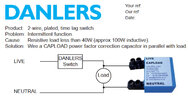 devices to stop/reduce this. But also the bulb can be part of the problem, my wife's bedroom has G9 bulbs,
 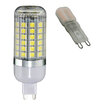 the large one has a smoothing capacitor inside nearly as big as the whole of the smaller bulb, also switches, my Energenie smart switch is designed for having no neutral, and works OK with large bulbs, but where the load is low, the TP-Link (Tapo) smart switch that has batteries to power it works far better.
Of course, no need for smart switches or dimmer switches today, this can now be all built into the bulb. With the reduction in cost for a smart bulb, last one I got from Poundland at £5, easier and simpler to leave the light switched on, and use a smart bulb.
devices to stop/reduce this. But also the bulb can be part of the problem, my wife's bedroom has G9 bulbs, the large one has a smoothing capacitor inside nearly as big as the whole of the smaller bulb, also switches, my Energenie smart switch is designed for having no neutral, and works OK with large bulbs, but where the load is low, the TP-Link (Tapo) smart switch that has batteries to power it works far better.Of course, no need for smart switches or dimmer switches today, this can now be all built into the bulb. With the reduction in cost for a smart bulb, last one I got from Poundland at £5, easier and simpler to leave the light switched on, and use a smart bulb.

My unofficial hack was to use 1 regilar g10 bulb in thr group of g10's on my parents.

Well, thats not exactly an energy-saving solution! And what will your parents do now that those "regular" GU10s are no longer available?My unofficial hack was to use 1 regilar g10 bulb in thr group of g10's on my parents.
D
Deleted member 310928
Try removing the switch and see if cores of the cable feeding the switch have enough slack. If they do move them apart so that they don't stay in close proximity. This might solve your problem.Good morning, I recently changed my bedroom ceiling light from a triple spot to a fancy shaped dimmable (using a remote) LED light, the same as I fitted in our lounge. When I switch off the light it remains on very low which can only be seen when room in darkness but distracting when trying to sleep. This doesn’t happen with the lounge lights. I originally thought perhaps it had some kind of luminous coating but when switching off at the board, it goes out completely. If anyone can shed any light (no pun intended) on possible causes and if unsafe, I appreciate any thoughts. Thank you.
If the SL insulation is intact, it's probably the total stray capacitance between PL and SL pulling the SL up high enough to cause the effect, allied with poor design of the fittings that should be tolerant of this. Could you tell us which light fitting you purchased? I wonder if the schematic is available.
The current to make the led bulb glow is very low so you don't really need to worry about it too much.
It wont! those cores are in "close proximity", crammed together in the cable sheath, all the way to the light. What might solve it is to check if the earth wire is actually connected to earth.If they do move them apart so that they don't stay in close proximity. This might solve your problem.
Otherwise a snubber is the way forward.
D
Deleted member 310928
Quite a few times, I've seen myself changing me old halogen bulbs to LED's and they'll remain illuminated with the switch off. What I do first is remove the switch and see if I can separate the unsheathed cores but it could be a rather subjective opinion as the cable are tinned PVC with a low insulation resistance (tested a couple of years ago) so I may have got lucky quite a few times.It wont! those cores are in "close proximity", crammed together in the cable sheath, all the way to the light. What might solve it is to check if the earth wire is actually connected to earth.
- Joined
- 27 Jan 2008
- Messages
- 29,249
- Reaction score
- 3,588
- Location
- Llanfair Caereinion, Nr Welshpool
- Country
I have swapped bulbs around a few times, and it has worked. However, the main problem seems to be electronic switches, followed closely by two-way switching.
 the neutral goes direct to the lamp, and the lines go first to one switch, then the other, so there is bound to be some inductive and capacitive linking. What matters is where is the earth. Three core and earth has one wire one side of the earth, and two the other side
 if the blue wire shown in the second picture is the top wire in the first picture, then the earth wire is between it and the other line feeds, otherwise the line in and out are right next to each other, so since we use AC there will be some transfer.
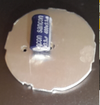 then on the other side
 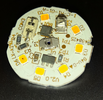 we have the rectifier, some LED's, a driver chip, and some resistors mainly to leak the capacitor to earth, so we do not get a belt of the bulb if we touch the terminals after it is removed. There are no regulations on how much shimmer when switched on, or how much needs to be leaked when off. And some bulbs are far more complex
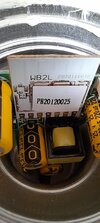 so this one was a smart bulb, clearly a lot more inside the bulb. So we are left with, suck it and see. Swap bulbs around until you find one which will work, the result is I have a draw full of bulbs, likely enough to keep my children going for the rest of their life, never mind my life.
This is of course important, if no earth it would not matter which wire is selected. However, the basic thing is, our wiring was never designed to use LED lights, and the more efficient the lamps are, the more likely we are to get this problem. I like many others I am sure, took a failed LED lamp, and had a look inside, behind the printed circuit is an electrolytic capacitor to stop shimmer when switched onWhat might solve it is to check if the earth wire is actually connected to earth.
then on the other side we have the rectifier, some LED's, a driver chip, and some resistors mainly to leak the capacitor to earth, so we do not get a belt of the bulb if we touch the terminals after it is removed. There are no regulations on how much shimmer when switched on, or how much needs to be leaked when off. And some bulbs are far more complex so this one was a smart bulb, clearly a lot more inside the bulb. So we are left with, suck it and see. Swap bulbs around until you find one which will work, the result is I have a draw full of bulbs, likely enough to keep my children going for the rest of their life, never mind my life.
Anyone ever tried feed into L1, neutral into L2 and switched live into com?
Do you have a neutral at your switch?
Do you have a neutral at your switch?
Last edited:
This is the light, Miyawell, from Amazon (yes I know) obviously Chinese. I should point out I’m not an electrician and it was basically swapping like for like, wiring and terminal block wise. It is properly earthed. The space inside the ceiling rose part is extremely limited with the driver for the remote control dimmer unit packed in there tightly with cables etc. There is no room at all to fit anything else in there so I’m a bit stumped really.

D
Deleted member 310928
Have you mate?? My grandma's house had some switches wired like this but it can form into a plasma arc when the switch turns off. When someone turns off the switch the arc needs to finish before connecting back into neutral. So it can become a dangerous situation but haven't see anyone recently wiring it like that. Maybe it had something to do with the old ancient switch contacts moving much slower than the new modernised ones?Anyone ever tried feed into L1, neutral into L2 and switched live into com?
I haven't mate but I've seen it done to stop the dim glow on led lights, The L1 and L2 are never closed, but I was nervous posting it as you have to get it right.Have you mate?? My grandma's house had some switches wired like this but it can form into a plasma arc when the switch turns off. When someone turns off the switch the arc needs to finish before connecting back into neutral. So it can become a dangerous situation but haven't see anyone recently wiring it like that. Maybe it had something to do with the old ancient switch contacts moving much slower than the new modernised ones?
Sounds like it been wired in series at the main connection. Do other lights on the same circuit go dim as well.

DIYnot Local
Staff member
If you need to find a tradesperson to get your job done, please try our local search below, or if you are doing it yourself you can find suppliers local to you.
Select the supplier or trade you require, enter your location to begin your search.
Please select a service and enter a location to continue...
Are you a trade or supplier? You can create your listing free at DIYnot Local
Similar threads

- Replies
- 2
- Views
- 1K


