• Looking for a smarter way to manage your heating this winter? We’ve been testing the new Aqara Radiator Thermostat W600 to see how quiet, accurate and easy it is to use around the home. Click here read our review.

Earth/moon.

Capacitive leakage/coupling to what?
Everything conductive.
In the absence of any 'earth'-referencing, why should one side of the supply get any more coupled to anything (earth, moon or whatever) than the other side).
It won't, but that's not important.
You seem to be working on the assumption that the system is so isolated that you could touch a line conductor and not get a shock. In reality, an installation of any size will have significant capacitance from all conductors to anything conductive - such as the metal the moon station is likely to contain a lot of.
That effectively creates a virtual star point neutral connected to chassis. Not a hard enough link to trip OCDs on faults, but more than enough to be dangerous.

Bear in mind you said "then I can't see that there would be any point in 'fault protection'". In reality you need exactly the same protections as for any other IT system - that includes protection against line-line faults, and protection against shock for everyone involved.
 
The situation would be not unlike the case with a Motor Vehicle, where:-

On a motor vehicle, "earth" refers to the metal body of the car itself, which acts as (usually) the negative terminal of the electrical system, providing a return path for current and essentially acting as a "grounding point" for the entire vehicle's electrical circuits.
Essentially, the car's body is considered "earth" and is (usually) connected to the negative terminal of the battery.


A similar situation applies to any device supplied by batteries (and not connected to anything else), where the common point on the circuit is referred to as "Earth or Ground".
 
In a car I`ve always referred to it as chassis. in the UK we refer to Earth but I seriously do not know what we might actually call it on the moon or elsewhere, I suppose we might still refer to it as earth just like many refer to hoovering no matter what the make of the machine used.
I know in some countries they refer to it as ground not earth o I suppose that we might feel easier calling it ground if it is not actually on the earth, I suppose that might be the most logical answer but when the time comes will we actually be logical???
 
The situation would be not unlike the case with a Motor Vehicle, where:-
More like setting up some large outdoor event with multiple "mobile" units, power distribution, and all that goes with that.
So unless you do everything right, a fault in one unit can create a hazard in other units. And that's the same whether it's AC or DC.

Edit: also, EVs aside, vehicles are all ELV and low power. Once you get to a small village that's "all electric" then it'll be neither ELV nor low power.
 
Living in an area of South Wales known for it's pits and mining, we won't call it earth or ground. We'll call it coal :ROFLMAO:
 
Last edited by a moderator:
If us humans ever end up living on the moon and we require a TT earthing system will it be called a mooning system with a moon rod?

Will the circuit protective conductor be called "moon"

And will we still use green and yellow sleeving or will it be grey?

The things I think :) ;)
I haven't read the whole thread and maybe somebody's already said it - but why not follow the Americans and use ground? That works anywhere in the solar system, and beyond!
 
Living in an area of South Wales know for it's pits and mining, we won't call it earth or ground. We'll call it coal :ROFLMAO:
A coal rod! Hmm I never considered that.

Do the good folk of Cumbria have Lake Rods and River Rods?
 
I know in some countries they refer to it as ground not earth o I suppose that we might feel easier calling it ground if it is not actually on the earth, I suppose that might be the most logical answer but when the time comes will we actually be logical???
I was talking to a few international Swedish students the other day and they apparently call it "Jord".
 
.... in the UK we refer to Earth but I seriously do not know what we might actually call it on the moon or elsewhere, I suppose we might still refer to it as earth just like many refer to hoovering no matter what the make of the machine used.
I don't think it's anything like as 'bad' (strictly 'wrong') as 'hoovering' etc. ...

Don't forget that, in everyday English, and perhaps rather confusingly, the word "earth" has two distinct meanings firstly,there is 'planet earth', but then there is the substance ('soil') forming the outer layer and surface of the planet on which we stand. Concentrating on that second meaning, we might well end up talking about 'the earth of the moon', in which case talking about "earth"/"earthing" in an electrical context might be as reasonable on the moon as it is here?

Kind Regards, John
 
Portable earth system
1739015820345.png
simple!
 
You seem to be working on the assumption that the system is so isolated that you could touch a line conductor and not get a shock.
I suppose that part of my mind might have been going in that direction, even though I knew that to be wrong - although it does depend upon how significant/serious a 'shock' one is talking about.
In reality, an installation of any size will have significant capacitance from all conductors to anything conductive - such as the metal the moon station is likely to contain a lot of. ....
Yes - if, for simplicity, we assume that both sides of the supply have the same degree of capacitive connection to 'anything conductive', then each example of 'anything conductive' should acquire a potential (relative to either side of the supply) of half of the supply voltage.
That effectively creates a virtual star point neutral connected to chassis.
What I question is whether, in practice in real-world situations, the reactance/impedance of the capacitive couplings would be low enough to result in a significant/serious shock if someone simultaneously touched one of the line conductors and some bit of 'anything conductive' that was (through a high impedance) at roughly half supply potential (relative to either line).

In fact, is your argument throwing a bit of confusion (and maybe 'spanners') into the works of earth-referenced electrical installations (with CPCs) on planet earth? Large examples of touchable 'electrically floating' metal (e.g. radiators with plastic plumbing' presumably qualify as your examples of 'anything conductive' and so, per above, should require a potential of about half the supply voltage (relative to either L or N, hence also 'earth', since N & E are roughly the same)- but, again, through a very high impedance.

However, in this case, I'm not sure what you would conclude and 'advise'. Perhaps the most initially 'obvious' thing would be to 'earth' the radiator - but that certainly would not help (quite the contrary!) someone who, per your comment above, simultaneously touched the radiator and L (although it would 'help' if they simultaneously touched the radiator an N, for what that's worth!) :-)

The implication of what you suggest is that a person would 'get a shock' if they simultaneously touched a radiator and something actually 'earthed' (because the ('anything conductive') radiator would theoretically be at about half the supply voltage (relative to L, N or E). In practice, that does not happen to any significant effect - and, again, I would suggest that is because of the very high impedance paths that result in the 'half supply voltage' potential of the object.
Not a hard enough link to trip OCDs on faults, but more than enough to be dangerous.
Clearly far to high impedance path to trip any OCD but,above, I'm not sure about 'dangerous'.
Bear in mind you said "then I can't see that there would be any point in 'fault protection'". In reality you need exactly the same protections as for any other IT system - that includes protection against line-line faults, and protection against shock for everyone involved.
In the absence of something like 'earth referencing', I'm not sure how you would propose to provide 'protection against electric shock'. RCDs presumably wouldn't help - if someone put their body in parallel with one of the (high impedance) couplings between one line and 'anything conductive' (at 'half supply voltage'),some of the current would go through them (rather than the capacitance), but the current in both lines would remain equal- hence no 'residual current' to detect. What would you propose?

 
I suppose that part of my mind might have been going in that direction, even though I knew that to be wrong - although it does depend upon how significant/serious a 'shock' one is talking about.

Yes - if, for simplicity, we assume that both sides of the supply have the same degree of capacitive connection to 'anything conductive', then each example of 'anything conductive' should acquire a potential (relative to either side of the supply) of half of the supply voltage.
Indeed, but I was actually thinking more the other way around. If we assume (as it's quite likely) that the habitats would be "tin cans", then all the electrical cabling will have capacitance to it, and since (as you point out) that will (on the whole) apply equally to all phases, it will create a high impedance grounded virtual star neutral.
So the supply system definitely won't be fully floating.
What I question is whether, in practice in real-world situations, the reactance/impedance of the capacitive couplings would be low enough to result in a significant/serious shock if someone simultaneously touched one of the line conductors and some bit of 'anything conductive' that was (through a high impedance) at roughly half supply potential (relative to either line).
In real world large installations, yes it would. In something "house" sized, probably not, but by the time you get to "village" size, it's going to add up to quite a bit.
Large examples of touchable 'electrically floating' metal (e.g. radiators with plastic plumbing' presumably qualify as your examples of 'anything conductive' and so, per above, should require a potential of about half the supply voltage (relative to either L or N, hence also 'earth', since N & E are roughly the same)- but, again, through a very high impedance.
In the context, a "large" radiator is tiny.
In the absence of something like 'earth referencing', I'm not sure how you would propose to provide 'protection against electric shock'.
Exactly as we do now - by a combination of insulation, equipotential bonding, automatic disconnection of supply, ...
RCDs presumably wouldn't help - if someone put their body in parallel with one of the (high impedance) couplings between one line and 'anything conductive' (at 'half supply voltage'),some of the current would go through them (rather than the capacitance), but the current in both lines would remain equal- hence no 'residual current' to detect.
Which is why you'd need the same basic protections against contact with the live conductors.
But you are right, an RCD won't necessarily protect in an IT system. But I suspect that in a large system, where the virtually grounded virtual neutral is grounded upstream of the end user's RCD protected circuit, the fault you describe may well trip an RCD.
 
I have a debate years ago with the father-in-law, also an electrical engineer, over the supply to his caravan parked about 1.5 meters from the house, on slabs, and connected to the house to keep battery topped up.

He has a TN-C-S supply and I said this is not allowed for a supply to a caravan.

He pointed out the electric and gas meter could be touched at the same time as the caravan, and the two meters were bonded to the house, so the most likely scenario was to touch these two items together rather than grovel on the floor to find cracks between slabs where one could touch true earth.

Furthermore, he said we should assess the risk, not follow the wiring regulations blindly. It was clearly his call anyway, but once one thinks about it, he was right, I would say what was wrong, was the caravan was parked too close to the house, but although I can find fire regulations for caravans in use, for caravans in storage could not find any regulations as to distance.

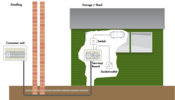
The same problem with tin sheds, and electric cars. I look at the rather dated supply to outbuildings and look at the picture 1739019548096.png no distance given, but that looks like a problem with a metal shed. It does state
one means of earthing must not be simultaneously accessible with an exposed-conductive-part connected to another means of earthing
not got the 16th to hand to look up reference.

However, clearly distance does matter, and I think distance to the moon is enough!
 
Indeed, but I was actually thinking more the other way around. If we assume (as it's quite likely) that the habitats would be "tin cans", then all the electrical cabling will have capacitance to it, and since (as you point out) that will (on the whole) apply equally to all phases, it will create a high impedance grounded virtual star neutral. So the supply system definitely won't be fully floating.
Yes, w're agreed about that.
In real world large installations, yes it would. In something "house" sized, probably not, but by the time you get to "village" size, it's going to add up to quite a bit.
I'm not sure I get that. As far as one 'house' within the 'village' is concerned, all of the capacitive coupling outside the house will simply appear as a (small) path between the two sides of the supply, which will be indinstingusible from (and dramatically overshadowed by) 'loads' within the rest of the village, and of no consequence. As far as one 'house' (or whatever) is concerned, all that matters is capacitive couple to 'anything conductive' within the house - which, as I've suggested, will probably be pretty insignificant
In the context, a "large" radiator is tiny.
Yes, but it's probably the largest 'anything conductive' within the average (terrestrial!) house and, as above, that's all that really matters (although, I suppose, 'moon houses'; may be metal!).
Exactly as we do now - by a combination of insulation, equipotential bonding, ....
Insulation etc.is obviously fundamental and crucial. Equipotential bonding (in the sense of connecting together all simultaneously touchable conductive parts) would also make sense - although, per your argument, probably wouldn't be necessary, since you are implying that all such parts would be at roughly half supply potential(relative to either line) - but that obviously would not help in terms of the scenario you initially mentioned, of someone simultaneously touching one of those parts and a line conductor
automatic disconnection of supply, ...
How would/could one achieve that? ...
But you are right, an RCD won't necessarily protect in an IT system. But I suspect that in a large system, where the virtually grounded virtual neutral is grounded upstream of the end user's RCD protected circuit, the fault you describe may well trip an RCD.
I don't really get that, either. In the absence of any referencing to anything else, any current which flows in one line has to return via the other - so, again, I can't see how there could ever be any 'residual current' to detect. All of the capacitive couplings you have been talking about (and any current passing through a person's body) will simply appear as an impedance between the two lines (just like any 'load') - hence of no consequence to the RCD - won't it?
 

If you need to find a tradesperson to get your job done, please try our local search below, or if you are doing it yourself you can find suppliers local to you.

Select the supplier or trade you require, enter your location to begin your search.


Are you a trade or supplier? You can create your listing free at DIYnot Local

 
Back
Top