Downlight number

Joined
9 Jan 2022
Messages
16
Reaction score
1
Country
United Kingdom
I'm getting myself very confused - so fitting downlights in a lounge - lounge is 6mx4m 2.7m high
600lm downlights

how many do I need! I'm getting different numbers off different sites. We want it reasonably bright.
What layout - 0.6m from walls I get that but if I do that what layout for the others?

Thanks for your help
 
It's all subjective.

My bedroom was 5.5m by 4m. I over thought things and used trigonometry to calculate the amount of 50w halogen bulbs required. I fitted 10, that's 500w of lighting. I ended up...

Edit- not sure what is going on here. I actually fitted 20, which was way over the top and required me to use two seperate circuits. I don't understand why the site published my first (and incorrect post rather than my intended post).
 
Last edited:
Despite all your planning the position of the joists will ultimately determine where the lights can actually be fitted.

I would recommend you fit downlights which YOU can change the bulbs then you will have flexibility - and of course make sure that they are dimmable

12 - 15 would be my guess

who is doing this?
 
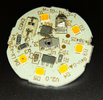
The typical MR16 equivalent unit is very limited in the spread of light. In the main inside the lamp, we have bulb inner1.png which will direct most of the light down from the unit. It may have a defused light, but the LED chips are mounted on a flat plate. So what matters is what the surface they are pointed at is. In my case, I have 4 pods, aimed at different points in my kitchen, which to be frank are not good enough to light the whole kitchen, I need to install a lighting track so I can fit pods to light the dark areas.

As quartz halogen, likely they were enough, but as LED, sadly lacking. To fit down lights which face only down, the ceiling needs to be at least 10 feet from the floor, any less, and they need to be directed at points where light is required. Even when high, I look at my old house, the 24 watt LED tube that replaced the original 64 watt fluorescent did better than 16 x 4 watt down lights, so the down lights no better than the original fat 5 foot fluorescent tube.

Forget lumen, it is the spread which is important.
 
The typical MR16 equivalent unit is very limited in the spread of light.
Although many are intended as 'spotlights', hence much narrower beam angles, MR16 LEDs are available with beam angles up to at least 120 - just one of which would illuminate an area about 4 metres in diameter at 1.2 metres below ceiling level, and about 8 metres in diameter at floor level in a 2.4m high room.
 
Although many are intended as 'spotlights', hence much narrower beam angles, MR16 LEDs are available with beam angles up to at least 120 - just one of which would illuminate an area about 4 metres in diameter at 1.2 metres below ceiling level, and about 8 metres in diameter at floor level in a 2.4m high room.
Good luck with that!
 
Good luck with that!
Well, provided only that the lamps/bulbs in question are 'up-to-spec', what I wrote was merely very simple maths!

Realistically, I obviously was not suggesting that one could light a hypothetical "4 metre diameter" room with one of those downlights - but what I was suggesting was that (with same caveat/assumption) one would not need many (certainly not 10 or 20!) such lights to satisfactorily illuminate the OP's room.
 
Well, provided only that the lamps/bulbs in question are 'up-to-spec', what I wrote was merely very simple maths!

Realistically, I obviously was not suggesting that one could light a hypothetical "4 metre diameter" room with one of those downlights - but what I was suggesting was that (with same caveat/assumption) one would not need many (certainly not 10 or 20!) such lights to satisfactorily illuminate the OP's room.
I think the reality is the way the figures are arrived at leaves something to be desired, I find the best way to see the results are with a basic digital camera (most certainly not an Apple device).

This is a good example: On the day, the light circles were not all that apparent to the naked eye, the flags are 8 x 5ft and the lights were MR16 LED WW 50º at 9ft offset by approx 2ft above the top of the flag as per calculation which was supposed to be more of an oval. The calculation wasn't mine, personally I'd have used very different lights.

1743289694447.png
1743289490691.png
 
I think the reality is the way the figures are arrived at leaves something to be desired,
Sure. As I indicated what I wrote assumed that the lamps/bulbs performed per they claimed spec - if they didn't,then all bets would obviously be off.
This is a good example: On the day, the light circles were not all that apparent to the naked eye, the flags are 8 x 5ft and the lights were MR16 LED WW 50º at 9ft offset by approx 2ft above the top of the flag as per calculation which was supposed to be more of an oval.
Do I understand correctly - the light positioned 2 feet above the top of an 8 x 5 feet flag, 9 feet horizontally in front of the flag, horizontally on the centre line of the flag and 'pointing down' towards the centre of the flag?

If so then the below rough scale diagram indicates what my hasty and rough calculations suggest should be roughly the elliptical cone of light hitting the flag IF the light really did have a beam angle of 50° (i.e. ±25°), with even distribution of light across the beam. If I've got my sums roughly right, at the plane of the flag, that roughly elliptical area of illumination would be about 8.2 feet wide and 11.8 feet high, covering virtually all of the flag plus a lot more (particularly below the flag) - and the light being used in your example clearly did not really achieve that!

There is undoubtedly some uncertainty (at least, in my mind) as to what a claim of "a beam angle of X°" actually means.

1743302918738.png
 
Sure. As I indicated what I wrote assumed that the lamps/bulbs performed per they claimed spec - if they didn't,then all bets would obviously be off.

Do I understand correctly - the light positioned 2 feet above the top of an 8 x 5 feet flag, 9 feet horizontally in front of the flag, horizontally on the centre line of the flag and 'pointing down' towards the centre of the flag?

If so then the below rough scale diagram indicates what my hasty and rough calculations suggest should be roughly the elliptical cone of light hitting the flag IF the light really did have a beam angle of 50° (i.e. ±25°), with even distribution of light across the beam. If I've got my sums roughly right, at the plane of the flag, that roughly elliptical area of illumination would be about 8.2 feet wide and 11.8 feet high, covering virtually all of the flag plus a lot more (particularly below the flag) - and the light being used in your example clearly did not really achieve that!

There is undoubtedly some uncertainty (at least, in my mind) as to what a claim of "a beam angle of X°" actually means.

View attachment 377710
As I said I didn't do the calculations myself but the person calculated 9ft to cover the whole height. I will add the fitting was clipped onto a tile grid bar so it may be possible 4½ tiles chosen rather than 3½ but yes your drawing is essentially what we were expecting and 'on the day' is what we thought we had.
More of the pic, sorry have to block out children singers.
1743331063093.png
As I mentioned I'd have used something of this ilk to light them but not my decision.
1743331019191.png
 
As I said I didn't do the calculations myself but the person calculated 9ft to cover the whole height.
Fair enough, and as I wrote, my rough suggestions also indicated that if it really did have a 50 °beam angle, 9 feet should have been more than enough.

In any event, returning to the point I made to eric, 50° is a lot less than the 120° I mentioned - and I feel sure that anything claiming to have a 120° beam angle would, at 9 feet, been more than able to illuminate your entire flag.
 
As quartz halogen, likely they were enough, but as LED, sadly lacking. To fit down lights which face only down, the ceiling needs to be at least 10 feet from the floor, any less, and they need to be directed at points where light is required. Even when high, I look at my old house, the 24 watt LED tube that replaced the original 64 watt fluorescent did better than 16 x 4 watt down lights, so the down lights no better than the original fat 5 foot fluorescent tube.

Forget lumen, it is the spread which is important.

Is the correct answer! Downlights, create over-bright pools of light, which means that areas outside the pools, appear much darker, because they fool the eye. A pool of light is great, if it happens to strike the area you need, but often you will be between the light source, and what you are trying to see, making it even more difficult. The only value for down lighting, is decorative effect, rather than effective lighting, unless you have very high ceilings.
 
Is the correct answer!
Quite so. As you've both said, what matters is beam angle ('spread'), not lumens.
Downlights, create over-bright pools of light, which means that areas outside the pools, appear much darker, because they fool the eye. A pool of light is great, if it happens to strike the area you need, but ....
Not necessarily. What you describe is a feature of spotlights (of any design), not necessarily of 'downlights' in general. Many lamps/bulbs for downlighters have pretty narrow beam angles, commonly around 36° (±18°), hence clearly are intended as 'spotlights' - but, as i wrote, much wider beam angle ones are available.

As I suggested just a single downlighter with a lamp/bulb that really had a beam angle of 120 ° (±60°) ought to produce a 'pool of light' with an area approaching 4 metres diameter at 'working height' and approaching 8 metres in diameter at floor level - so just a small number of those ought to provide pretty even illumination 'where it was needed' in a large room.
 
Not necessarily. What you describe is a feature of spotlights (of any design), not necessarily of 'downlights' in general. Many lamps/bulbs for downlighters have pretty narrow beam angles, commonly around 36° (±18°), hence clearly are intended as 'spotlights' - but, as i wrote, much wider beam angle ones are available.

As I suggested just a single downlighter with a lamp/bulb that really had a beam angle of 120 ° (±60°) ought to produce a 'pool of light' with an area approaching 4 metres diameter at 'working height' and approaching 8 metres in diameter at floor level - so just a small number of those ought to provide pretty even illumination 'where it was needed' in a large room.

I will have to disagree with you.... No matter how wide the beam angle, unless a spot, the light landing on an object will always be brightest in the centre of the beam, nearest the source. The higher the ceiling, the less noticeable the effect. Working directly under the beam, you will be working in your own light, so then become reliant on reflected light, and the spread of beam of other down-lights in the area. For cosmetic effect, down lights work well, for practical use they are generally hopeless.
 

If you need to find a tradesperson to get your job done, please try our local search below, or if you are doing it yourself you can find suppliers local to you.

Select the supplier or trade you require, enter your location to begin your search.


Are you a trade or supplier? You can create your listing free at DIYnot Local

 
Back
Top