• Looking for a smarter way to manage your heating this winter? We’ve been testing the new Aqara Radiator Thermostat W600 to see how quiet, accurate and easy it is to use around the home. Click here read our review.

Off-peak tariff, does it really save money?

Joined
27 Jan 2008
Messages
27,400
Reaction score
3,307
Location
Llanfair Caereinion, Nr Welshpool
Country
United Kingdom
For the last year, I have had the British Gas EV off-peak tariff, I was not able to get payment for export, they said they would, but never happened, so intend to swap suppliers, so for a few days I will be on fixed rate. So the off-peak charging of my batteries has stopped.

Typically, I would use around 6.5 kWh at 8.95p, now using 2.2 kWh at around 29.57p, so costs 6.88p more per day. How much will vary, but with off-peak, the batteries were fully charged at 5 am when the off-peak ends, it does not matter if I will get sun at 9 am or dull all day, so most days the state of charger would not drop below 60% in the mornings, so I would export (for no payment) a lot more than I imported.

OK charging an EV clearly one is using the off-peak. But even storage radiators, fully charged overnight, even if the next day is warm, just in case.

I have expected to use a lot more money wise, while waiting for the transfer, My app for the 4th says £1.16 daily spend, 5th says £0.70 both including standing charge, clearly once I am getting paid for export this will change, but last time I had no off-peak only had a 3.2 kWh battery, now have 6.4 kWh.
 
To answer the question i the title of the thread ....

.... if one knows the price of ('imported') 'peak' and 'off-peak' electricity with a dual-rate tariff and the price with a standard ('single rate') tariff then, as has always been the case, it requires only trivial arithmetic to determine the minimum proportion that needs to be at off-peak rate in order to 'save money' in comparison with a single-rate tariff. I haven't bother to look recently, but traditionally one had to use at least about 35% of one's electricity at night for the dual rate tariff to be cheaper.

Only you can know, with you complicated supply arrangements, what that proportion would be for you.

If you had enough battery capacity, then I presume that all your import could be 'off-peak' (with zero import at 'peak' times), in which case there would obviously be a cost saving.
 
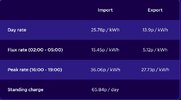
The problem is, one can't forecast how much sun. With payment for export, the Octopus Flux tariff looks good Oct tariff.jpg so three stage the highest cost 4 pm to 7 pm, I looked as far back as I could, and only found two days when battery run out before 7 pm, so seems good, and standard tariff is less than either rates with British Gas.

But when looking at the options, what it does not tell one, is the hoops one needs to jump through to get the tariff, we were promised feed in with British Gas and never got it, and it seems Scottish Power also promise, but when it comes down to it don't deliver.

We had a massive exit fee with British Gas, so had to wait until the contract ended. Our solar panel installers tell us they expect to get us with Octopus by Wednesday or Thursday, so it is just a few days on a single tariff, but a lot depends on what one's software will permit as well.

It would be nice to set it to charge on off-peak to say 50%, but my only control is how many hours, could try at just an hour, but it depends on state of charge when one get to off-peak time, from 50% to full only takes an hour, from 10% to full, around 1.5 hours. And what is important is for the battery to last until 7 pm.

You can get paid for export independent of payment for import, but when that happens the rate is very low, had British Gas simply said no we will not pay you, I could have looked else where, but it promises to pay, then nothing happens.
 
We had a massive exit fee with British Gas, so had to wait until the contract ended. Our solar panel installers tell us they expect to get us with Octopus by Wednesday or Thursday, so it is just a few days on a single tariff, but a lot depends on what one's software will permit as well.mise

Get the promise in writing, then they would have been in breach, and they could not have then charged you an exit fee.
 
Had economy 7 about 30 years ago and had a very early RF smart meter.
The tariffs were switched and we were paying full price for night units
The power company and the energy supplier would not have it and would not even investigate.
Never again for dual tarrif and no to smart meter
 
Look at the latest import and export times and rates for Octopus Flux,
Look at the latest import and export times and rates for Octopus Go.
Also possibly worth looking at Tomato.

Do the maths.

If you decide to switch to Octopus, it's worth £50 to get a referral code from an existing customer.
 
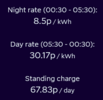
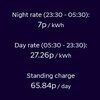
@StephenStephen the Octopus Flux I showed the rate #3 the Octopus go 1744011015537.png does not seem to give an export rate, It is similar to the British Gas EV rates slightly better 8.5 v 8.95, 30.17 v 31.31 but 67.38 v 59.14 on standing charge. Octopus EV Oct tariff EV.jpg is far better, don't understand why only offered to EV users, but with both go and EV it does not state export rates.

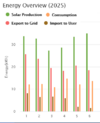
This is the rub, 1744011777621.png this time of year, I am exporting a lot of solar. The rates for solar export vary a lot, 19.9p and 27.73p standard and peak with Flux, but the rate with other tariffs can be 15p and Octopus limits Go users to its 8p per kWh.
I have 6.4 kWh of storage, but yesterday produced 35 kWh of solar, exported 18.6 kWh, I could not get batteries large enough to store that, 12.8 kWh is limit on my inverter, also the inverter is only 5 kW so if I use more than that is taking it from the grid.
I added a second battery, as charge rate for battery is 2 kW and discharge 3 kW, so I was seeing a half charged battery and yet exporting, and if using a 3 kW appliance and something else, importing on a full battery, the inverter as said is 5 kW so being able to discharge over 5 kW battery wise will be no gain as the inverter only 5 kW, it is rare to be using nothing, so 4 kW charge limit is rarely reached, so really helped to go to two batteries, but adding more would not really help that much.
At this time of day, just about producing enough solar to cover background use, if boiler not running. My panels are better in the evening than the morning, hill shields early morning sun, so no panels on that side of the roof.
But with this thread what I am looking at is this
1744013316961.png

Typical when charging overnight showing state of charge of battery and this
1744013459376.png

When not charged overnight, so 3 am to 8:30 my battery was down to the reserve of 10%. So imported 2.2 kWh for the day, next day imported 1.7 kWh and today solar just keeping pace with background use, 9:15 am so seems likely I will use around 0.8 kWh this at a standard rate, where when using off-peak only 8.95p per kWh, but with off-peak, not seen less than 6 kWh used. Since often washing machine, tumble drier, and dishwasher ran at night, looking at around 8 kWh off-peak used.

The flux off-peak is more expensive, so it may be that I will not charge for the full 1.5 hours it takes from 10% to go to 100%, but at 2 am battery between 22% and 37% so even 1 hour charge, will likely fully charge the battery, get around 30% in half an hour, so that's at least 2 kW every night. And then come winter, will it run out?

Flux difference between off-peak import and standard export is 1.55p per kWh, so putting too much in the battery overnight is likely going to cost less than 5p per day, but this does show how too large of a battery is just as bad as too small, I would be daft not moving to Flux, even with the higher off-peak charge.

However, it is not as clear-cut as it first seems. The lower standard rate to my rate at the moment, and the higher off-peak rate, plus shorter time, means running the three machines overnight will not save as much, so we will not be so much of a slave to what the sun is doing.
 
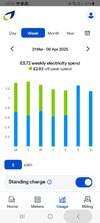
Well, this screenshot BG Energy WE 6th April with SC.jpgshows what happened when my off-peak contract ended. It includes standing charge, as that also changed. This time of year it seems off-peak or not makes little difference.
 
I use Octopus Flux and quite happy with it, although rates are not as good this year as they were last year. They do differ by region, so make sure you check with the correct postcode. Last year the difference between daytime export and offpeak import for me was just 1 pence! So charged at 15p overnight, and exported at 14p during the day. Had to use the grid only on a handful of days in all of 2024. This year it's negative 6 pence. Still worthwhile for me, my electricity bill was zero for March (after accounting for standing charges) and small surplus for April so far.

I had to submit the MCS cert and the DNO98 form for export to be active and it took about a month to be enabled, overall pretty seamless.
 
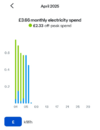
I was worried about the cost during the transfer, having returned to standard single rate while the transfer is going on, but the cost seems about the same.1744110415243.pngSeems I have been charging the battery with off-peak, then exporting without the SOC dropping much. Just crossing fingers now.
 
Had economy 7 about 30 years ago and had a very early RF smart meter.
The tariffs were switched and we were paying full price for night units
The power company and the energy supplier would not have it and would not even investigate.
Never again for dual tarrif and no to smart meter
So were you paying night rate for day units? If so you were quids in
 
So were you paying night rate for day units? If so you were quids in
Not really, if the state of charge before the sun powers the solar panels is at 20% or lower, then yes, but if at 60% then no room to store the solar, so giving it away for free. I am using around 2 kWh from the grid, some days less with no off-peak charging, but taking 7 kWh from the grid when using off-peak.

It is down to how big this dip
1744274224620.png
is in the morning. If I was paid for export, less of a problem.
 
This is the problem, even when one is paid for export, the rates are not the same, so for example Octopus Flux, you import at 15.45p overnight, but export is 13.9p later in the day, so for every kWh more than required, it costs 1.55p which is not so much in the grand scheme of things, if you can export 4 pm to 7 pm then 27.73p, but if you run out 36.06 to import.

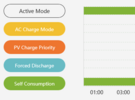
I can set time 1744290024822.png to charge batteries, and for that matter discharge, but it does not seem to give an IFTTT option of charging until at 50% or discharging until 50% so I could set it to only charge for ½ hour, and how much they would have would depend at what was in them when they started.
 
This is the problem, even when one is paid for export, the rates are not the same
I don't know how it works with battery storage, but getting nothing from solar at night fits in nicely with low night demand.

Does anybody remember a post where somebody said he was with Octopus, but getting no prompts to go for a smart meter?
 

If you need to find a tradesperson to get your job done, please try our local search below, or if you are doing it yourself you can find suppliers local to you.

Select the supplier or trade you require, enter your location to begin your search.


Are you a trade or supplier? You can create your listing free at DIYnot Local

 
Back
Top