• Looking for a smarter way to manage your heating this winter? We’ve been testing the new Aqara Radiator Thermostat W600 to see how quiet, accurate and easy it is to use around the home. Click here read our review.

Tripping ELCB?

Joined
18 Nov 2013
Messages
48
Reaction score
1
Location
Dorset
Country
United Kingdom
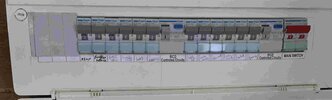
The right hand ELCB(?) immediately next to the main switch on the right had side keeps tripping intermittently (about once a week). The last time it tripped the house was unoccupied.

I was thinking of swapping the position of the two elcb's to try to isolate whether it is an elcb fault or a circuit fault.

I've loosed all 4 bolts (2 at the top to release the tails and 2 at the bottom which I assumed would release the unit) but it doesn't budge.

Is there a clip or something else that needs to be released.

Any advice would be appreciated.

TIA
 

Attachments

  • elcb.jpg
    elcb.jpg
    96.6 KB · Views: 80
Yes there’s a clip on the back. I’ve just failed to find an image online. See if you can find something.

You need to be very careful working inside the CU. Is there other mains isolation, or are you relying on just turning that main switch off?

Edited to add:

If I were you, I’d try turning off the garage circuit and see if that fixes it.
 
Once a week is a tricky fault to track down.

Maybe keep a record of when it trips and see if there is any pattern, this is one of the issues with dual RCD boards
 
Hmm, swapping out the RCD's probably won't help.

Sounds like a N - E fault but when you say the house was unoccupied during the trip, that suggests its not.

Any outside lights? One circuit is/might be for the garage so see if any water has got into any fittings and causing the RCD to trip. Any outdoor sockets that aren't actually rated for outdoor use?

As the house in unoccupied you can try unplugging everything and see if it still trips.

Failing that, get an electrician in to ramp test the RCD.

Also its better if you refer to the device as a "RCD". ELCB's have reached their due date quite a time ago.
 
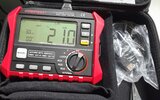
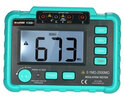
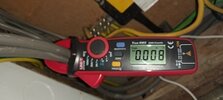
The three testers, RCD tester ramp.jpgVC60B.jpgDiffrence line neutral 8 Feb 24 reduced.jpg are all expensive, around £75, £35 and £35 each, so DIY is down to a lot of luck. The early ELCB-v was a bit useless, so we moved to the ELCB-c better known as an RCD. But the problem was, the strain on the terminals could send them out of spec, and this is reflected by it being the only item in the consumer unit we actually test.

They do fail, but not that often, more likely it is doing its job. They are held in place by DIN rail
1745253591610.png
and you can see the release catches. The term derives from the original specifications published by Deutsches Institut für Normung (DIN) in Germany, which have since been adopted as European (EN) and international (IEC) standards.

I would say of the three testers, the clamp-on multi-meter is about the most useful, as it also measures volts and ohms, but it needs to read amps in increments of 0.001 amp, or 1 mA, to be of much use, I got the UT210E as also wanted DC amps, and did not need frequency, but even some of the expensive clamp-on meters only measure in 10 mA increments, so need to be careful.

Changing to RCBO seems the best idea, ⁣but
1745254561739.png
can work out expensive. Need to consider if an electrician is not a better option.
 
Actually RCCBs - Residual Current Circuit Breakers.

RCCBs, RCBOs plus Sockets and FCUs etc. with the feature are all RCDs.
I knew you would comment on that.

Vacuum/Hoover/Dyson or a Henry, same thing (at least for me).

It’s the thought that counts though.
 
Vacuum/Hoover/Dyson or a Henry, same thing (at least for me).
They are air velocity cleaners, they do not produce a vacuum, as to the manufacturer's name, Hooke's joint I always called a Hardy Spicer even when I knew it was wrong.

But the "about once a week", is the stumbling block. I found my old RCDs would trip maybe 5 times in two weeks, then it would be two years before the next one. I had the test equipment except for the clamp-on, and failed to find the cause, I blamed a spike on the supply, maybe someone up the road welding?

Which is why this house went with RCBOs.

I considered a load of different methods, including a 9 mA drain to earth (using the loop impedance tester) but never did find out why they tripped.
 
One Kilogram is 1000 grams which is the same weight as 2.302 lb ( short for the Latin word libre )

One Kilometre is 1000 metres which is the same distance as 0.621 mile
 

If you need to find a tradesperson to get your job done, please try our local search below, or if you are doing it yourself you can find suppliers local to you.

Select the supplier or trade you require, enter your location to begin your search.


Are you a trade or supplier? You can create your listing free at DIYnot Local

 
Back
Top