Issue with one electrical outlet tripping RCD

Joined
27 Feb 2015
Messages
36
Reaction score
1
Country
United Kingdom
Hello

I have a double gang electrical socket in my living room which has a router and electric fan heater plugged in.

Occasionally when turning the fan heater on, it trips the RCD and switches off my router and other electrics plugged in on the same circuit.

Apart from the fan heater, I don't have any thing else plugged in which draws a high load. It happens at random, could be during a busy time of the day or a quiet evening when it's just me at home.

The fan heater is brand new from Argos but I had the same issue with the previous fan heater (also from Argos). I believe my iron also tripped the RCD from the same socket once a long time ago.

I am thinking of replacing the double gang socket as the first step. Is this recommended? Or should I get a professional in?
 
Seems likely a neutral to earth fault.

With no load, neutral and earth are at the same voltage, so if linked, no current will flow through the link. But as the load increases, neutral starts to move away from earth voltage and go towards line.

So a bit of damp toast in the toaster, can cause RCD to trip when the kettle is used.

Many items only have single pole switching, so even if not running, if left plugged in it can cause a trip.

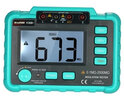
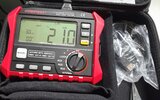
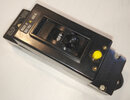
The meter we use, VC60B.jpg uses 500 volts DC, it is not a standard multi-meter, this Diffrence line neutral 8 Feb 24 reduced.jpg meter may also help, but cost of meter means often cheaper to get a spark in to fix the problem.
 
The fan heater is brand new from Argos but I had the same issue with the previous fan heater (also from Argos). I believe my iron also tripped the RCD from the same socket once a long time ago.

If the same fan heater, is plugged into a different socket on the same circuit, does it still trip the RCD?

If it does, return it to Argos as faulty, if not, then worth replacing the socket.
 
If the same fan heater, is plugged into a different socket on the same circuit, does it still trip the RCD?
Yes, that's the obvious first question - followed, if appropriate, by ascertaining what happens if it is plugged into a different circuit.
If it does, return it to Argos as faulty, if not, then worth replacing the socket.
As eric has said, the problem with that is that, if there is a N-E fault somewhere, then plugging a largish load in anywhere could result in a trip, even if the heater is not faulty (the OP has indicated that he thinks the same thing has happened with an iron).

I would therefore suggest that, before concluding that the fan heater is faulty, one probably ought to find out what happens when similarly large loads (or, even better, larger loads) are plugged in (essentially anywhere).
 
Hello

Thanks for the replies.

The problem happens at random and it can be days or weeks before it happens again. It happened today and the last time was about a month ago.

The problem has only ever happened with this double gang socket, although the old fan was used in various places in the house and left on for a long time (particularly after a carpet clean went wrong and started causing a weird smell in places where it wasn't drying out fully).

Similarly the iron has been used in loads of sockets without any problems.

I did some reading on neutral-earth faults and frankly it looks beyond my knowledge and skills. I'd have to get a pro in to take a look.
 
If you do opt to replace that twin socket, get yourself a double pole switched type. They are a little more expensive, but with both poles breaking at the same time in the generation cycle, you might well eliminate the problem. I'm not saying it will, but it is a possibility.
 
If you do opt to replace that twin socket, get yourself a double pole switched type. They are a little more expensive, but with both poles breaking at the same time in the generation cycle, you might well eliminate the problem. I'm not saying it will, but it is a possibility.
I'm not sure how having a DP switch would make any difference, given that the trips have obviously only occurred when the switch was 'on', but it would certainly do no harm.

I do, however, thing that it's extremely unlikley that the trips have anything to do with the socket.
 
I did some reading on neutral-earth faults and frankly it looks beyond my knowledge and skills. I'd have to get a pro in to take a look.

They are really not that complex, a simple explanation is....

Normally, current flows in through the live, out through the neutral. An RCD simply compares the current flowing in via the live, versus out through the neutral, if the difference exceeds 30mA, the RCD is designed to trip. That basically means that some current is finding an alternate escape route, to earth. That escape route, could be via you, or some faulty equipment, but it could equally be a L to E, leakage, or an N to E leakage. Quite often, the fault can be leakage via moisture.

As leakage via either the L, or the N can cause the trip, hence the mention of isolating both poles, with a double pole switch.
 
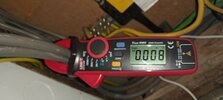
Seen here
1745443366842.jpeg
the meter is around both the line and neutral cables. So the reading is what goes elsewhere, we assume that elsewhere is earth.

As to DIY testing, what is wanted, is a simple plug in tester, I looked at a cheap tester, but these 1745443932339.png still cost £50, the instructions tell us
1745444142435.png
so it puts an extra 7 mA to earth with the loop test, so it will show when the background current is high as it will trip the RCD, we are told 30% is maximum background leakage, so 9 mA, the RCD should not trip below ½ rating so 15 mA, in practice more like 27 mA so in theory the tester would mean 16 mA when added to the 9 mA, so the loop test should not trip the RCD but the RCD test should.

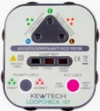
But the tester is clearly designed for radial circuits, the loop test shows better than 1.8Ω, but the pass mark is 1.38Ω with a ring final, so really not fit for purpose. The next stage up price wise is this Loop-test.jpgRCD tester ramp.jpg shown both testing loop impedance and RCD test, I was playing with my new toy, this is the advert
1745445244300.png
only £17 more, and it does a proper job. But £67 is still a lot of money, and you need to know not only how to use the meter, but how to use the reading to improve the situation.

I seem some cheap testers 1745445881806.pngand they may work, but since I have a proper tester, not something I am going to buy and try.
 
.....I looked at a cheap tester, but these <image. still cost £50, the instructions tell us View attachment 379778so it puts an extra 7 mA to earth with the loop test, so it will show when the background current is high as it will trip the RCD, we are told 30% is maximum background leakage, so 9 mA, the RCD should not trip below ½ rating so 15 mA, in practice more like 27 mA so in theory the tester would mean 16 mA when added to the 9 mA, so the loop test should not trip the RCD but the RCD test should.
I'm not so sure about all that. In particular, I'm not at all sure what is meant by ...
1745458232412.png

In particular, it can't test a 30 mA RCD if the maximum L-E current is only 7 mA, can it?
But the tester is clearly designed for radial circuits, the loop test shows better than 1.8Ω, but the pass mark is 1.38Ω with a ring final, so really not fit for purpose.
It's not clear (at least, not to me) why they chose the 1.8Ω threshold. The maximum Zs is obviously dictated by the rating of the OPD and, as I presume you're implying, that is about 1.37Ω for a B32 MCB, which is what would usually be protecting a ring final circuit. Given that I would think that ring final circuits are still by far the most common sockets circuits in UK, one might have expected them to use that figure, or something close to it, for their test threshold (rather than 1.8Ω).

You suggest that the device is "clearly designed for radial circuits", but they would usually have a B20, for which the maximum Zs is 2.19Ω - so, again, it would not be clear why they had chosen 1.8Ω ! If you were interested, I suppose you could ask the manufacturer?
 
I'm not so sure about all that. In particular, I'm not at all sure what is meant by ...
1745458232412.png

In particular, it can't test a 30 mA RCD if the maximum L-E current is only 7 mA, can it?
I had assumed the 7 mA is for loop test, Line to earth, and 18 mA is 11 mA going line to neutral? And 30 mA line - earth for ELI test?

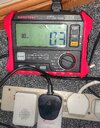
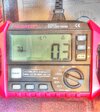
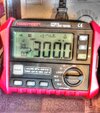
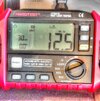
Since I don't have one, and do have this Loop impedance.jpg to test loop impedance, can't see me ever getting one. The RCD test at least two required RCD x 0.5.jpg showing it does not trip and this one RCD x 1.jpg showing it does trip, in this case in 12.5 mS. The plug in tester
1745494923174.png
does not show with will not trip as x 0.5 current, or how fast at rated current.
 
I had assumed the 7 mA is for loop test, Line to earth, and 18 mA is 11 mA going line to neutral? And 30 mA line - earth for ELI test?
Who knows? As I said, it seems difficult (impossible?) to work out the meaning of what they have written.

You say you had assumed that "the 7 mA is for the loop test, Line to earth" and also "30 mA line-earth for ELI test". However, since "loop test" and "ELI" test are simply two ways of referring to the same thing, 7 mA for one and 30 mA for the other would surely make no sense, would it?
 
I was simply considering a way of increasing the leakage on the socket circuit, to help find the cause, without building some Heath Robinson test rig. I am sure @JohnW2 that, like me, you have a proprietary tester, so there is no need for us to work out a cheap method, I can plug in my tester and press the button.

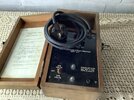
When in the early 1990s I returned from the Falklands to find the RCD, it caused me a problem, I had not even used an ELCB tester Clare ELCB tester3.jpg for the old ELCB-v ELCB-v.jpg and the firm did not have a tester as we use today even. We had RCDs from 30 mA to 5 amp on site, and a nail in a cable of a site hut, as I found out, would take out 30 mA, 100 mA, 300 mA, 1 amp and 5 amp RCDs even with the delay turned right up. But he had somewhere to hang his coat.

Having isolators which did not turn off neutral did not help, we soon worked out about neutral - earth faults, but a 500 amp moulded breaker can feed so much. Lucky most was 110 volts, and the transformer stopped faults on the 110 tripping the RCD. Even the clamp-on ammeters were not much help, not sensitive enough to detect 30 mA.

By the time of the next job, we had the RCD tester, although we could not test the 5 amp RCD with it. But the suck in and see approach had gone, but at home DIY wise people still have no other way. All we can do give a warning, to not just switch off, but also unplug, I have given the example of damp bread in toaster tripping RCD when kettle used many times.

So I will throw down the gauntlet, how would you advise working out which item has a neutral - earth fault? Is there a DIY method without using expensive equipment, or using some Heath Robinson device?
 
I was simply considering a way of increasing the leakage on the socket circuit, to help find the cause, without building some Heath Robinson test rig. I am sure @JohnW2 that, like me, you have a proprietary tester, so there is no need for us to work out a cheap method, I can plug in my tester and press the button.
I don't disagree with any of that, but it doesn't alter the fact that I don't understand the meaning of the statement in the instructions of the device you were discussing, nor the fact that I don't think your 'assumptions' about what it meant could be correct.

I'm not really sure how "increasing the leakage on the socket circuit" will "help find the cause". I presume that you are thinking of increasing the leakage until an RCD trips, but given the wide range of in-spec RCD thresholds (not to mention the fact that the RCD could be out-of-spec), I'm not sure that would help very much.
 
So I will throw down the gauntlet, how would you advise working out which item has a neutral - earth fault? Is there a DIY method without using expensive equipment, or using some Heath Robinson device?

Not a very clear question, but...

If the 'items' in question, are plug-in items, then L>E, or N>E leakage could be detected using a mA meter in series with the earth lead of the item. The simplest way would be using a short extension, adapted to extract the earth.
 

If you need to find a tradesperson to get your job done, please try our local search below, or if you are doing it yourself you can find suppliers local to you.

Select the supplier or trade you require, enter your location to begin your search.


Are you a trade or supplier? You can create your listing free at DIYnot Local

 
Back
Top