• Looking for a smarter way to manage your heating this winter? We’ve been testing the new Aqara Radiator Thermostat W600 to see how quiet, accurate and easy it is to use around the home. Click here read our review.

Joining Scaffold Boards

Joined
13 Nov 2006
Messages
1,268
Reaction score
241
Location
Kent
Country
United Kingdom
I have been asked to instal scaffold boards as shelves, but with one twist. They want two boards joined to make shelves of variants up to 440mm. The customer/mate will have the brackets fabricated for each run of shelves.

I've never done this before and I am concerned that the boards will cup or twist over time?

I could do a proper quote with a disclaimer on it I suppose.

Has anybody tried this or have advice on this idea please?
 
Ensure the timber is as dry (seasoned) as possible to reduce warping.
With scaffold boards that's pretty hard to do. Whereas using kiln dried wood it would be much easier.
 
You could drill/dowel join the boards together or perhaps a tongue and groove then glue to ensure stability between them.
 
You could drill/dowel join the boards together or perhaps a tongue and groove then glue to ensure stability between them.
Agreed on the dowels, although you'd be better off using long, large diameter hardwood dowels, say 10 or 12mm diameter about 60 to 10mm long - or possibly the modern equivalent, Dominos, again long and big (say 14 x 30 x 100) if you can cadge up a machine.

I wouldn't go T&G because that will take a lot of machining (got a spindle moulder? or maybe a plough plane with the T&G irons?), however, grooves in both edges and a loose (plywood?) tongur could do the trick and is a loeasier to machine with a 1/2in router and a grooving bit - downside is that the tongue eould be visible at the ends.

Because scaff planks are far from perfectly flat or straight the OP is going to need a few cramps to pull the joints together and hold them whilst the glue goes offer. Sash cramps or cramp heads on home made timber bars would do the job
 
keep in mind
unless they are feature brackets, they will stop perhaps 50mm short off the front face so when selecting boards to join together make sure its a full width board at the front face to give greatest support
also unless the edges are planed to clean full boards are 227mm/9 inch so will finish up as 454mm
i only mention in case it can throw out plans as not really a big point in its self
 
another point
the boards will have to be partly de-banded on any 2 mating faces or iff a 2-3mm gap between loose boards is a problem

its also worth keeping any spare bands as you can jazz up shelf front faces or fix to the supporting brackets as 2 examples
 
Remember grain likes to straighten, so have a good think about the end grain when choosing what to use
 
other points for scaffold boards

allow enough spare so you can plan to cut off the ends iff that is your preference rather than trying to lever off as damage will happen
Easiest way to de-band is cut off the board about 25mm before the band starts and cut down each side about 15mm in from the band through the nails then easier to remove often with an old wood chisel between the nails from the cut face splitting in half along the nail line
 
I thought the whole point of these was their rustic nature! Why else would anyone have dirty cheap wood in their house. I guess you're all seen the joke where a man makes a pallet from his old coffee table.
 
I thought the whole point of these was their rustic nature! Why else would anyone have dirty cheap wood in their house. I guess you're all seen the joke where a man makes a pallet from his old coffee table.
The op hasn't said where the boards will be installed.
I had a 'table' made out of used cigarette packets in the early 80s.
 
I thought the whole point of these was their rustic nature! Why else would anyone have dirty cheap wood in their house. I guess you're all seen the joke where a man makes a pallet from his old coffee table.
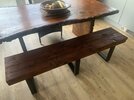
Exactly , using scaffold boards for shelves is for a rustic far from perfect finish .Bench below is two scaffold boards, sanded, oiled and screwed together from underside.
Not perfect , it’s not supposed to be.
 

Attachments

  • IMG_1753.jpeg
    IMG_1753.jpeg
    285.8 KB · Views: 55
Exactly , using scaffold boards for shelves is for a rustic far from perfect finish .Bench below is two scaffold boards, sanded, oiled and screwed together from underside.
Not perfect , it’s not supposed to be.
Looks good, though.(y)
 
Ensure the timber is as dry (seasoned) as possible to reduce warping.
With scaffold boards that's pretty hard to do. Whereas using kiln dried wood it would be much easier.
I think this could be the sticking point, scaffold boards are stored externally at most timber suppliers I use...
 
You could drill/dowel join the boards together or perhaps a tongue and groove then glue to ensure stability between them.
I have a biscuit jointer but wasn't keen on using that, I don't own a domino, that would be ideal, but I can't justify the cost.
I have two makita 1/2 Router's and plenty of sash clamps, so the loose tenon is feasible.
 

If you need to find a tradesperson to get your job done, please try our local search below, or if you are doing it yourself you can find suppliers local to you.

Select the supplier or trade you require, enter your location to begin your search.


Are you a trade or supplier? You can create your listing free at DIYnot Local

 
Back
Top