
Tariffs with solar and battery, this time of year hardly matters, but what about winter?

What's the usable capacity of the battery? - maybe that will help me understand...
Two batteries with an useable capacity of 3.2 kWh each, but I choose to only use 90% leaving 10% for UPS should it be needed. One battery is needed to be allowed to export to some providers, and it stops the system flitting every time a cloud comes over from import to export, but charge rate 2 kW and discharge 3 kW so easy to have half charged battery and still export, or use just over the 3 kW so importing, so second means charge at 4 kW and discharge at 5 kW (inverter limit) so actually store solar energy when there, and can run small items as well as a 3 kW appliance.

What I had failed to consider was with off-peak, it would store more overnight so solar would be available before the batteries were nearly drained, this time of year half the time I will start getting solar before the batteries are fully discharged, even with no off-peak charging, so single tariff is best, but winter this all changes.
 
Two batteries with an useable capacity of 3.2 kWh each, but I choose to only use 90% leaving 10% for UPS should it be needed. One battery is needed to be allowed to export to some providers, and it stops the system flitting every time a cloud comes over from import to export, but charge rate 2 kW and discharge 3 kW so easy to have half charged battery and still export, or use just over the 3 kW so importing, so second means charge at 4 kW and discharge at 5 kW (inverter limit) so actually store solar energy when there, and can run small items as well as a 3 kW appliance.

What I had failed to consider was with off-peak, it would store more overnight so solar would be available before the batteries were nearly drained, this time of year half the time I will start getting solar before the batteries are fully discharged, even with no off-peak charging, so single tariff is best, but winter this all changes.
Ah, yes that's quite a different proposition - the batteries are mainly filling in gaps I see, and my thinking about it might be quite wide of the mark ..
 
I want to set things up, and then forget. The idea of swapping tariffs through the year is not what I want. So the worst month, December
1747459511511.png
my solar is well down, so any gains are by using off-peak. Without off-peak, £126.62 is the likely bill.
I did screenshots before leaving British Gas, so the actual was £75.51 monthly electricity spend, of which £27.77 was off-peak. So off-peak saved me around £50. So it seems I will need off-peak.
Only some tariffs allow payment for export, so looking at
1747460968978.png
and to be frank, it does my head in, trying to work it all out. It seems Octopus Go night rate 8.5p/kWh, day rate 29.4p/kWh, standing charge 67.83p/day is about the best tariff for me. So day rate a little up from the 25.37p/kWh I pay now, standing charge a little lower to 68.17p/day I pay now, and since 8.5p is less than 10p if I export what I have stored overnight. No real loss.

It seems Octopus Flux is designed for solar panels, but Go seems a better tariff, so what am I missing? The times 00:30 - 05:30 are a bit later to the British Gas tariff I was on. But otherwise very similar. As with BG there is a leaving early fee, but only £25 where BG was £75.

What have I got wrong, I need a sanity check.
 
I want to set things up, and then forget. The idea of swapping tariffs through the year is not what I want. So the worst month, December ....... my solar is well down, so any gains are by using off-peak. Without off-peak, £126.62 is the likely bill. .... I did screenshots before leaving British Gas, so the actual was £75.51 monthly electricity spend, of which £27.77 was off-peak. So off-peak saved me around £50. So it seems I will need off-peak.
As I presume you realise, picking a tariff which is best for "the worst month" will not necessarily be (financially) best for you over a whole year.

As I've said before, you need to make guesstimates of what the situation will be in each month of the year, and then work out which tariff would result in the lowest total of bills over the year as a whole.
 
What have I got wrong, I need a sanity check
If you're on Octopus Go for import, you still get the standard Outgoing Fixed export @15p.

The "gotcha" with Go is that the terms and conditions state you're only eligible if you own an EV. Although they don't actually check, nor do you actually tick a box saying that you do.

As an alternative EON "Next Drive" specifically says it's open to people with solar/storage, and rates are better.

Are you controlling your system with Home Assistant?
 
Are you controlling your system with Home Assistant?
No, in the main Google Home, it brings the many hubs, and systems together, and allows voice commands with our Nest Mini's which are dotted around the house.

My son uses Alexa and I can see very little difference between the two.

I looked at Octopus Flex, and it has a problem in my mind, the off-peak is more expensive to the export fee. This
1747565587983.png

was typical the last time I had off-peak. The amount of energy stored overnight, is not used before the sun takes over, looking at the purple line, state of charge, I had only dropped to 80%, it is set to stop at 10% so there is some energy for the UPS should we get a power cut, so 70% of the batteries capacity was wasted. At the time no payment for export, so a total loss.

But if I pay 8.5p for off-peak, and get paid 15p for export, then it does not matter. I am still on the gain.

And winter I found I was gaining more with the batteries and off-peak, than I was with the solar panels, I was seeing my bill drop from around £120 a month to £70 per month, mainly due to batteries and off-peak.
the terms and conditions state you're only eligible if you own an EV
I have two e-bikes, and a mobility scooter, so technically I do have an EV. What I don't have is a charging system which can be controlled by my supplier.

I do not want to have to mess around to use the cheap or free power, once set up, I want to in the main forget about it. If I look at the end of the day
1747566576196.png
there is enough energy left to run washing machine, dish washer, or tumble drier, without running out of battery before off-peak kicks in. OK heart of winter I may need to be careful, but in the main I can simply forget about when is the best time to run the big three. I can just let it look after itself.

It was the same with central heating, until I had got the control right, I was playing all the time, but once all set up correctly, I have just forgot about it, just need to inspect oil level in the tank every so often.
 
I have two e-bikes, and a mobility scooter, so technically I do have an EV. What I don't have is a charging system which can be controlled by my supplier.
"Intelligent Octopus Go" requires an EV or charger that they can control. "Octopus Go" doesn’t.

Reason for asking about how you control the system is that I what you were referring to, charge the battery only to a given percentage. That's needed in our case as the system is well oversized, so the battery needs to have space to accept the surplus during peak generation. But I suspect our systems don't have much in common, mine is Solaredge and I'm controlling it using Modbus over IP.
 
Now on Octopus Go, so three rates, 8.50p/kWh off peak 00:30 to 05:30, 15p/kWh for export, and 30.17p/kWh peak.
As I presume you realise, picking a tariff which is best for "the worst month" will not necessarily be (financially) best for you over a whole year.
Since 8.50p is less than 15p, it does not matter if the battery has no room for solar, as export pays more than the import cost. This is why I did not go for Flux, as could pay 17.1p and then have no room for solar which is only 10.54p for most of the day, OK could get 30.68p for export 16:00 to 19:00 but that would hardly pay for the loss if batteries could not store the solar, or pay for the massive 39.9p if I do need power 16:00 to 19:00, and I wanted to set up and forget.

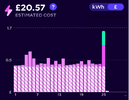
I must admit, I look and sometimes wonder what I am looking at 1748345849161.png on Sunday had daughter helping us, so used far more electric to normal, I looked at the green bit, and was scratching my head, what did it mean? I think it means night rate, but if so, why no shown for Monday? But most of the bill seems to be the standing charge.
 
I'm on Go as well. For me green is night rate.

Screenshot_20250527_125242_Octopus.jpg


You may not have had a bill yet, but when you do it should give a breakdown of each day ..
Screenshot_20250527_130046_Drive.jpg
 
Thank you @aesmith I will monitor from time to time, but it is basic thank god at long last, sorted, 7th September 2023 solar went in, and it has been delay after delay ever since.
1) Needed a smart meter, 30th Jan 2024 before that was fitted.
2) 4th April off-peak tariff, this was a pain as locked in for a year, and when I failed to get paid for export and realised British Gas were not going to play ball, it was not worth paying the £75 exit fee.
3) 15th October 2024 I got a second battery, this resulted in the off-peak becoming more of a problem, as I was exporting for no return as battery had been charged with off-peak.
4) 10 April 2025 moved to Octopus.
5) 1st May 2025 started to be paid for export.
6) 25th May 2025 got off-peak again.

I think the battery and off-peak save about the same as the solar, but at the moment getting back as export payment about double to what we are spending. Did look at the iboost+ which was a mistake, as off-peak cost less than I get for solar, but not worth changing now I have it.
 
I had a few glitches but nothing like that! I already had a smart meter.
Solar was commissioned 31st May 2024, I believe the export tariff was in place by 14th June, but Octopus messed around and I made enough a fuss that they credited me for export right from the very start.

Then I had smart meter problems meaning I couldn't switch to an off peak tariff for the Winter. Then it started working again and I signed up for Go, then it stopped again. So for my import from 1st April onwards I've not been billed, and there's a risk that they won't recover the h/h data and end up billing at standard rate.
 
The smart meter I have is not the same as yours, I am south and you are north of the divide Liverpool to Hull. One of the reasons for solar and battery was the UPS that goes with it, but I did not realise the smart meter was even required until after the solar was fitted, I have an export meter, but it has never been used.
 

If you need to find a tradesperson to get your job done, please try our local search below, or if you are doing it yourself you can find suppliers local to you.

Select the supplier or trade you require, enter your location to begin your search.


Are you a trade or supplier? You can create your listing free at DIYnot Local

 
Back
Top