• Looking for a smarter way to manage your heating this winter? We’ve been testing the new Aqara Radiator Thermostat W600 to see how quiet, accurate and easy it is to use around the home. Click here read our review.

Outhouse Project

Joined
16 Jun 2025
Messages
4
Reaction score
0
Country
United Kingdom
Afternoon,
First time posting and pretty much a total novice, so apologies if lingo isn't right or anything is unclear, but I'd be very grateful for ideas / help.

Recently moved into a new home, and we have an outhouse, which we've had plumbed to contain the washing machine - all great. However, it's a single-skin wall, we've no idea how it'll feel doing laundry in January and it really could be more useful than it is today.
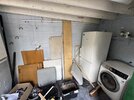
There's the previous owner's fridge (I believe this is now my beer fridge) and we'd want to keep that in, plus a few cupboards / areas to store things. I'd like to get rid of the stuff on the walls, cupboards, hooks and everything.

I think the simplest way to make it a nicer place to go in, and less owned by the spiders, would be to insulate / board / plaster / paint it. I've read and seen I could frame it, insulate with a gap and then plasterboard on top, or I could 'warm batten' it? It doesn't need house level insulation I guess....and it will probably need ventilation to stop damp if washing machine used a lot in winter? It's electrically sound now, electrician has wired a few more plugs and a fuse box as well as light, which he'd help me with place on new boards or whatever as needed.

Plastering I wouldn't go near, but I'd like to try and get to the point it could be plastered. I'm just torn as to which route to take to not lose lots of internal space and not go too OTT as a first-timer.

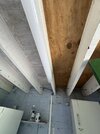
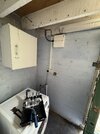
Pictures attached, but it's 308cm wide, 245cm deep, 210 to the joists for roof and 229 to top of ceiling.
 

Attachments

  • IMG_0482.jpg
    IMG_0482.jpg
    350.9 KB · Views: 43
  • IMG_0483.jpg
    IMG_0483.jpg
    283.6 KB · Views: 46
  • IMG_0484.jpg
    IMG_0484.jpg
    266.1 KB · Views: 48
With the term " outhouse", I'm guessing it's not attached to the house in any way, and therefore doesn't have a heat source? My own thoughts are that there's no point in insulating a building with no heat going into it.
If be thinking of just battening the walls and plasterboarding, eventually. My first priorities would be having a good window, good door and frame, and making sure the cold water feed into the washing machine is well lagged.
( in my own biased opinion as a tiler, I would wire in an electric UFH mat and tile that floor :) THEN it's worth insulating )
 
Just wear suitable clothing in the winter AND ensure it’s ventilated. Electric underfloor heating in such a building - no unless you like burning money
 
With the term " outhouse", I'm guessing it's not attached to the house in any way, and therefore doesn't have a heat source? My own thoughts are that there's no point in insulating a building with no heat going into it.
If be thinking of just battening the walls and plasterboarding, eventually. My first priorities would be having a good window, good door and frame, and making sure the cold water feed into the washing machine is well lagged.
( in my own biased opinion as a tiler, I would wire in an electric UFH mat and tile that floor :) THEN it's worth insulating )

Thanks for the reply - good question actually. It's not attached (unless a pipe and an electric cable count!). What do you mean by lagged for the cold water feed please?

I guess it doesn't need insulating, I just assumed that it would be worth it to retain whatever heat it collects, but in winter I guess that's nothing. If I just batten + plasterboard, would you still put up damp proofing? It has a ventialtion brick at the bottom, would you plasterboard around that or leave that as ventilation between brick and plaster?

Thanks again for replying.
 
Outhouse always reminds me of a lifetime ago when most houses had an outside dunnie that often was frequented by dunnie budgies
 
My first priorities would be having a good window, good door and frame, and making sure the cold water feed into the washing machine is well lagged.

With the pipes lagged, if the situation is as described, there remains the risk of the washing machine itself freezing, and many fridges, fridge/freezers will stop working if the environment they are in is too cold..

To at least avoid the above - It might be worth the OP insulating, and adding some heating which switches on if the temperature falls below 5C. Much depends upon how detached the outhouse is, from the main house, the OP hasn't yet explained that?
 
With the pipes lagged, if the situation is as described, there remains the risk of the washing machine itself freezing, and many fridges, fridge/freezers will stop working if the environment they are in is too cold..

To at least avoid the above - It might be worth the OP insulating, and adding some heating which switches on if the temperature falls below 5C. Much depends upon how detached the outhouse is, from the main house, the OP hasn't yet explained that?
Thanks - think I understand the term better now.

It's 2 metres door to door from the back door - but it's connected by a back gate (the electric and water run across this).

What kind of heating would make sense - an electric heater with thermostat?
 
It's 2 metres door to door from the back door - but it's connected by a back gate (the electric and water run across this).

Which suggests it is completely isolated from any heat from the house. I helped a neighbour with one similar, decades ago. The house back door, directly faced the old outhouse door, with and open to the weather, passage between them, though it was enclosed by the outhouse roof. The step-down to - passage floor, used to turn into deep puddle. I gave him a hand to raise the passage floor with concrete, and add a door at either end of the passage, making the outhouse much more useful, and a little warmer.

What kind of heating would make sense - an electric heater with thermostat?

Yes, but one which includes a thermostat, able to be set at 5C. A wall mount convection heater.
 
I'm sticking to my suggestion of Electric UFH ....... Not as a primary source of main heating for a room you will sit in and watch the telly:- just as a secondary background ' anti freezing/anti damp' heat, over the winter. You put down a ' medium ' spec mat, say 250 Watt, set for 10 till midnight, and 3 till 5 , and that's ( obvs) 4 hours of heating at 250W = 1 Kw. That's not a convector heater on the wall only heating 1 corner of the outhouse, that's the whole floor, at what, 30p for 4 hours? You don't need to heat it all day.
Remember, insulating works both ways - if it freezes, it stays cold !
I definitely leave the airbrick uncovered, the ventilation will help stop damp/mould etc.
 
I'm sticking to my suggestion of Electric UFH ....... Not as a primary source of main heating for a room you will sit in and watch the telly:- just as a secondary background ' anti freezing/anti damp' heat, over the winter. You put down a ' medium ' spec mat, say 250 Watt, set for 10 till midnight, and 3 till 5 , and that's ( obvs) 4 hours of heating at 250W = 1 Kw. That's not a convector heater on the wall only heating 1 corner of the outhouse, that's the whole floor, at what, 30p for 4 hours? You don't need to heat it all day.
Remember, insulating works both ways - if it freezes, it stays cold !
I definitely leave the airbrick uncovered, the ventilation will help stop damp/mould etc.
your understanding off underfloor heating may be very different to mine ??

in my mind true underfloor heating by nature is expensive to install, very slow acting and only ever suitable for areas with extreme levels off insulation
where as background heating like say a 300 or 600w tube heater can stop frost more effective as its acting where it matters directly to the room instantly not from heating the floor slab first then radiating up some time later
 
Last edited:
We certainly do have a difference of opinion. The underfloor electric heating mats I install rest about 5mm below a porcelain tile floor. Not quite instant to feel it, but not far off it. The mat is only where you want it and need it, and as all heat eventually rises, its a very uniform and even way of heating a space. And if it does hold heat when switched off, then what’s wrong with that? No hot spots/cold spots as with a convector, and doesn’t take up any space on the wall. Can also be fitted with insulation boards under it.
 
You put down a ' medium ' spec mat, say 250 Watt, set for 10 till midnight, and 3 till 5 , and that's ( obvs) 4 hours of heating at 250W = 1 Kw. That's not a convector heater on the wall only heating 1 corner of the outhouse, that's the whole floor, at what, 30p for 4 hours? You don't need to heat it all day.

Did you mean Kwh there? 250w might not be enough, the under-floor heating will be much more involved and expensive to install, plus much slower to react.

That's not a convector heater on the wall only heating 1 corner of the outhouse, that's the whole floor, at what, 30p for 4 hours? You don't need to heat it all day.

The word 'convector', means the heat is dispersed in the room by the air. A convector (or tube heater), is quick, cheap, and easy to install, and will react quickly to the room's air temperature, which is what is exactly what is needed here. It's the room air temperature which is important, that will determine whether pipes freeze.

Perhaps your opinion is biased, by the fact that you install under-floor heating.
 
Which suggests it is completely isolated from any heat from the house. I helped a neighbour with one similar, decades ago. The house back door, directly faced the old outhouse door, with and open to the weather, passage between them, though it was enclosed by the outhouse roof. The step-down to - passage floor, used to turn into deep puddle. I gave him a hand to raise the passage floor with concrete, and add a door at either end of the passage, making the outhouse much more useful, and a little warmer.


Yes, but one which includes a thermostat, able to be set at 5C. A wall mount convection heater.

Thanks - I can't connect them, the outhouse is off to the side. so an option of insulation backed plasterboard, mounted on battens, with a wall mounted convection heater should work well?

Should also mean I can put some cupboards / shelves in and make it a room we can store things in without worrying.

Appreciate the help.
 
Did you mean Kwh there? 250w might not be enough, the under-floor heating will be much more involved and expensive to install, plus much slower to react.


The word 'convector', means the heat is dispersed in the room by the air. A convector (or tube heater), is quick, cheap, and easy to install, and will react quickly to the room's air temperature, which is what is exactly what is needed here. It's the room air temperature which is important, that will determine whether pipes freeze.

Perhaps your opinion is biased, by the fact that you install under-floor heating.
It is also important when trying to control the building's atmosphere dew point to avoid condensation affecting the building's stored contents(y)
 
Did you mean Kwh there? 250w might not be enough,
No, I didn’t, I meant 250W. A bathroom underfloor heating mat ( as a secondary heating source, used in conjunction with a rad or other primary input) starts at 150 W.
Unless otherwise instructed, my go-to is a 175W. You don’t need a lot of power to dissipate in a room to stop it freezing.
Maybe we’re interpreting the O.P.s heating requirements differently??
Personally, I wouldn’t go for a Tube convector; what’s the point of mainly heating the outside wall behind it, with SOME of the heat actually radiating into the room ? TBH, I would use a cheap, plug in, portable, thermostatically controlled Oil Filled electric heater before using a convection tube.
( and of course I’m biased re electric flooring)
 

If you need to find a tradesperson to get your job done, please try our local search below, or if you are doing it yourself you can find suppliers local to you.

Select the supplier or trade you require, enter your location to begin your search.


Are you a trade or supplier? You can create your listing free at DIYnot Local

 
Back
Top