
Mobility Scooter battery, which one...

Joined
8 Jul 2008
Messages
1,469
Reaction score
121
Location
Derbyshire
Country
United Kingdom
Deciding on some new AGM Lead acid batteries for a mobility scooter.

I'm going for 2x36Ah (approx) lead acid type.

I looked in to the lithium option...but I'm not convinced of the benefit (unless someone can convince me otherwise).

I using the sizing options on the tanya website, these are the results.

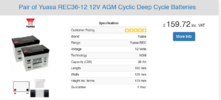
A pair of Yuasa at £170
1750530003261.png

or

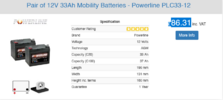
A pair of Tanya's "own brand" batteries branded as Powerline at £86 for a pair art 33 -36ah
1750529967028.png

or

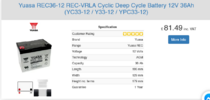
MK 35ah AGM x2 at £170
1750530085258.png

The only issue with the Poweline one are that the lug/connections are not the screw type. but I'm sure an adaptation can be made.
The price is too low to ignore consideration...but, I was trying to decide if it was too much of a trade off in potential quality or something.
They are the only ones that do not mention that they are "deep cycle", but they do have mobility on them, so they must be for that purpose.

Thoughts?
 

Attachments

  • 1750530040401.png
    1750530040401.png
    81.1 KB · Views: 40
Until the experts have 100% perfected lithium and the charging thereof, I think you are wise. Far too many fires have been started when charging lithium-ion batteries. As for adapting the connection lugs, perhaps the prospective supplier of the battery could advise you where to obtain the necessary parts. Also, if they are sold as 'mobility' then each has to meet that criteria under the sale of goods act.

EDIT .. the lugs as in the photo are the bolt-through type so easily adapted to suit your needs(y)
 
Last edited:
Until the experts have 100% perfected lithium and the charging thereof, I think you are wise. Far too many fires have been started when charging lithium-ion batteries.
Actually, there is no issue in that regard as far as I understand. A lot of the mobility scooter lithium batteries are the safer Li-Po type. But I still do not think the benefits work out.
 
I got a pair of AGM 35 Ah was in a hurry so went to Abergele Manchester batteries to get them direct. A pair of Tanya's "own brand" batteries branded as Powerline as I remember, but since then the scooter has not really been used. So, new batteries are now around 6 years old.

They were neglected in a shed, every so often I would charge them, but the problem is they can only be charged in the scooter as a pair, I have just removed them from the casing so I can charge them off the scooter, and was considering reusing them as emergency lights.

So the AGM take time to charge, where the lithium can charge much faster. That is the main advantage, the second is they are lighter, but they will need a special charger to go with them, where I am charging the AGM with a pair of Lidi chargers.

I seem to remember something like a 25-mile range, at 4 MPH that's 6 hours continuous driving, so see not need to extend the range, so only change I would make, is a connector so I can remove the batteries and charge them off the scooter, so like with the e-bike I can take battery in doors to charge and leave scooter or e-bike in the car.
 
Would you just go for the far cheaper powerline rather than the more expensive (and assumed better quality) Yuasa?

One thing I think people also overlook with the AGM lead acid, is that the weight of those batteries do provide a nice low centre of gravity counterweight against someone sitting high up in the chair.

But, on the Lithium front, SLK do 2 x20ah (assuming there is more usable capacity vs 50% of a 36ah lead acid). They cost £400 all in.

Still leaning strongly in favour of the AGM lead acid I think. Especially if people think those powerlines are good enough.
 
Of the original batteries, one, had a shorted cell which resulted in baking the other battery. By that time 10 years old, if it had been used every day likely it would have lasted longer, but 10 years is not bad, I did try to get the scooter to tip, no way even on a slope, and mother drove it off a curb where the daft council had put pattens with the brick sets and with poor eyesight she could not see what was a patten and what was a curb on Rhyl prom.

So super steady.
 
Wonder if the weight will reveal anything about the quality of the battery.

It seems that the cheaper batteries may have much less robust innards. More susceptible to damage to vibration, thinner lead plates, less cycles and so on.

Just trying to work out how much of an impact that has in mobility scooter applications, and whether it is worth the extra £80+ for a better brand.
 
Likely the batteries will come with a set of bolts and nuts... I seem to recall them being in little plastic bags with our purchase of 20/22 Ah ones of different brands. Would be worth a check with supplier to be on the safe side.

I've bought golf buggy batteries in the past when cheaper than "mobility". eBay sellers have Lucas for £120 a pair which we've used as well as Yuasa. (I avoid MK as they were OEM in our first scooter with a faulty charger and for no other reason.) Ditto for unknown to me brands. 17/18 Ah SLK were fitted in the second scooter and did OK but nothing special.

Unknown brand with no supporting technical specs (or manufacturer website I can find)... well you pays your money and you takes your chances.

FWIW. Our current powerchair with 24V Lithium 10Ah and 13Ah packs take typically 5-6 hours to recharge using what appears to be a standard 2A mobility smart-charger psu... (presumably a properly controlled charging circuit is in the battery housing).
That's not dissimilar to the scooter lead acid charging time.
One 24V 12Ah lithium battery pack costs £110 at the moment from that supplier.
 
OK, i bit the bullet and bought some new Yuasa's

The scooter is not used enough to warrant lithium or all the additional considerations and costs that involves.

Scooter is a TGA Zest Plus 4mph scooter. (Great scooter by the way)

So i went for the 36ah AGM Yuasa

I received them and did a prolonged first charge, until it showed as full, and then just left it on float charge. It was nearly 24hrs worth.

However, I am confused by some of the readings after doing a test before and after with my multimeter.

Old Batteries - voltages.

Scooter off - 26.46
Scooter turned on at the key - no movement - 16.78

Flat Ground
Moving - slowest speed - 15.7
Moving - Half Speed 14.9
Moving Full speed - 14.4

Hill Climb:
Slow - 14.4
half - 13.65
Full - 13.65

When batteries were disconnected, they were reading 13.03 v each.

These batteries as far as I could tell were toast. The meter would start to show red after just 3 or 4 miles of light scooting.


so when I got the new batteries, after that long initial charge, I expecting very different readings and minimal voltage drop under load. (this is what I have read I should expect).

However...

New batteries.

Scooter off - 27.04V

Scooter on (key turn only) 17.32

Flat Ground
Slow - 16.2
Med - 15.4
Full - 15

Hill
Slow - 15.2
Med - 14.5
Full 14.3

So, I am confused. Those readings seem to indicate they are not in good health.

Am I missing something. Or should I be getting minimal voltage drop.
 
It is near impossible to read my scooter battery voltage once fitted to the scooter, this is my complaint about the scooter, can't charge batteries off the scooter, and the charger as found to my cost, will overcharge batteries if a cell goes down, the 12 volt smart charger I use, 7.3 volts is minium for it to start charging, and 10.5 volt and under it will only pulse charge, so unlikely to charge a battery with a shorted cell more than 0.8 amp, where the scooters' charger can deliver around 8 amp.

Run volts should not be below 11 volts per 12 volt battery, so for 24 volt battery looking at 22 volts, below which one would expect the scooter to auto turn off. This stops over discharge of the battery, so for the readings you show, one would expect to find some high resistance between the measuring point and the battery.

I do remember having odd readings using an AVO automotive meter, it seems the shielding in the meter was not as good as it should have been, and the radio frequency around where I was measuring was giving me false readings, it said I was using around 60 amps, and at that the cable being used would have melted, I borrowed a Fluke meter, and the readings were as expected, around 4 amps.

I do not know how the scooters regulate the power to the motors, but I would think likely some pulse width modulated or switch mode, which could be a reasonable high frequency, which could upset some meters.

I have questioned the way both the scooter and e-bike handle a discharged battery, I would have hoped slowly it would go slower and slower, so one could limp home, but no, it just turns off, leaving one with only one option, push it home. Not so bad with e-bike you can at least peddle it, but may be called a scooter, but trying to scoot with it, does not really work.
 
I am expecting a Pride Envoy 8 to be delivered Tue 5th Aug. I'm fed up with finding all Blue Badge spaces taken up by ruddy grockles, so the scooter will save me having a struggle to park in town(y)
 
Scooter off - 27.04V

Scooter on (key turn only) 17.32
Slow - 15.2
Med - 14.5
Full 14.3

Are you sure the batteries you have been supplied with, are actually new ones? Where are you taking the measurements, you need to always connect your meter, directly at the battery terminals.

I had a Class 1 Rascal - 2x 12v 33aH. That would slow down noticeably on the hills, but no speedo to confirm it - I assumed due to volt drop, and a low power motor.

My latest, is a Class 3 Veleco Gravis, 5x 12v 30aH. That has a speedo, and the speedo confirms it runs at full speed, even up all of the hills to be found around here. It's full speed is a noughty 16mph.

When it comes to time to replace the batteries, I have been investigating LifePo4, which don't catch fire, are reputed to have longer life than either lead-acid, or lithium, but slightly heavier than lithium. Like lithium, they need a special charger.
 
Is there anything about scooters where it's advantageous for the batteries not to die?

I'm guessing not, unlike the 12V battery in a BEV, where if I had one I would without hesitation put in one of the "smart" lithium alternatives.
 
Exactly where are you measuring these voltages?

A series pair of SLA/Gel batteries, open circuit at 25C should be 25.600 Volts for 100% SoC... (after any surface charge removal). Slightly lower Volts at 21 C.

So your meter is either very inaccurate (over-reading) or you are not removing the surface charge initially on those batteries. It takes many hours off charge for that to dissipate.

Otherwise the two sets of numbers are similar... but seemingly there's some bits that are dropping volts when ON... (most scooters batteries will have individual fuses, plus a resettable overload mcb inline to the control circuits and motors etc.,.)... but I doubt they would account for it. Perhaps some DC high current connections are poorly made / gone resistive?
Battery internal resistances can come into it but should be a low milliOhms figure (8-12?).

What does/did the voltmeter show when scooter OFF after those tests? Any surface charge will have been removed by such a trip.
 

If you need to find a tradesperson to get your job done, please try our local search below, or if you are doing it yourself you can find suppliers local to you.

Select the supplier or trade you require, enter your location to begin your search.


Are you a trade or supplier? You can create your listing free at DIYnot Local

 
Back
Top