• Looking for a smarter way to manage your heating this winter? We’ve been testing the new Aqara Radiator Thermostat W600 to see how quiet, accurate and easy it is to use around the home. Click here read our review.

EV CHARGING AND FUSE

Joined
26 Jun 2025
Messages
48
Reaction score
4
Country
United Kingdom
Hello all, so we were thinking to buy a ev car and sell the petrol one but upon research I found out to have a ev you need to reach a few requirements.

Main fuse should be adequate.
Can't be a looped supply.

Now can someone explain to me about evs and how a 60amp fuse rating won't be sufficient for a ev? A 7KW charger by the way.

Also If I buy an ev what options do I have to charge it for example can I charge it outside or in my house?

Thanks and sorry for the stupid questions I don't know much about this field and I wish someone can educate me!
 
There is a whole list of things which need to be complied with, and also a whole load of ways around the problems, and not sure if I know them all.

Permission was required, not sure if that is still the case, to ensure the supply can take the load, but by using monitors on the whole supply the charger can be configured so it reduces the charge rate if the rest of the house has a high demand.

There has to be loss of PEN detectors, and DC current detectors, and the list goes on, but these are normally built into the charger, the problems are more to do when the car is parked on the street, and the street furniture needs to be a set distance away.

The charging unit has to have it own dedicated RCD and so often a special consumer unit needs to be fitted to allow it to comply, but the cost when compared to the cost of the car is nothing, where the problem arises is when the car is not owned by the user, and then the cost of charger install can seem excessive.
 
Best explained by using Google or Bing or another search engine and read some specialist forums for the information. It will have been covered many times.

60 Amp fuse is not a problem.
Modern EV "charger" units (EV Supply Equipment, EVSE) will have a whole home Current Clamp sensor and the device can be programmed to limit the EV charge current to a safe level when the home appliances are drawing towards the 60 Amp fuse limit. 7 kW is 32 Amp but the EV can be told to take 30, 24, 12, 10 or even 6 A while the home needs to use most of the 60 Amps available... (that may vary by EV make - some EVs only have 3.5 kW on board chargers).
Seldom a problem as most will charge overnight on a cheap rate...
Those seeking to maximise / exploit off peak use via HW tank, washing and drying might at times - but most don't charge an EV every night of the week.

The District Network Operator will unloop if required via the install notification process (if you are looped - a photo of your meter box / DNO fuse/meters/tails would allow them wot know to say).

EVSEs can be located in garages (most EVs are too wide for normal dwelling entrances) if wanted.
Or on an outside wall with the EV on a driveway outside.
 
Best explained by using Google or Bing or another search engine and read some specialist forums for the information. It will have been covered many times.

60 Amp fuse is not a problem.
Modern EV "charger" units (EV Supply Equipment, EVSE) will have a whole home Current Clamp sensor and the device can be programmed to limit the EV charge current to a safe level when the home appliances are drawing towards the 60 Amp fuse limit. 7 kW is 32 Amp but the EV can be told to take 30, 24, 12, 10 or even 6 A while the home needs to use most of the 60 Amps available... (that may vary by EV make - some EVs only have 3.5 kW on board chargers).
Seldom a problem as most will charge overnight on a cheap rate...
Those seeking to maximise / exploit off peak use via HW tank, washing and drying might at times - but most don't charge an EV every night of the week.

The District Network Operator will unloop if required via the install notification process (if you are looped - a photo of your meter box / DNO fuse/meters/tails would allow them wot know to say).

EVSEs can be located in garages (most EVs are too wide for normal dwelling entrances) if wanted.
Or on an outside wall with the EV on a driveway outside.
Thanks! Can it be charged via the socket?

And why do ev guzzle so much power?

Say if I charge it for 5 mins will I be able to drive to the local shop for eg?
 
Those seeking to maximise / exploit off peak use via HW tank, washing and drying might at times - but most don't charge an EV every night of the week.
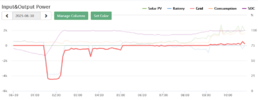
My grid use. 1751287206189.png I don't have an EV unless you count my e-bike, and as you can see 1:30 am to between 2 and 3 am is when I draw most power from the grid. I can only charge the battery at 4 kW and with washing machine, tumble drier, dishwasher, and immersion heater, I am still unlikely to hit the 60 amp, but off-peak is only 00:30 to 05:30 so trying to do a lot in a short time.

I can reduce the charge rate for the house battery, and it is also charged from solar, but with the extra to charge a car, could easily exceed the 60 amps.

This time of year, off-peak 8.5p and export 15p so 6.5p extra if I used solar, but in the grand scheme of things that is not much, today only exported 7 kWh to 2 pm as the AC been running most of the day, but some days can export 26 kWh, but some of that was imported earlier the same day.
 
Thanks! Can it be charged via the socket?
The socket?

13A socket... STRONG advise is not to do so regularly/ Emergency use. Max 10A 2.4kW per hour. Plugs and sockets can overheat.

That's why EVSEs are fitted... safer and designed for the higher currents (plus other safety factors)... Read up more rather than asking random questions.
And why do ev guzzle so much power?
Do they?

Say if I charge it for 5 mins will I be able to drive to the local shop for eg?
Dunno. Depends on how near your shops are.

My locals shops (ignoring the village Inconvenience Post Office that's closing shortly for a many week refurbishment) are 3 miles or so... That'd be around 1kWh there and 1kWh back.

But my car has a 69kWh battery... 66kWh usable... Most EV drivers rarely let the charge drop below 20%. {Nor charge to more than 80%, although my maker say 90%, unless going on a long journey shortly after.}

However you've obviously done absolutely no research and reading up on EVs... so Google and do some reading of the Car Mags etc.,.

ALL these questions are answered with more / better explanation as to why than I can do... In fact it's where I have got the above answers from.
 
My grid use. I don't have an EV unless you count my e-bike, and as you can see 1:30 am to between 2 and 3 am is when I draw most power from the grid. I can only charge the battery at 4 kW and with washing machine, tumble drier, dishwasher, and immersion heater, I am still unlikely to hit the 60 amp, but off-peak is only 00:30 to 05:30 so trying to do a lot in a short time.
Yours should be showing 7kW while heating HW and charging the home battery = 32 A... so an EVSE would reduce the EV to 28A under load balancing. Another 10A (say) from the washing machine heater would make the EV drop to 18A... Then back to 28A when the washing waters hot enough.
The EV would go to 32A as soon as the home battery or HW immersion loads were satisfied.

Your DNO fuse might be warming up nicely while HW immersion, home battery and an EV were all on at the same time and drawing 60 Amps. { * The EVSE may actually ensure that the EV takes a bit less than the difference between home load and fuse rating for all I know. }

It's exactly that sort of scenario the modern EVSE with load balancing via the whole house current transformer is designed for... To avoid DNOs having to uprate the cables and fuses to homes 'urgently' rather than as a routine area by area upgrade.

On other forums there have been examples of EVSEs installed on looped supplies, limited to 60 A, and being like it for a year or more before the DNO come to unloop. {Plus issues over access rights and neighbour disputes and costs...} So research and due diligence is key.
 
I would stick with a petrol. Best choice.

Mind you, they are giving away EV's with delivery mileage only and a few years old
 
Best explained by using Google or Bing or another search engine and read some specialist forums for the information.
@TAMD8389 - if you find any forums where people are saying that EVs are just unexploded bombs that will catch fire and destroy your house, and that they are all part of a sinister government plot to control your mobility, leave them.
 
13A socket... STRONG advise is not to do so regularly/ Emergency use. Max 10A 2.4kW per hour. Plugs and sockets can overheat.
Worked for me for years but I'm reluctant to just say "yeah, crack on, you'll be fine". I paid particular attention to the temperature of the socket and plug when in use.
 
But my car has a 69kWh battery... 66kWh usable...
So 7 kW x 5 hours = 35 kWh, so it is all down to how many miles per day. Sister did 100 per day, son does 30 per day, I hardly do 30 per week, if someone talks about 30 MPG or 60 MPG I have driven enough cars to work out what it means, and I also know the manufacturer's lie, I used to drive a Vauxhall Agila and a Toyota Yaris to Heathrow and back on a regular basis, they claimed the same MPG, but I always got more out of the Yaris.

So we look at 3.6 miles/kWh and 4.8 miles/kWh, and we don't have a clue what in real terms it means, as even 69*3.6 = 248 miles, we have no idea if these are true miles, or some figment of the manufacturers' imagination.

My neighbour had an EV van for his milk round, the same miles every day, around 68, range quoted at 130 miles, and sometimes he did not get back, OK early model Renault kangoo, he never used the heater, that's not good with milk, and most of the time going slow, and some days returned with loads to spare, but he had to have a pick-up as a back-up.

My son has gone electric, but good reason, it is a deal with his firm, so he gets such a good deal, he would be daft not to take it, and I find very few with EV cars who did not get some excellent deal, and the car is not his, so he is not worried about second hand value.

To find someone who will admit they have made a mistake with anything is hard, human nature not to admit it.
 
So we look at 3.6 miles/kWh and 4.8 miles/kWh, and we don't have a clue what in real terms it means, as even 69*3.6 = 248 miles, we have no idea if these are true miles, or some figment of the manufacturers' imagination.
If you're talking about manufacturer figures [ie, WLTP] then they're not true miles, they're just a comparator figure.
 

If you need to find a tradesperson to get your job done, please try our local search below, or if you are doing it yourself you can find suppliers local to you.

Select the supplier or trade you require, enter your location to begin your search.


Are you a trade or supplier? You can create your listing free at DIYnot Local

 
Back
Top