• Looking for a smarter way to manage your heating this winter? We’ve been testing the new Aqara Radiator Thermostat W600 to see how quiet, accurate and easy it is to use around the home. Click here read our review.

RTS turn off

The thing you are missing is that these tariffs that have an off-peak rate charge you more than the standard rate during the other seventeen hours.

Therefore, if you don't use a lot during off-peak periods then overall you will be paying more.
 
If off peak means E7 then I am using E7 for lights, computer, fridge, etc.

So 7 hour of use at slightly cheaper rate, and a similar 17 hours of consumption at a much more expensive peak rate. Do you not understand, that the peak rate cost, more than compensates for the tiny saving you might make on the cheap rate? E7 is just about worthwhile, for those who can make good use of the cheap rate - storage heaters, car charging, water heating. You aren't making any use of E7, just paying much more than you need to.
 
The thing you are missing is that these tariffs that have an off-peak rate charge you more than the standard rate during the other seventeen hours.
Off peak rate electricity is not used during the other 17 hours. Peak rate is used during the other 17 hours.
 
How much is this more expensive peak rate than peak rate?

The standard tariff CAP, at the moment is 25.73 pence per kWh 51.37 pence daily standing charge. You are paying during those 17 peak hours, 26.95p. Keeping in mind that the CAP is the absolute maximum, you can be charged on a standard tariff, however, I paid much less than the CAP. Without bothering to actually calculate the average, as said, the actual cost varies from day to day - it looks as if I paid around 18p per Kwh, electric, on the Tracker, and around 5p per Kwh for my gas.

The only way you have to make your E7 worthwhile, is to switch absolutely everything off for those 17 hours, then switch them on for the 7 hours of off-peak.
 
So, I am paying above the CAP?

The bill that I never look at says I am on E7:
tariffs.jpg
 
The bill that I never look at says I am on E7:

You should be asking yourself why you are on E7 at all!
and as pointed out - paying way more than you need to for both your electric, and your gas you seem to be paying 25% more than me. You need to give your head a shake.
 
your gas you seem to be paying 25% more than me.
That's because we are in different locations.

I did a quick calc. E7 is likely cheaper for me. There is only 1p difference between peak E7 and standard CAP. E7 brings in savings for 7 hours and cheaper standing charge.
 
That's because we are in different locations.

Well, all the quote web sites, ask you for a postcode, and an estimate of your annual consumption. It only takes a minute to do.

I did a quick calc.

Try a longer calculation.

There is only 1p difference between peak E7 and standard CAP.

The point you are missing, is that the CAP is the absolute MAXIMUM, they can charge on a standard tariff. The majority of customers are paying less than the CAP. I am paying much less than the CAP.
E7 brings in savings for 7 hours

That's great, but only if you are making good use of it, with storage heaters, water heaters, and car charging. You are doing none of those things..

It's bit like saying the shop down the road sells at 30% off, but you never go in the shop to save anything. You've got to be able to use it, to save anything - you cannot make use of it.
 
AI Overview

Generally, gas for hot water is cheaper than Economy 7 electricity, especially with the current energy price cap. While Economy 7 offers cheaper electricity at night, gas generally has a lower unit cost and higher efficiency for heating water.
Yes, I read that too. Does not quite work out, as, although it seems easy 20.15p v 6.37p, I found when my boiler ran, it heated up the boiler and pipework, which had cooled down again on next firing, so using around 15 kWh per week with electric, and over double that with oil, and my off-peak is 8.5p/kWh.

I use off-peak for water heating with one immersion heater, my tank will stay warm for around 3 days, so no real point turning the immersion heater off, but if cool at night it will turn on, and if exporting in the day it will turn on, did consider changing things, but the few pence saved, not worth the hassle.

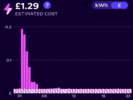
1752503598597.png
Looking at my power used yesterday, there was a little at end of day used at high rate (30.17p/kWh), but most of imported power was at 8.5p/kWh, the smart meter will show about the same, but not caught up yet, day before 1752504038280.png most of the day, just shows standing charge, only power from grid, is off-peak. The old teleswitch could tell you, but you needed to actually read meter.
 
Well, your favourite shop ain't better.

Of course you could try comparing standard rates, rather than the ridiculous E7 rates - the one which you cannot make any sensible use of. Even better, you could check out the Tracker tariff.

With that, I'm outa here, and away from this silly nonsense.
 
Because tariffs change region to region, hard to compare London prices when I am on Mid-Wales prices. But I did look at the rates, and some did seem silly, I can't see what is the difference between a battery which is built into a car and connected to the grid, to one in a house and connected to the grid, in both cases energy is being stored for latter use, and so to give a EV user 5 hours and the one EV 3 hours off-peak one would expect the 3-hour one to be cheaper, but it's not. The Flex tariff offered to solar panel users is not one I would want to use.

My son tells me his EV tariff, means Octopus is turning his charging on/off as odd hours, so he can't plug in the EV and say it needs 70 kWh so it will be charged in 7 hours, the "intelligent go" means he does not know when he can "go" with a full charge.

I remember many years ago, looking at some council houses in Lixwm where the storage was central, with fans to put the heat into rooms when required, and a friend living in one, told me the bricks could stay hot for a week, and each room was thermostatically controlled, and for those homes, it would not have mattered if the off-peak was 3 hours, 5 hours, 7 hours or 10 hours as the heat store would last out, and house very well insulated, this was late 70s, so not new technology, the problem with the off-peak heating is the storage radiator not the tariff, which once fully charged, will not retain the charge even with everything turned off output wise, for even 24 hours.

We have seen bad heating systems installed throughout the ages, with coal fires and no ducts to bring in combustion air, and if sucked the air from the room in general causing massive drafts. My last house was designed to be heated with a single central gas fire, with open-plan house, that also did not work, we soon installed central heating.

The net result is, every homeowner has to work out what suits them. There is no magic system which suits all. A late friend of mine, had a home in the middle of 12 acres of woodland, and he said he was not growing enough wood for his needs, the council issued him with a green waste bin, and as he said, it would not even fit one tree. Not sure, I believe him, I have two green bins, and I keep the thick stuff for the BBQ, not a large garden, but the wood is mounting up.

But to work out which tariff would best suit my lifestyle was not easy, there is no one suits all, and there is still a lot of guess work.

 
I remember many years ago, looking at some council houses in Lixwm where the storage was central, with fans to put the heat into rooms when required, and a friend living in one, told me the bricks could stay hot for a week, and each room was thermostatically controlled, and for those homes, it would not have mattered if the off-peak was 3 hours, 5 hours, 7 hours or 10 hours as the heat store would last out, and house very well insulated, this was late 70s, so not new technology, the problem with the off-peak heating is the storage radiator not the tariff, which once fully charged, will not retain the charge even with everything turned off output wise, for even 24 hours.

The central storage system, was a very sensible solution, but near impossible to add to an existing building. A large heated lump, helps to retain itself to retain heat, and the insulation can be much more effective. Much easier to control the release of the heat.

The distributed storage heaters, fail on both counts - size, and quite thin insulation, and so the all the heat escapes, during the day, wastefully - whether heat wanted or not. I once had a flat, heated by storage radiators - I would be out at work all day, when it was warm in the flat, and arrive home when the warmth was exhausted.
 

If you need to find a tradesperson to get your job done, please try our local search below, or if you are doing it yourself you can find suppliers local to you.

Select the supplier or trade you require, enter your location to begin your search.


Are you a trade or supplier? You can create your listing free at DIYnot Local

 
Back
Top