
By helping him, you are enabling him to carry out work that is out of his depth.
It’s worth noting that he’s not the only one who will read, and learn from, the very interesting posts like opps’ above.

By helping him, you are enabling him to carry out work that is out of his depth.

Point taken ie opps great work on the sills, i am going to repair some concrete soon so will follow his great advice, i also see Herts P+D view, he does seem to do an awful amount of varied work, which he has no clue about instead of concentrating on fewer trades/jobs.It’s worth noting that he’s not the only one who will read, and learn from, the very interesting posts like opps’ above.

Don't worry, I am not refering to you, I know from your threads that you are tradesman and know your trade.I am guessing, or rather hoping, that you are not referring to me... I am not the OP.
I wrap polythene dust sheet around a length of timber and clamp it to the underside of the window sill. None of the fillers mentioned above will stick to the polythene.
Once the timber is in place, force the filler into the irregular underside. I try to make sure that it only goes backward about 5mm. If it is an old sill with no drip channel, I don't want rainwater to track back to the wall.
I normally fill the top of the sill first and sand, adding more filler as required. I normally use a very wide knife (12") for the top of the sill.
I use a suitably sized filling knife to face fill the front edge. Some of the filler will reach over the previously sanded top edge. I then use the filling knife to pull the excess filler on to the top face (to ensure it bonds).
Once the filler has set, I remove the clamps. The underside should not need sanding. The poly should pull away. On the balance of probability, you may need to refill the tiny areas difficult to access because of the clamps.
Which sander do you have? I tend to use the 150mm Rotex for the larger areas (80 grit paper). I then use my old DX93 (delta sander) for the internal corners.
If you are going to use the Toupret Touprelith F be advised that it has an annoying quirk. You can apply the first coat, sand it back and then apply a second coat to deal with low spots. When you sand the second coat back, the first coat shows (very slight) evidence of the latter filler (very) slightly ripping the first layer. I normally apply dilute SBR or a couple of coats of masonry paint and drop the abrasive grit to about 150 grit before applying a second coat of filler. That problem doesn't happen with their harder fillers or 2 pack.
I hope the above makes sense, it has been a long day and I am having a few pints.
How about normal Toupret masonry filler?, I have that.
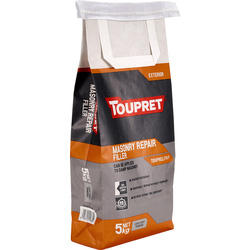
 www.toolstation.com
If you mean Toupret Masonry Repair filler
Toupret Exterior Masonry Repair Filler (Touprelith F)
Fills without depth limit and repairs without formwork. It will adhere to damp masonry and is weather resistant while also being easy to shape. Usable on all rough masonry surfaces, and can overcoat 48-72 hours from application.• Adheres to Damp Surfaces• No Depth Limit• Paintable 72 hours after...
That is Touprelith F. They rebranded their products a couple of years ago. I still tend to use the old names.

How did u fix the wood to the sill underneath? Screw it in? After washing the surface I ran my hand over it all and seems the bare masowas a bit dust so put peel stop on that (basically a stabiliser). Will fill all the scraped holes on sill leave the scraping on top section View attachment 390265View attachment 390266View attachment 390267
Keitai's before pictures will be better than the finished onesNice work opps. I can't wait to see Keitai's before and afters.


If you need to find a tradesperson to get your job done, please try our local search below, or if you are doing it yourself you can find suppliers local to you.
Select the supplier or trade you require, enter your location to begin your search.
Are you a trade or supplier? You can create your listing free at DIYnot Local