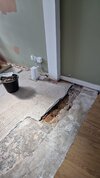
1940s exLA house ground floor construction

Joined
27 Sep 2011
Messages
457
Reaction score
5
Location
Somerset
Country
United Kingdom
One of my kids has bought an ex Local Authority house. The previous owners built an extension which was 99% finished when they sold it. Just a bit of floor levelling, paint and flooring to be done.
The original house floor and the extension floor are not at the same height, only a few mm here and there, hence the floor levelling needing doing. I decided to chip away some of the old flooring to level it out a bit more and soon found myself unearthing damp rubble and dirt along and close to the old original wall area.
When they built house 80 years ago, did they spread a relatively thin concrete layer, an inch maybe, as the floor?
 
I decided to chip away some of the old flooring to level it out a bit more and soon found myself unearthing damp rubble and dirt along and close to the old original wall area.
When they built house 80 years ago, did they spread a relatively thin concrete layer, an inch maybe, as the floor?

Might what you are finding, be rubble between the original cavity walls? What is the construction of the rest of the house floors, built on a concrete slab, or does it have timber floors?
 
Thanks for the quick reply!

Infilled cavity is a possibility, might need to chop back some more floor to see whats what. It seems to be a bit further back from the original wall area though.

It's the dampness that bothers me most and why it's damp as ithe extension been built for some time now. Prior to chopping back the concrete, there was no obvious signs of any damp showing either.

The rest of the house ground floor is concrete floors.
 
If there's no DPM you'll have to dig it out and put one in. Whilst the property might be in a location where a inch of concrete over rubble might be enough to stay dry, it's not good practice and you might as well insulate the floors as you're messing about with them.

It might be that someone infilled the original suspended floors at some point in the past, or more likely it was built that way. Shortage of building materials in the 1940's for obvious reasons, also houses being thrown up quickly to meet demand.
 
Hmmm, not too keen to dig up the entire ground floor, it was just a matter of levelling out the extension/house join really. I'll chop a bit more out and see what I find.
If a DPM wasn't put in back then, why does it need adding now?
 
If a DPM wasn't put in back then, why does it need adding now?

Almost certainly, it will have been built with one, but what is the wall construction, of the outer walls - brick?

Show some photos, of the base of walls, outside.
 
Im not there at the moment ,but from what I recall, there is a series of holes just below the render line, so a dpm was injected I guess. I thought Deluks was suggesting putting a DPM over the whole floor after digging up the top layer.
The outer walls are rendered.
 
When they built house 80 years ago, did they spread a relatively thin concrete layer, an inch maybe, as the floor?
The idea of a 'waterproof' floor many years ago was a smattering of hard core, with quarry tiles on a bed of lime mortar.
 
The idea of a 'waterproof' floor many years ago was a smattering of hard core, with quarry tiles on a bed of lime mortar.
That was our kitchen, it had to go. Lifting the tiles, in order to re-tile the kitchen with something more modern and I was greeted by a ragworm.

This would be a good opportunity for the OP to fit ufh and take advantage of the government heat pump grant.
Obviously £££, but would be a nice bit of future proofing.
 
A kitchen was fitted not long ago, so until we can see how the whole floor was constructed, digging it all up and fitting UFH isn't an option. They have just bought the house, so the repayments alone are enough!
 
I've got a picture of the problem area. It's inset from the original walls, which would have been where the encased steel is on the wall. There is a thin screed on top of a crumbly, black 'concrete'. You can see it by the wall. I'm now wondering if this is just painted on bitumen, if thats how they did it back then.
 

Attachments

  • IMG-20250930-WA0001.jpg
    IMG-20250930-WA0001.jpg
    233 KB · Views: 24
black 'concrete'. You can see it by the wall. I'm now wondering if this is just painted on bitumen, if thats how they did it back then.

Not clear on what your mention of 'encased steel' was about, but....

My guess as to what you have, is a large concrete slab, upon which the house has been built. On top of the concrete, has been poured hot bitumen, which produces a flat floor. The other possibility, is that a strip foundation has been laid, walls built, then an infill of concrete between the walls, finished with bitumen.

Have you an sds drill? You could pick an area of floor, and drill it, to check how thick the slab is? You will need to reseal the holes.
 
I mentioned the encased support as its where the old wall was, just to give a perspective.
I do have an SDS drill but my plan was to chop back a bit more of the surface, which appears to be a smooth layer added more recently, to see what's underneath. Your idea might be better.
Will probably pull off some more of the laminate to see it the flooring surface changes further into the room. I'm guessing the 'builder' who did the extension patched up areas.
 

If you need to find a tradesperson to get your job done, please try our local search below, or if you are doing it yourself you can find suppliers local to you.

Select the supplier or trade you require, enter your location to begin your search.


Are you a trade or supplier? You can create your listing free at DIYnot Local

 
Back
Top