- Joined
- 3 Jul 2016
- Messages
- 13
- Reaction score
- 0
- Country

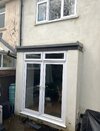
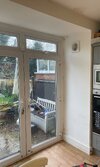
I’m trying to work out the best approach for a small bay projection on our kitchen. The bay is roughly 2.5m by 0.6m and projects beyond the external wall only at ground-floor level. Inside, the ceiling in this area is lower than the rest of the kitchen, so the main ceiling steps down.
We’ve always had some damp marks on the bay ceiling, especially in the top corners. Outside, the bay is topped with a flat roof finished in fibreglass.
The original fascia was timber and beginning to fail. I planned to remove it, but it had been partly rendered into place. Since there was enough space, I ended up over-cladding it with a composite fascia instead.
While doing that, I drilled into the old fascia to see the roof build-up. From top to bottom it appears to be:
• Fibreglass roof covering on a deck • A void of about 100mm • A board forming the ceiling (timber or plasterboard)
So it is basically an uninsulated cold roof. The void has never had ventilation as far as I can tell.
I can add ventilation at the front by installing louvred vents in the fascia. The sides seem to be solid timber for at least 250mm or so, which means front-only venting is the only realistic option. Not ideal for airflow, but doable.
My concern is what happens if I do add vents. At the moment the void is sealed and presumably kept slightly warmer by heat loss from the room below. If I vent it, I’ll be introducing cold air into that space. That could cool the bay ceiling further and increase condensation risk on the inside surface, especially because this is a kitchen with higher humidity.
So I’m unsure what the lesser evil is. A cold roof is supposed to be ventilated, but will adding vents create a new condensation problem either inside the room or within the void itself?
Interested in any experiences or guidance.
We’ve always had some damp marks on the bay ceiling, especially in the top corners. Outside, the bay is topped with a flat roof finished in fibreglass.
The original fascia was timber and beginning to fail. I planned to remove it, but it had been partly rendered into place. Since there was enough space, I ended up over-cladding it with a composite fascia instead.
While doing that, I drilled into the old fascia to see the roof build-up. From top to bottom it appears to be:
• Fibreglass roof covering on a deck • A void of about 100mm • A board forming the ceiling (timber or plasterboard)
So it is basically an uninsulated cold roof. The void has never had ventilation as far as I can tell.
I can add ventilation at the front by installing louvred vents in the fascia. The sides seem to be solid timber for at least 250mm or so, which means front-only venting is the only realistic option. Not ideal for airflow, but doable.
My concern is what happens if I do add vents. At the moment the void is sealed and presumably kept slightly warmer by heat loss from the room below. If I vent it, I’ll be introducing cold air into that space. That could cool the bay ceiling further and increase condensation risk on the inside surface, especially because this is a kitchen with higher humidity.
So I’m unsure what the lesser evil is. A cold roof is supposed to be ventilated, but will adding vents create a new condensation problem either inside the room or within the void itself?
Interested in any experiences or guidance.