However over the last few days things stopped working correctly. The radiators will only warm up if I turn on a unit that is next to the hive receiver - it’s a horstman HRT4 ASR-ZW which I still connected to a thermostat downstairs. But I don’t understand why the system is using this. The Hive app works, the batteries are new and the boiler is firing up. But why is it only working when I manually turn on the Horstman when I previously I didn’t need to? Why does the Hortsmann need to be involved at all?

You are using an out of date browser. It may not display this or other websites correctly.
You should upgrade or use an alternative browser.
You should upgrade or use an alternative browser.
Heating in a muddle
- Thread starter David M
- Start date

- Joined
- 5 Nov 2024
- Messages
- 5,397
- Reaction score
- 2,541
- Country

It sounds like you didn't fit the Hive correctly as the Horstmann was the original controller, this is why it's likely involved. I take it it's the receiver?
You say no wiring was needed, yet something has been left in, so still part of the circuit
You say no wiring was needed, yet something has been left in, so still part of the circuit

So, do you have one zone but 2 stats?
And each stat should bring the heating on, depending on which one has the lower target temp?
And each stat should bring the heating on, depending on which one has the lower target temp?
- Joined
- 5 Nov 2024
- Messages
- 5,397
- Reaction score
- 2,541
- Country
If it's a single zone (1 thermostat), I suspect that the Horstmann had the receiver set to override or something and it's just lost that function or power maybe? If you give some more information as to the receiver and how the Hive has been wired we can guide you so that it's just the Hive working.Thanks country fan
It does look like There is a problem with how I set this up but it worked for six weeks and now the Horstmann turns itself to Off even when the Hive target temperature is set up

- Joined
- 27 Jan 2008
- Messages
- 29,128
- Reaction score
- 3,567
- Location
- Llanfair Caereinion, Nr Welshpool
- Country
The question is how should it work? OK, my house is a bit on the large size, but the idea of one device turning boiler on/off, does not work. Forgetting my flat, under the main house, the main house has 3 devices which can trigger the boiler.
We can adjust heat-up times, with the lock shield valves, but we can't control cool-down times. So the TRV in general stops over-heating, and the wall thermostat stops under heating. Although, we can link TRV heads if required.
As to domestic hot water, a cylinder of hot water can last 3 days, and it costs to fire a boiler, so in general want the DHW heating while the CH is running as well, so you do not heat the boiler to produce just enough hot water to wash your hands. It seems odd, but in many ways one of the oldest systems was the best economy wise, the old C Plan had a lot going for it in the winter.
But to consider faults, first one must look at the system used. Honeywell gave the systems letters, the C, S, W, Y, etc. The W normally inside the boiler where the reservoir is built into it. The Y uses a three port valve, the S uses 2 two port valves, and the C does not need any valves, but my C Plan has 2 two port valves, so counting the valves can be miss-leading.
So Tado, Tapo, Honeywell Evo home, Drayton Wiser, and Hive, all allow TRV heads to connect to some central unit, which has a verity of names assigned to it, so the TRV heads can both stop over and under heating. In some the central unit is a simple hub, in others it doubles as a thermostat. There are also ways to control TRV heads from remote heat sensors, so where the TRV is in a draft, it can be controlled by a device not in the draft, but also the draft can be used to detect when doors are opened and inhibit the radiator for a set time, so it is not heating outside when unloading a car for example.
Cost of TRV heads and wall thermostats varies a lot, so where two rooms have nearly the same conditions, one may have a full-blown linked electronic TRV head, and the other a cheaper non-linked head.
So in my case if the wife's bedroom gets too cold, the TRV head can start the boiler running, but in my bedroom the TRV head can allow the radiator to heat up if boiler already running, but can't start the boiler. Both are electronic with different temperatures for different times of the day.
So the way central heating controls heat in the home varies, some people don't have any TRV's, some have only mechanical, some have electronic programmable unlinked, some have electronic linked direct, some have electronic linked to a wall thermostat, so many options.
My house was a mess, and it took some time to get it working as I want, it is a compromise, my boiler is simple on/off oil fired, gas boilers can often modulate, and gain the latent heat from flue gases, so in general three ways to control a boiler.
1) On/off device, be it thermostat, programmer or combination using electric to control.
2) Up/down device, otherwise as above, but connects to ebus, OpenTherm is likely most popular way.
3) Return water temperature, this relies on the by-pass valve, lock shield valve, and TRV being set correctly.
The third and the first two can be combined, the aim with a modulating boiler is to reduce how often it is switched off and on again, each time it is switched off and on, it has to work out how much to modulate the output from scratch, and it also often has a cool down function, where each time switched off, it continues to run pumps etc, for short time, the same on switch on, where it runs a purge first, so where we can, we want analogue control. With central heating in general, on/off (digital) is bad, up/down (analogue) is good.
We can adjust heat-up times, with the lock shield valves, but we can't control cool-down times. So the TRV in general stops over-heating, and the wall thermostat stops under heating. Although, we can link TRV heads if required.
As to domestic hot water, a cylinder of hot water can last 3 days, and it costs to fire a boiler, so in general want the DHW heating while the CH is running as well, so you do not heat the boiler to produce just enough hot water to wash your hands. It seems odd, but in many ways one of the oldest systems was the best economy wise, the old C Plan had a lot going for it in the winter.
But to consider faults, first one must look at the system used. Honeywell gave the systems letters, the C, S, W, Y, etc. The W normally inside the boiler where the reservoir is built into it. The Y uses a three port valve, the S uses 2 two port valves, and the C does not need any valves, but my C Plan has 2 two port valves, so counting the valves can be miss-leading.
So Tado, Tapo, Honeywell Evo home, Drayton Wiser, and Hive, all allow TRV heads to connect to some central unit, which has a verity of names assigned to it, so the TRV heads can both stop over and under heating. In some the central unit is a simple hub, in others it doubles as a thermostat. There are also ways to control TRV heads from remote heat sensors, so where the TRV is in a draft, it can be controlled by a device not in the draft, but also the draft can be used to detect when doors are opened and inhibit the radiator for a set time, so it is not heating outside when unloading a car for example.
Cost of TRV heads and wall thermostats varies a lot, so where two rooms have nearly the same conditions, one may have a full-blown linked electronic TRV head, and the other a cheaper non-linked head.
So in my case if the wife's bedroom gets too cold, the TRV head can start the boiler running, but in my bedroom the TRV head can allow the radiator to heat up if boiler already running, but can't start the boiler. Both are electronic with different temperatures for different times of the day.
So the way central heating controls heat in the home varies, some people don't have any TRV's, some have only mechanical, some have electronic programmable unlinked, some have electronic linked direct, some have electronic linked to a wall thermostat, so many options.
My house was a mess, and it took some time to get it working as I want, it is a compromise, my boiler is simple on/off oil fired, gas boilers can often modulate, and gain the latent heat from flue gases, so in general three ways to control a boiler.
1) On/off device, be it thermostat, programmer or combination using electric to control.
2) Up/down device, otherwise as above, but connects to ebus, OpenTherm is likely most popular way.
3) Return water temperature, this relies on the by-pass valve, lock shield valve, and TRV being set correctly.
The third and the first two can be combined, the aim with a modulating boiler is to reduce how often it is switched off and on again, each time it is switched off and on, it has to work out how much to modulate the output from scratch, and it also often has a cool down function, where each time switched off, it continues to run pumps etc, for short time, the same on switch on, where it runs a purge first, so where we can, we want analogue control. With central heating in general, on/off (digital) is bad, up/down (analogue) is good.
It’s single zone. Oil fired boilerIf it's a single zone (1 thermostat), I suspect that the Horstmann had the receiver set to override or something and it's just lost that function or power maybe? If you give some more information as to the receiver and how the Hive has been wired we can guide you so that it's just the Hive working.
When I got the Hive two months I simply removed the existing Drayton timer box and fitted the Hive receiver instead. No wiring was neeeded and it all powered up. For these two months I have been able to turn my heating on remotely an hour before getting home and both heating and hot water have functioned on their schedule correctly.
But suddenly I’m the last few days Eveything has reverted to working only by me turning up or down the original hortsmann thermostat in the sitting room. It’s done this with no changes being made so it’s a mystery
If I disconnected the original horstmanm do you think it would work simply using the Hive. I can’t see any reason I’d want two ways to control the boiler
Attachments
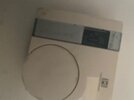
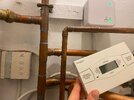
Last edited:
- Joined
- 27 Jan 2008
- Messages
- 29,128
- Reaction score
- 3,567
- Location
- Llanfair Caereinion, Nr Welshpool
- Country
From the sound of it, Horstmann and Hive are in series, not parallel, many just turn the original thermostat up to maximum, and let Hive take over. This shows Y Plan change 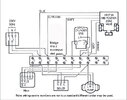
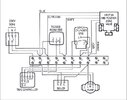 where a link is put in the wiring centre, but numbers are not fixed, so it takes some investigation to find the correct wire to bridge. I would turn the Horstmann up full, and wait until summer to sort out, this is not the time for heating to fail as you have made an error.
where a link is put in the wiring centre, but numbers are not fixed, so it takes some investigation to find the correct wire to bridge. I would turn the Horstmann up full, and wait until summer to sort out, this is not the time for heating to fail as you have made an error.From the sound of it, Horstmann and Hive are in series, not parallel, many just turn the original thermostat up to maximum, and let Hive take over. This shows Y Plan change View attachment 403042View attachment 403041 where a link is put in the wiring centre, but numbers are not fixed, so it takes some investigation to find the correct wire to bridge. I would turn the Horstmann up full, and wait until summer to sort out, this is not the time for heating to fail as you have made an error.
- Joined
- 5 Nov 2024
- Messages
- 5,397
- Reaction score
- 2,541
- Country
Ok, this is your issue. You haven't decommissioned the Horstmann, leaving a circuit that's gone haywireWhen I got the Hive two months I simply removed the existing Drayton timer box and fitted the Hive receiver instead. No wiring was neeeded and it all powered up. For these two months I have been able to turn my heating on remotely an hour before getting home and both heating and hot water have functioned on their schedule correctly.
No mystery really, something has obviously happened, perhaps without your knowledge? Or maybe it's just working off the Horstmann now.It’s done this with no changes being made so it’s a mystery
No you don't need 2 ways. You can disconnect the Horstmann but you'll need to put a link wire in the wiring center end. If you want the easiest thing for now, safely isolate the electrics, open Horstmann receiver and link the 2 switch wires or Common and NO, then the Hive should take over.If I disconnected the original horstmanm do you think it would work simply using the Hive. I can’t see any reason I’d want two ways to control the boiler
Last edited:
- Joined
- 27 Jan 2008
- Messages
- 29,128
- Reaction score
- 3,567
- Location
- Llanfair Caereinion, Nr Welshpool
- Country
My own house, just got a new thermometer for Christmas
 and the TRV heads, and wall thermostats also report,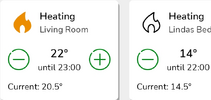
 point is rooms vary in temperature,
 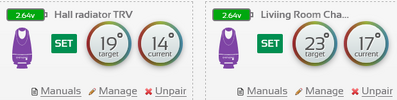 even in the same room,
 So 17, 20.6, 20.5, and 19.8 all in same room at same time, two of the rooms on the thermometer are not heated, so not that bad, but to expect to control whole house with one wall thermostat is asking a bit much, even when I went on holiday in a caravan, two thermostats even for a unit so small.
even in the same room,
Trying to do a cheap up and down zone, without 2 ports?

DIYnot Local
Staff member
If you need to find a tradesperson to get your job done, please try our local search below, or if you are doing it yourself you can find suppliers local to you.
Select the supplier or trade you require, enter your location to begin your search.
Please select a service and enter a location to continue...
Are you a trade or supplier? You can create your listing free at DIYnot Local
Similar threads
- Replies
- 7
- Views
- 7K
D

- Replies
- 5
- Views
- 9K
