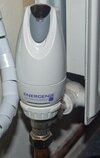
Yes, spot on, my thinking. Mother's house, hall, had a wall thermostat, and a radiator without a TRV, after trying to set the lock shield valve, and failing to get reasonable results, I decided to fit a TRV to the radiator, and it was a massive improvement.
OK, few more details, hall had the wet room off it, and if hall cold, so was wet room, as the extract fan LABC insisted on, pulled replacement air from hall. Also, there were stairs from the hall, so the chimney effect, this was reduced by fitting a curtain around the stairs, and the front door did not seal too well as threshold free to allow wheelchair access, and to get a wheelchair in/out resulted in the door being open for longer than normal.
So the idea was set the TRV to around 17°C and wall thermostat to 19°C as wall thermostat higher, and further away from the front door, I say 17°C but in real terms, set to around 2.25 on the *123456 scale starts closing at around 17°C but not fully closed to around 19°C so we got a rapid recovery until 17°C and then the recovery slowed down allowing rest of house to heat up, before the wall thermostat turned off the boiler. It was so much better once the TRV was fitted, not just in theory, it worked in practice.
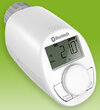
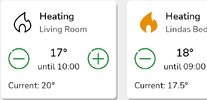
Of course the electronic TRV head is calibrated in °C, and the droop (difference between fully off and fully on) is far less, so if using an electronic head, then may need to link it to the wall thermostat, the likes of Drayton Wiser are designed to do this, assign a TRV and wall thermostat to same room, and they, it seems, auto link together, but as yet not tried.
The problem is radiators against an outside wall, will be cooled by the wall, or more to the point, the TRV head will be cooled, until it turns on, and a thermal circulation is established. So if all radiators are on internal walls, there is no need for any wall thermostat, the electronic TRV head connects to the hub, which in turn tells the boiler when to fire if connected as on/off, or how much to fire, if connected with the likes of OpenTherm. Drayton Wiser allows both TRV heads and wall thermostats to be linked to the hub, so you can select the method which works best with your home design.
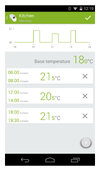
Years ago we did not have by-pass valves, or modulating boilers, and we did not gain the latent heat from the flue gases, and the TRV was to stop room's overheating, specially bedrooms in open plan homes. We would have one radiator without a TRV, so the pump would not be damaged if they all closed, often that was the bathroom, but things have moved on, and many it seems are still installing as they would have done in the last century, and have not realised central heating today is all about analogue control, turning things on and off is so last century, it causes a temperature hysteresis, today hard-wired motorised valves are out, as simple on/off, and the electronic TRV head has taken over, which increase or decrease flow to maintain room temperature without the hysteresis, and allow you to set times for each room to be heated, so a child's bedroom may have heating turn up at 8 pm, but adults bedroom not until 11 pm, and the idea of one on/off thermostat controlling whole house, as so last century.