Roomstat and TRV

Joined
17 Feb 2009
Messages
118
Reaction score
5
Location
Lancashire
Country
United Kingdom
Ok I know the principle of either there being no TRV (or if there is set it on max) in the same room as the room stat BUT, say I had the room stat at 19C, would it be beneficial to put the TRV on a setting just above 19c (about number 3 on a Drayton) in order for the water to be fairly flowing through the rad. from cold but trickling through when 'topping' the temp. up during the day but still satisfying the room stat? All rads are balanced, in the other rooms with TRV's this works great as they are sometimes hot and sometimes just warm (dependant on room temp. obviously).
Thoughts please
 
If I could though (maybe by using a separate thermometer to check), would it be beneficial to slow the flow down, especially when nearing room stat temp?
 
Thoughts please
Yes, spot on, my thinking. Mother's house, hall, had a wall thermostat, and a radiator without a TRV, after trying to set the lock shield valve, and failing to get reasonable results, I decided to fit a TRV to the radiator, and it was a massive improvement.

OK, few more details, hall had the wet room off it, and if hall cold, so was wet room, as the extract fan LABC insisted on, pulled replacement air from hall. Also, there were stairs from the hall, so the chimney effect, this was reduced by fitting a curtain around the stairs, and the front door did not seal too well as threshold free to allow wheelchair access, and to get a wheelchair in/out resulted in the door being open for longer than normal.

So the idea was set the TRV to around 17°C and wall thermostat to 19°C as wall thermostat higher, and further away from the front door, I say 17°C but in real terms, set to around 2.25 on the *123456 scale starts closing at around 17°C but not fully closed to around 19°C so we got a rapid recovery until 17°C and then the recovery slowed down allowing rest of house to heat up, before the wall thermostat turned off the boiler. It was so much better once the TRV was fitted, not just in theory, it worked in practice.

Of course the electronic TRV head is calibrated in °C, and the droop (difference between fully off and fully on) is far less, so if using an electronic head, then may need to link it to the wall thermostat, the likes of Drayton Wiser are designed to do this, assign a TRV and wall thermostat to same room, and they, it seems, auto link together, but as yet not tried.

The problem is radiators against an outside wall, will be cooled by the wall, or more to the point, the TRV head will be cooled, until it turns on, and a thermal circulation is established. So if all radiators are on internal walls, there is no need for any wall thermostat, the electronic TRV head connects to the hub, which in turn tells the boiler when to fire if connected as on/off, or how much to fire, if connected with the likes of OpenTherm. Drayton Wiser allows both TRV heads and wall thermostats to be linked to the hub, so you can select the method which works best with your home design.

Years ago we did not have by-pass valves, or modulating boilers, and we did not gain the latent heat from the flue gases, and the TRV was to stop room's overheating, specially bedrooms in open plan homes. We would have one radiator without a TRV, so the pump would not be damaged if they all closed, often that was the bathroom, but things have moved on, and many it seems are still installing as they would have done in the last century, and have not realised central heating today is all about analogue control, turning things on and off is so last century, it causes a temperature hysteresis, today hard-wired motorised valves are out, as simple on/off, and the electronic TRV head has taken over, which increase or decrease flow to maintain room temperature without the hysteresis, and allow you to set times for each room to be heated, so a child's bedroom may have heating turn up at 8 pm, but adults bedroom not until 11 pm, and the idea of one on/off thermostat controlling whole house, as so last century.

 
would it be beneficial to put the TRV on a setting just above 19c (about number 3 on a Drayton) in order for the water to be fairly flowing through the rad. from cold but trickling through when 'topping' the temp. up during the day but still satisfying the room stat?

You don't understand how a TRV works. A TRV begins to close, as it's set temperature is approached, and begins to reopen, if the room temperature begins to fall. Thus, it will maintain that temperature, while ever there is a flow of hot water available. If there is no heated water flowing, it will just sit there wide open, assuming the room temperature is too low.
 
You can’t really equate specific temperatures with a general number on a TRV.
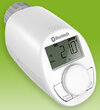
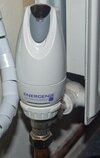
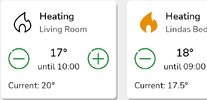
Depends on the TRV head, 61dmtMm13BL.jpg these when I got them (2019) were £15 each, this earlier model IMGP8035.jpg more expensive and a pain as can't adjust at the TRV, needs a computer or phone, and a hub, where first one shown can use bluetooth, but also can be manually controlled at the head. Some allow both, and some will actually fire the boiler Wiser heating all.jpg showing how wife's bedroom TRV head was firing the boiler, when not required to heat the living room.
 
You don't understand how a TRV works. A TRV begins to close, as it's set temperature is approached, and begins to reopen, if the room temperature begins to fall. Thus, it will maintain that temperature, while ever there is a flow of hot water available. If there is no heated water flowing, it will just sit there wide open, assuming the room temperature is too low.
Spot on, and this is a problem if lock shield not set correct, as once the boiler does fire, the radiator can get stinking hot, before the TRV has had the time to close.

Midday Saturday my eQ-3 TRV heads exercise the valve, and recalibrate themselves, and it takes around 6 minutes to fully open, fully close, and return to setting, if the lock shield is not set, 6 minutes is long enough for radiator to get really hot, and it starts the hysteresis, non-electronic are slower, this house still has an on/off oil boiler, so always some hysteresis, but mothers house with a gas modulating boiler the rooms would stay at temperature set, and radiators were just warm enough to maintain the temperature.

The problem was the built-in anti-hysteresis software in the TRV heads was OTT. So set the living room at 20°C at 7 am, and it was 10:30 am before the room was warm enough, so I cheated, and would set the room at 22°C at 7 am and 20°C at 8 am and the room would be at 20°C at 8 am. The Wiser TRV head is claimed to work out how long it takes to heat a room, so set to 20°C at 8 am, and it works out when it needs to start heating the room.

I have Energenie, Kasa, eQ-3, and Wiser heads, each one has plus and minus features, there is no best. Kasa allows the use of remote sensors, so when a radiator against a cold wall, a wall mounted sensor on the opposite wall can control it, most seem to have window open detection, so I have my eQ-3 in kitchen set so if it gets a cold draft, it turns off for set time, I have I think set to 10 minutes, so it turns the heat off in kitchen when back door is open as we unload shopping from the car.

If we heated all rooms with 14 rooms, it would cost a fortune, so the TRV heads have the time set when each room is to be heated, but not heating a room until 10 pm, and the living room not heated after 11 pm, does not give enough time for the room being heated at 10 am to reach a controlled temperature, so I have in main house, three devices which can turn on the boiler, two wall thermostats and one TRV head.

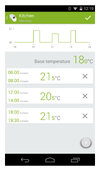
The heating is never really turned on/off, all devices turn up/down, this 51RAAw1+hEL.jpgshows the setting for one of the eQ-3 heads.
 
Spot on, and this is a problem if lock shield not set correct, as once the boiler does fire, the radiator can get stinking hot, before the TRV has had the time to close.

Does it matter? The room will need likely need heat input, and the TRV will shut itself down when the set temperature is achieved. If the room is at temperature, the TRV will already be partly, or fully closed.
 
My 'problem' is that the 2 downstairs rooms are 'joined' via an archway opened all the time (about the width of 2 average doors, so not quite open plan). One room has the room stat and TRV set on max but am unsure wether to set the other TRV to max or not.
 

If you need to find a tradesperson to get your job done, please try our local search below, or if you are doing it yourself you can find suppliers local to you.

Select the supplier or trade you require, enter your location to begin your search.


Are you a trade or supplier? You can create your listing free at DIYnot Local

 
Back
Top