
Horizontal expansion vessel

Joined
13 Feb 2005
Messages
253
Reaction score
2
Country
United Kingdom
Hi

Just had a new boiler installed with a supplementary expansion vessel. The installer has fitted the expansion vessel horizontally rather than vertically. I don't think this is good practice. I presume the flexible hose wasn't long enough, I've contacted Zilmet to see if the warranty is voided with horizontal installation. Is it worth getting installer back to fit vertically or is the install OK. I also noticed that it transitions to plastic pipe within 1m of boiler which doesn't comply with Ideal vogue installation instructions. The system plastic pipe was like this prior to the new boiler but was hoping the installer would have rectified during the install of the new boiler. Any advice much appreciated.
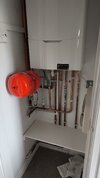
 

Attachments

  • 19064.jpg
    19064.jpg
    157.6 KB · Views: 24
Did I look up expansion vessel fitting instructions to see if it can be installed horizontal?
 
I have seen the expansion tanks like that before. It has not been an issue. I am not a plumber. I am a decorator.

If the system is maintaining mains pressure, I don't see what the problem is,

The expansion "tank"is there to deal with potential drops in pressure.

Again, I am not a plumber
 
I contacted Zilmet the manufacturer of the vessel and they stated the warranty would be void if related issues arise as the vessel should be mounted vertically.
 
I'd be curious to know why.
I don't see how the orientation of the vessel will affect its performance, given that part of it contains water, and part of it contains air.
 

1. Diaphragm Stress and Uneven Wear​


In a vertical vessel, the rubber diaphragm (the membrane separating the air and water) expands and contracts symmetrically. When placed horizontally, gravity pulls the diaphragm toward the "bottom" side of the tank.


  • Friction: The diaphragm can rub against the internal steel walls of the tank as it moves.
  • Uneven Expansion: The rubber is stretched unevenly, which can lead to premature thinning, cracking, or a total rupture of the membrane.
  • Waterlogging: If the diaphragm doesn't move freely, the "air cushion" side may not compress correctly, preventing the vessel from absorbing pressure spikes.

2. Sediment and Sludge Buildup​


Heating systems naturally contain small amounts of debris, such as iron oxide (magnetite).


  • In Vertical Installation: Sediment typically settles at the very bottom of the vessel (near the water connection), where it can be easily flushed back into the system or captured by a filter.
  • In Horizontal Installation: Sediment settles along the entire length of the vessel's side. This debris can get trapped between the diaphragm and the tank wall, acting like sandpaper every time the system heats up and cools down, eventually puncturing the rubber.

3. Air Pockets and Stagnation​


Vertical vessels are designed to "self-purge" or at least keep air in the right place.


  • Air Migration: If a vertical vessel is laid on its side, air can become trapped in the water-side chamber. This trapped air can migrate back into your pipework, causing "banging" (water hammer) or airlocks in radiators.
  • Stagnation Risks: Horizontal installation can create "dead zones" where water does not circulate. In potable water systems, stagnant warm water is a primary breeding ground for Legionella bacteria.

4. Structural Weight and Support​


A vertical vessel is designed to carry the weight of the water (which can be quite heavy when full) along its vertical axis, often supported by a specific bracket or its own legs.


  • Leverage on Pipes: If a vessel is hanging horizontally off a pipe, the weight of the water creates a massive "lever" effect on the joints. This often leads to weeping leaks or snapped fittings over time.
  • Internal Support: The internal bladder in some models is only anchored at one or two points designed for vertical suspension; laying it flat can cause the internal assembly to collapse or detach.
 
Is it worth getting installer back to fit vertically or is the install OK. I also noticed that it transitions to plastic pipe within 1m of boiler which doesn't comply with Ideal vogue installation instructions.

Get the installer back, to rectify the very obvious issues.
 
I contacted the installer, he said the warranty on both the boiler and expansion vessel will be fine and install is OK. I've told him I will get confirmation from Ideal and Zigmet and if they say it's OK then fine. Luckily I haven't paid him yet as I suspect Ideal boilers will confirm that it is not acceptable to install plastic pipe within 1m of boiler outlet, it clearly states this in the installation manual with MUST NOT highlighted in capitals and bold.
 
I've installed 1 replacement horizontal one after ~ 14 years in my daughters oil fired system, its still there 8 years later now.
 

If you need to find a tradesperson to get your job done, please try our local search below, or if you are doing it yourself you can find suppliers local to you.

Select the supplier or trade you require, enter your location to begin your search.


Are you a trade or supplier? You can create your listing free at DIYnot Local

 
Back
Top