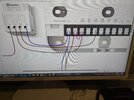
Wiring a relay to protect a programmer help.

Joined
5 Nov 2018
Messages
38
Reaction score
6
Country
United Kingdom
Hi. I hope you are all well.

I have installed a Tado v3+ receiver in my house for just over 1year. Around 3 weeks ago, the heating would just stay on always without any demand. As this was under warranty, tado sent a replacement and after 3 weeks it has done the same. The relay has fused closed in central heating mode.

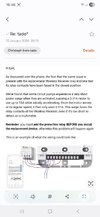
Tado are going to send another one but said I need to install a relay to stop the pump fusing the contact in the receiver. Now, they have sent an image so please find attached. What I need help with is where to install it. Can it be installed in the wiring centre? It is a Y plan set up.

Any help would be fab.

Regards Lee
 

Attachments

  • Screenshot_20260114_164622_Email.jpg
    Screenshot_20260114_164622_Email.jpg
    131.2 KB · Views: 30
1. Most inductive loads have a heavy current surge when the voltage is first applied. Don't understand why Tado should think this is unusual.
2. Unfortunateley I can't see the connections clearly in your attached image. I bigger image of the wiring diagram would be helpful, together with an explanation of where the brown and blue leads not attached to the relay come from.
3. Have they advised you of what "protective" relay is required?
4. I find it hard to see how a relay can offer protection other than switching the pump itself.
 
I can’t see how a pump would fuse contacts as it’s the Tado and motorised valve that carry out the switching, not the pump.
 
What I need help with is where to install it.

Anywhere that is convenient, where it will physically fit, and where it is safe to do so. In particular the relay in their photo has exposed (live) screw terminals, so that needs to be in an enclosure of some sort.

Have they advised on a specific relay? What is the rating of its contacts?
 
1. Most inductive loads have a heavy current surge when the voltage is first applied. Don't understand why Tado should think this is unusual.
2. Unfortunateley I can't see the connections clearly in your attached image. I bigger image of the wiring diagram would be helpful, together with an explanation of where the brown and blue leads not attached to the relay come from.
3. Have they advised you of what "protective" relay is required?
4. I find it hard to see how a relay can offer protection other than switching the pump itself.

Hi. Thanks for the reply. Please see another video attached.

I woukd like to install the relay in the airing cupboard with the wiring centre if possible.

They have not told me which relay I need. I assume the brown and blue leads are just the neutral and live?

Thanks for the reply.
 

Attachments

  • 20260114_203228.jpg
    20260114_203228.jpg
    328.2 KB · Views: 7
I can’t see how a pump would fuse contacts as it’s the Tado and motorised valve that carry out the switching, not the pump.
It is the Tado doing the switching but as can be seen, it appears the pump is putting too much of a load, central heating pumps are inductive and this can cause contacts to weld together - the pump may be on it's way out - it may just be too much for the Tado.

The way to resolve this is absolutly as suggested, have the tado power an additional (sacrificial) relay of a higher rating [ this way if the relay contacts fail then it's easier (and cheaper) to replace the relay.

I suggest you get one that fits into a relay holder, this then makes it easy to swap out if it fails.
Adding a snubber circuit across the contacts may help reduce the arcing causing this, or perhaps using a solid state relay instead.

What is the pump? can you give a clear photo of it's data plate? OR tell us the make/model and the technical details on it?

Both need putting into an enclosure, depending upon the size a simple ABS box of suitable dimensions will suffice.
 
Anywhere that is convenient, where it will physically fit, and where it is safe to do so. In particular the relay in their photo has exposed (live) screw terminals, so that needs to be in an enclosure of some sort.

Have they advised on a specific relay? What is the rating of its contacts?

The receiver is in a kitchen and I don't want to have to run external cables from it to a relay somehow if that makes sense.
 
The receiver is in a kitchen and I don't want to have to run external cables from it to a relay somehow if that makes sense.
Where in a kitchen? is it in a cupboard? is it in an enclosure? (it needs to be).
 
It is the Tado doing the switching but as can be seen, it appears the pump is putting too much of a load, central heating pumps are inductive and this can cause contacts to weld together - the pump may be on it's way out - it may just be too much for the Tado.

The way to resolve this is absolutly as suggested, have the tado power an additional (sacrificial) relay of a higher rating [ this way if the relay contacts fail then it's easier (and cheaper) to replace the relay.

I suggest you get one that fits into a relay holder, this then makes it easy to swap out if it fails.
Adding a snubber circuit across the contacts may help reduce the arcing causing this, or perhaps using a solid state relay instead.

What is the pump? can you give a clear photo of it's data plate? OR tell us the make/model and the technical details on it?

Both need putting into an enclosure, depending upon the size a simple ABS box of suitable dimensions will suffice.
Hi

Thanks so much for your reply.

The pump is a cheap pump i bought from Toolstation around 12yrs ago.

I have put tado into a few places and never had this issue before.

Snubbed circuit, will need to look that one up.
 
I don't know about how you find the model number - have you a link to where it was bought online?
I just want to see the tech details.

Is there room in the cover (a photo would be great) for a relay?
 
Last edited:
I can see from searching that this is a common issue with Tado receivers - only about a 6A contact so probably not enough.
 
Last edited:

If you need to find a tradesperson to get your job done, please try our local search below, or if you are doing it yourself you can find suppliers local to you.

Select the supplier or trade you require, enter your location to begin your search.


Are you a trade or supplier? You can create your listing free at DIYnot Local

 
Back
Top