Pulled from another thread

Given that you are responding to quotes of two of my sentences (which probably have essentially 'opposite' answers) could you perhaps clarify what you are saying? In other words, are you happy with, say, "decreased by one third"?

:-)
Ah yes I see.
I'm happy with fractions and percentages and commonly flip back and forth between them.... Well apart from 'decimal fractions' with their plethora of definitions :unsure:

Although I understand the usually intended meaning, the bit I don't like is n times smaller/cheaper etc.
Rather like some of the chestnuts we have on here such as: Plugtop, Live, Fusebox etc


This thread isn't an attack on anyone BTW
 
Last edited:
Down a different track completely I had a funny a few weeks ago when we had a cold snap, is was something like 8°C one day and 2°C the next and someone said something like 4 times colder.

I picked up on it by converting to 45º & 35º and asked if they'd still say 4 times colder after the realisation I'd moved it to ºF a mutual friends schoolboy jumped on the band wagon and using ºK mentioned 275 and 281.
 
Ah yes I see. I'm happy with fractions and percentages and commonly flip back and forth between them.... Well apart from 'decimal fractions' with their plethora of definitions :unsure:
"Decimal fractions" (as previously discussed) are, of course, simply 'percentages' with the decimal point moved!

Although I understand the usually intended meaning, the bit I don't like is n times smaller/cheaper etc.
Maybe because I'm dim, I'm still not totally clear about your position. I understand that you don't like "N times smaller/cheaper", but think you're happy with "N times larger/more expensive". Is that the case? What about "a quarter smaller/cheaper"?
Rather like some of the chestnuts we have on here such as: Plugtop, Live, Fusebox etc
Yes, of course, we all have our pet hates and irritations - but that's just human nature, and we all vary. "Plugtop" certainly irritates me (as does having to ask for a lamp to put in my lamp :-), but I'm personally not too affected by the other two!
 
Down a different track completely I had a funny a few weeks ago when we had a cold snap, is was something like 8°C one day and 2°C the next and someone said something like 4 times colder.
Yes, it is different - since you would similarly (hopefully!) not be happy with "4 times hotter" if the figures were reversed, although you have said written that you are, in general, happy with N times larger.

The point here is that proportions/ratios/percentages etc. can only be used with quantities/measurements which have what mathematically is described as a "ratio scale". That requires not only that points on the scale are equally spaced (an "interval scale") but also that there is a 'true zero'. As you go on to infer the absolute (Kelvin) temperature scale is a ratio one, but Celcius and Farenheit are only 'interval' scales, not 'ratio' ones.
 
I picked up on it by converting to 45º & 35º and asked if they'd still say 4 times colder after the realisation I'd moved it to ºF a mutual friends schoolboy jumped on the band wagon and using ºK mentioned 275 and 281.
I noticed a variant of this problem in a newspaper headline today ...

The headline was of the form "Mr A, aged 55, and Miss Y, nearly half his age". Half his age is 27.5, so this really shluld mean that she is a little under 27.5.

However, as one might expect from the fact that this was appearing as a 'headline', that is not what they meant. They actually meant that the difference between their ages is 'nearly' half of his age (i.e. she was a little over 27.5). She is, in fact, 29 !
 
My wife has caught up with the maths of English now, she knows the answer to the question "You don't want another cup of coffee do you?" She answers, "I want a cup of coffee." No yes or no in the answer.

But we have so many errors. A boiler which does not boil the water, why are adverts for them not against the trade's description act?

I watch a lot of YouTube, and I see adverts for heating systems, and we see homes with an Energy performance certificate where gas tops electric, how? Electric is 100% or more if transferring energy rather than generating it. If called a Cost performance certificate, that would be a better name.
 
"One of the most common potential problems arises in relation to percentage changes/differences if people use the wrong wording. To say that the price of gas has "increased TO 150% over the past X years" is obviously very different from "increased BY 150% over the past X years" "

One of our local parties and their Election Rag a few years ago had an article about percentage increases etc and stated a few "facts".
Blimey none of them were any good at maths or arithmatic by a far bit off course of course - I did wonder if it was a deliberate polotics ploy or they were actually that stupid, did not me me a good feeling about whether to ever tust them again!

They were supposedly educated people!

Lots of folk make a common mistake if you give them a number then add 20% then subtract 20% and not ending up with the number started with, or, conversely the opposite start and finish by subtracting 20% etc etc.
Try to explain to them that the "Base Figure" is not constant in easy to understand language and there are still quite a few who don`t get it.

Mind you as a schoolboy someone tried to persuade that they had a bottle of spirit that was 110% alcohol.
I was mocked for quering it. Years later I looked at a bottle and it was degrees not percentage and years later I discovered alcohol was often quoted in degrees with 127 of them being 100% - If I remember correctly it was called something like the "Gaye Lussac" test.

Strange units - why 360 degrees in a circle ? etc etc

Mind you, around here, Half a pint of beer is often refered to as a gill.
 
"One of the most common potential problems arises in relation to percentage changes/differences if people use the wrong wording. To say that the price of gas has "increased TO 150% over the past X years" is obviously very different from "increased BY 150% over the past X years" .... Lots of folk make a common mistake if you give them a number then add 20% then subtract 20% and not ending up with the number started with, or, conversely the opposite start and finish by subtracting 20% etc etc. ... Try to explain to them that the "Base Figure" is not constant in easy to understand language and there are still quite a few who don`t get it.
Indeed. I can't be bothered to look back, but I feel sure that I will have made both those points earlier in this thread :-)
Mind you as a schoolboy someone tried to persuade that they had a bottle of spirit that was 110% alcohol. ... I was mocked for quering it. Years later I looked at a bottle and it was degrees not percentage and years later I discovered alcohol was often quoted in degrees with 127 of them being 100% - If I remember correctly it was called something like the "Gaye Lussac" test.
Once upon a time, the alcohol content of spirits was expressed as a percentage (which was not uncommonly greater than 100%) but that did not refer to the alcohol content of the whole (which obviously could not exceed 100%) but, rather represented "percent proof" - "proof spirit" (a bit over 50% alcohol) being the lowest concentration of alcohol (mixed with water) that would 'burn".
Mind you, around here, Half a pint of beer is often refered to as a gill.
That's just plain wrong ... half a pint is two gills, not one :-)
Strange units - why 360 degrees in a circle ? etc etc
I believe it relates to ancient times when 360 day calendar was used, hence one day corresponded to a one degree movement of observed celestial objects. Having just asked Mr Wikipedia, it would seem that Babylonian mathematicians/astronomers were responsible, over 4,000 years ago.

There have subsequently periodically been suggestions that the degree should be 'metricated', but they have never been pursued, not the least because 360 is a 'highly divisible' (number (lots of 'factors' - 2*2*2*3*3*5), appreciably more (and different) than would be the case with 100 !

Kind Regards, John
 
Mind you, around here, Half a pint of beer is often refered to as a gill.
That's just plain wrong ... half a pint is two gills, not one :-)

Yes indeed but was very very common with folks of a certain age actually knew that - I could never understand it but maybe just a Lancashire thing but indeed was very common, meeself I only drank pints and I am old enough to remember when most landlords refused to serve ladies pints, they had to make do with half a pint, a lot called it half a pint or just a half but many (especially older ones) called it a gill (maybe just a tradition around these parts.

I did know a chap (Slightly older than me) who had a saying "My Dad always taught me to never trust a man who drinks halves!" LOL.
 
I think in early days the maximum strength one could distil alcohol to was less by a fair way to being 100%, seems they were unaware it was not 100%, so rather than change the rating they gave it another name, think called "Proof" the other was petrol, which was compared to two paraffins. Long time ago when a school but think CnH2n+2 is a paraffin, so C7H16 and C8H18 I think were the two used to calibrate the engine.
There have subsequently periodically been suggestions that the degree should be 'metricated'
Is that what we call radians, 360 degrees = 2π radians. It seems easier to work some things out in radians. So why is a pi chart a circle, should in not be a semicircle?
That's just plain wrong ... half a pint is two gills, not one :-)
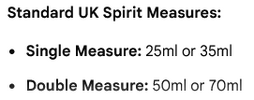
What I remember is a measure is 1/6th of a gill in England and Wales, and 1/5th of a gill in Scotland. Today 1770997569247.pngBeer and cider seem to be still imperal. 1770997771615.pngI have never bought a 1/3 of a pint of beer, I have when drinking beer on the train told them not to fill the glass, as the push-pull train was shaking quite a bit, and if full I would just spill it. Not a corridor train, but Tan-y-llyn it was passed through the windows at end of carriages, and W&LLR it was passed veranda to veranda. I remember it was cheap, around £2 a pint, and good stuff, but it was only open to volunteers of the North Wales narrow gauge railways, so think no profit was made.


 

If you need to find a tradesperson to get your job done, please try our local search below, or if you are doing it yourself you can find suppliers local to you.

Select the supplier or trade you require, enter your location to begin your search.


Are you a trade or supplier? You can create your listing free at DIYnot Local

 
Back
Top