
- Joined
- 27 Jan 2008
- Messages
- 29,355
- Reaction score
- 3,608
- Location
- Llanfair Caereinion, Nr Welshpool
- Country

Yes, lamp is the whole fitting, bulb, wick, mantel, tube, etc. is a part inside the lamp.

Exactly - which, as I always say, is why I find it bizarre that I am today expected to ask for "a lamp to put into my (table/standard/inspection/whatever) lamp"Yes, lamp is the whole fitting, bulb, wick, mantel, tube, etc. is a part inside the lamp.

Yes, but not much, nor for very long.Radiator store heat ...
Heat losses from room will surely be the same (for given room and outside temps) regardless of whether the air in it has been heated 'directly' or via radiator, won't it?, but more likely picture windows either side of the living room, single glazed.
You were seemingly implying that your ducted hot air system 'cost a fortune to run' because it was a ducted hot air system - which, as I said, I couldn't really understand. However, if it cost a fortune to run because it was faulty (leaking) that surely has nothing to do with the tyoe of heating (a 'wet system' which was constantly 'leaking under the floor' might also cost a lot to runI will assume there was a leak under the floor, but I simply don't know.
).
Oh, what a can of worms you have opened. I have debated this a lot with my son, as to the Myson fan assisted radiator, and if moving air around is good or bad.Heat losses from room will surely be the same (for given room and outside temps) regardless of whether the air in it has been heated 'directly' or via radiator, won't it?
Since 2002 my work has been mostly controls and the majority of that has been commercial heating/cooling /ventilation etc. Having worked for/with a number of west pond engineers/consultants I think I'm safe to say the term furnace has been used by all of them where we would say boiler, also I think possibly the same for cooler Vs chiller.The ones melting metal (or glass) are called furnaces too, the ones generating steam for heating homes seem to be called boilers. At least that’s what I‘ve gathered from decades of reading US books and DIY forum posts.
I'm sure it would quickly convert to water vapour not far round the system.Yes but were they actually producing steam or merely water vapour I`m sure most folk would want to know?
Yes, potentially true. I was thinking/talking about situations in which all of the air in a room was heated to a uniform temp, in which case I can't see why it would matter whether it had been heated 'directly' or via radiators. However, if one takes steps to (as far as possible) keep heated air away from the places of greatest potential heat loss (usually windows), one can obviously change that situation. With ducted heated air one is presumably essentially stuck with all of the air being similarly heated, and the same with radiators if combined with effective fans. As you go on to say ...Oh, what a can of worms you have opened. I have debated this a lot with my son, as to the Myson fan assisted radiator, and if moving air around is good or bad. .... If I put sensors around the room, I see some massive differential in the recorded temperature ...
It's not so much a case of 'good or bad' as of 'what one wants' (in terms of uniform heating of room, or otherwise)......Run a fan and air near windows is same temperature to centre of the room, as to if this is good or bad, not sure.
Yes, I remember such times well, but it didn't impact significantly on me in terms of heating (or cooking - and we also had torches and candles!), since at that time I didn't have 'central heating' of any sort!It was 1978 our winter of discontent, so the electric was turned off I am sure you remember, and the central heating can't run without the fans, so the house got very cold. And no other form of heating.

Almost the same - we did have solid fuel central heating and a back boiler in the fire feeding the immersion heater , so the fire was coal like in the main room and the cylinder in the bathroom aove got hot so the bathroom warmed up a bit and there was a little heating in the radiators but with no pump running it relied on gravity only so quite small and a very long time to get warmer from cold but slightly better than nothing I think.Yes, I remember such times well, but it didn't impact significantly on me in terms of heating (or cooking - and we also had torches and candles!), since at that time I didn't have 'central heating' of any so
That is also now questionable. We were shownalthough the radiators could theoretically be positioned as far as possible from windows etc, in practice by far the most common location is actually 'under the window'!
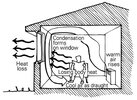
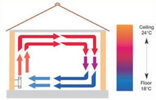 as how the radiators worked, but this was before double glazing. Under the window is often good for furniture placement, often a problem with curtains wrong side of radiator, but it also means the thermostat is against a cold wall, which is OK once the thermals have established themselves, but until that point the thermostat is at a lower temperature to the room in general.
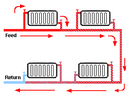 had the input to the radiator at the top and output at the bottom, this assists thermal flow, but places the TRV where it is directly heated by the radiator, to one side at the bottom is likely the best place to sample the whole rooms' temperature.
It may be 'questionable' but 'under the window' remains by far the most common location for radiators. Indeed, given that the only sensible location for radiators is around the periphery of a room, even with double (or triple) glazing, I imagine that the window is likely to still be colder than any of the other walls, isn't it?That is also now questionable. We were shown <images> as how the radiators worked, but this was before double glazing. Under the window is often good for furniture placement, often a problem with curtains wrong side of radiator, ....
True, but that is likely to result in more rapid heating up' of the room, isn't it?but it also means the thermostat is against a cold wall, which is OK once the thermals have established themselves, but until that point the thermostat is at a lower temperature to the room in general.
The TRV does not have to be at the 'input' side of the radiator. One can have the input to the top of the radiator and the TRV at the bottom.The old system had the input to the radiator at the top and output at the bottom, this assists thermal flow, but places the TRV where it is directly heated by the radiator, to one side at the bottom is likely the best place to sample the whole rooms' temperature.
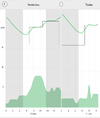 however, the point is, still at 17°C when it turned back on again at 9 am, so unlikely to have any problem due to hysteresis, but with my first house, having the heating off for 3 hours caused a massive temperature drop.
Maybe, but I made the point because a lot of people seem to think (wrongly) that TRV has to be on input, or wven that both input and output have to be at the bottom (since that seems to have become the norm, domestically).The whole input, output, top, bottom is an unanswered question, I found harder to trim the lock shield valve when the TRV is on the output, tended to over shoot more. But have found what really happens, is not the same as what we think will happen.
Yes I discovered something unexpected initially - as a humble Electrician working with plumbing/heating bods one job where once again I was asked to wire in the controls , this particular one was for our local Clown Hall, a rather big building so had some features that were not as simple as you find in a simple domestic system.Maybe, but I made the point because a lot of people seem to think (wrongly) that TRV has to be on input, or wven that both input and output have to be at the bottom (since that seems to have become the norm, domestically).
Sensors on pipes are obviously a different kettle of fish from TRVs. The latter are just sensing the surrounding ambient temp, so it doesn't matter whether they are installed on the input or output side of a radiator. Those sensing pipe temp will obviously only achieve something if sensing the temp on the return pipes - indeed, were they on the 'outgoing' pipes, they would presumably prevent the system ever working, since they would always be seeing a very high temp?Yes I discovered something unexpected initially .... Sensors on the pipework to direct the hot water for heating to run thru certain pipes but not others , about 5 distinct zones, it initially surprised me that the sensors were all placed on the returning leg from each zone rather than the outgoing leg as I had had initially guessed, I did have to have a little think as to why before it all clicked in my mind.
 either with or without local HMI, (Human Machine Interface) so would not matter where on the radiator the TRV is mounted, as it is monitoring the room temperature elsewhere.
What do you mean by that?@JohnW2 you make some good points, but we also need to realise not all TRVs are equal, some have the lock shield built into the TRV
They would presumably be 'new-fangled' ones!...some sense water and air, to compensate for how hot the radiator is.
TRVs obviously existed, and were very widely used, long long before anyone had heard of modulating boilers.The TRV is designed for modulating boilers, ...
What do you mean by "... will allow a constant supply of water but increase or reduce this supply to suit the room" - 'constant', 'increase' and 'decrease', between them seem to have covered all possibilities.... so they will allow a constant supply of water but increase or reduce this supply to suit the room, so the return water is as cool as possible,
Where are these thermostats located? What aspect of their 'flavour' removes the need for wall thermostat(s)?Also, the thermostats themselves come in many different flavours, with my Drayton Wiser there is no need for any wall thermostat

If you need to find a tradesperson to get your job done, please try our local search below, or if you are doing it yourself you can find suppliers local to you.
Select the supplier or trade you require, enter your location to begin your search.
Are you a trade or supplier? You can create your listing free at DIYnot Local


