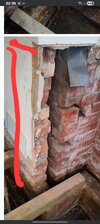
Small bay window inner leaf stud

Joined
6 Feb 2026
Messages
10
Reaction score
1
Country
United Kingdom
Hi, I need to rebuild the inner leaf of this little bay window. 1930's house with cavity walls. Previously it had a studwork inner leaf with some haphazardly placed pir boards for insulation, which I had to remove to clear debris from the cavities and around the joists. I will recreate this as it seems the simplest way to insulate this spot and retain the cavity.

How should I go about securing this to what is left of the bricks either side? The right side has unfortunately had a few layers of damp-proofers impermeable cement plaster/slurry followed by regular plaster which I don't really want to hack off as it goes all the way across a few more m of wall. The bricks behind do seem to be holding on to some moisture as well (there was a metal strap securing the previous stud work that attached under the cement which had rusted away to give an idea) so ideally I'd use something to seal the ends of those before filling in the gap to the stud. I'd also knock/grind back the rough edges of the plaster to give myself and edge to board up to.

And what about at the bottom? The joists sit at the level of the original bitumen dpc, which has cracked to pieces as the area has been fiddled with so much in the past so I'll add a new plastic one. I was thinking I could bed this on mortar, then re-lay the bricks and joists on top. As the bricks wouldn't clear the tops of the joists, I could secure some 4x2 to these with masonry screws as a sort of sole plate to which I could then attach the bottom of the studwork. I am concerned that the bond between the mortar and dpc won't really work with only one course of bricks/individual bricks above it though. Any other good options for this? Just screw the studwork directly to the joists?
IMG_20260225_163033.jpg

IMG_20260225_163048.jpg
IMG_20260225_163056.jpg
 
I thinkni understand what you are saying the way I'd do it would be cut the plaster off and remove/replace the broken bricks, cavity closer and dot and dab over the plaster cut away which would.leave you a nice surface to fasten your stud to... if you don't wat to do.that you could try put your vertical sud between the joist and damaged wall ,screw through the joist to the bottom of the stud and plug into the bricks upwards then fill the damaged bricks with motar

Re the bottom part of the stud on the I'd sister some joists where they ar short , and fasten some nogging across the joists at the ends then build your stud on these ... I wouldn't put another layer of bricks in

Regards
Jake
 

Attachments

  • Screenshot_20260228_023634_Chrome.jpg
    Screenshot_20260228_023634_Chrome.jpg
    293.7 KB · Views: 5
Personally, I'd foam on some 100mm PIR bonded plasterboard. It will do the lot, including closing off the cavity.
 
cdbe but he could end up with damp as they won’t be any gap for air circulation behind it being a outside skin wall
 
I thinkni understand what you are saying the way I'd do it would be cut the plaster off and remove/replace the broken bricks, cavity closer and dot and dab over the plaster cut away which would.leave you a nice surface to fasten your stud to... if you don't wat to do.that you could try put your vertical sud between the joist and damaged wall ,screw through the joist to the bottom of the stud and plug into the bricks upwards then fill the damaged bricks with motar

Re the bottom part of the stud on the I'd sister some joists where they ar short , and fasten some nogging across the joists at the ends then build your stud on these ... I wouldn't put another layer of bricks in

Regards
Jake
Is the DPC intact beneath those floor joists?

Make good the ragged brickwork.

Close off the cavity with proprietary cav closers and foam.

Build up to joist tops with masonry.

Lay DPC and build [ shaped stud frame on top and insulate the cavity.

Fix duplex plasterboard and shaped window board.

Skim up.
 
I thinkni understand what you are saying the way I'd do it would be cut the plaster off and remove/replace the broken bricks, cavity closer and dot and dab over the plaster cut away which would.leave you a nice surface to fasten your stud to... if you don't wat to do.that you could try put your vertical sud between the joist and damaged wall ,screw through the joist to the bottom of the stud and plug into the bricks upwards then fill the damaged bricks with motar

Re the bottom part of the stud on the I'd sister some joists where they ar short , and fasten some nogging across the joists at the ends then build your stud on these ... I wouldn't put another layer of bricks in

Regards
Jake
Thanks. The joists are quite small spans and I need to rearrange them anyway, so with the overlap I need for sistering I'd probably be better off just replacing with a proper length. They need rearranging for the vent as well, so running them along the inner skin at the sides and nogging across the back of the bay could actually be the easiest way.
 
Is the DPC intact beneath those floor joists?

Make good the ragged brickwork.

Close off the cavity with proprietary cav closers and foam.

Build up to joist tops with masonry.

Lay DPC and build [ shaped stud frame on top and insulate the cavity.

Fix duplex plasterboard and shaped window board.

Skim up.
DPC is knackered bitumen. I'd put a new one under the joists and overlap with the bitumen where it meets that. I had thought about cavity closers, but does that cavity actually need closing? If I build it up this way the cavity would run continuously around the bay so I'm not sure it needs closing. Cavity would also be continuous below the joists anyway.
 
You don't want air circulationg in the cavity. It will only serve to cool the masonry.

You are better off being more robust controlling the vapour with foil tape and duplex boards etc.
I see so your suggested use of closers would separate the bay cavity as a self contained unit from the rest of the cavity.

Yes, planning to keep vapour on the warm side of the studwork by sealing the insulation with foam and tape.
 

If you need to find a tradesperson to get your job done, please try our local search below, or if you are doing it yourself you can find suppliers local to you.

Select the supplier or trade you require, enter your location to begin your search.


Are you a trade or supplier? You can create your listing free at DIYnot Local

 
Back
Top