Looking after an SLA battery

Joined
30 Dec 2018
Messages
29,642
Reaction score
6,578
Location
Up North
Country
United Kingdom
Mobility scooter batteries in particular, plus leisure batteries...

What is the best way to get the longest working life out of them?

I have always been of the opinion, to use them, use as little of the capacity as possible then fully recharge them, and keep them fully charged. Every few weeks, if they have not been used, ensure they get a boost to a full charge. Leaving them partially charged, wrecks them. My batteries do last an awful long time..

Some say, even some claiming to be supposed experts, say use them until near flat, only then bother to recharge.
 
I think it may align to the 80 / 20 rule. Charge to 80% if being left unused for a while, discharge to 20% before recharge.

No, that is the 'rule' for lithium cells, as used in your laptop, and phone - some devices include that 80% limiter. For SLA they suggest try to limit discharge, to 50%.
 
The problem is time and over charging and under charging. If overcharged they lose water, if left even at 95% the sulphur starts to harden on the plates, and all cells will not be identical so you do every so often need a small amount of over charging to equalise the plates, but not for very long, or it will lose too much water.

So it is all down to the charger, the one I use reduces the charge in stages, and stops at 14.4 volts, the battery is then allowed to self discharge until 12.8 volts at which point it starts to charge again.

So a battery discharged to say 25% and with a mobility scooter with a range of 25 miles, looking at an 18-mile run, at 4 MPH that's 4.5 hours, and in real life that means multi-use with no charging between for example when on holiday, so it has been left discharged for a week or more, so it will cycle between 12.8 and 14.4 volts many times before fully recharged.

In the main we will not travel anywhere near 18 miles, and we will recharge within an hour of returning home, and during colvid I noted my wife Jag left on charge for many weeks, would actually charge every day at 12:30 pm for around ½ hour at 0.2 amps, so since same time every day I assume that was the time data is sent to Jaguar?

My problem is the scooter is a big lump, and the scooters own battery charger only works with the batteries the scooter. So I want to store scooter in a shed, so I have unscrewed the two batteries, and I use a cheap Lidi charger to keep them topped up. This also means if one fails, I don't lose both, which had happened, one cell went short circuit so other 11 cells were overcharged.
 
My problem is the scooter is a big lump, and the scooters own battery charger only works with the batteries the scooter. So I want to store scooter in a shed, so I have unscrewed the two batteries, and I use a cheap Lidi charger to keep them topped up. This also means if one fails, I don't lose both, which had happened, one cell went short circuit so other 11 cells were overcharged.

I only usually put mine on charge, after use. Basically I park it, straight in my workshop, which has the charger mounted on the wall, ready to plug straight in, before I even get off it. It then stays on charge, until the charger shows a green LED, then it is unplugged, after until next time it has been used, or given a boost if it has been unused for a good while. It seems to work, the 5x batteries, are good as new 12 months on.

What I'm seeing is lots of people complaining their batteries only last a few months, and people, even manufacturers, claiming that they should be run to near flat, before recharged.
 
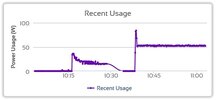
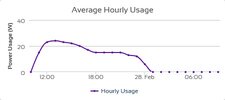
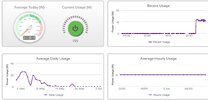
My energy monitor
1775214290737.png
will produce a graph,
Kia battery charge, 6th day pattern..jpg
this was recharging a flooded sealed lead acid, it would auto restart to charge each time battery dropped to 12.8 volts, and stop when it hit 14.4 volts, Honda battery first switch on..jpg if the battery is very low and allowed to sulphate it starts with pulses, then it goes to standard charge once recovered to some extent. The software rounds the edges so this Kia battery charge, second day..jpg showing the recharge is not really true, it does not really charge like that, it has stages. Start recharging Lindas old Jag battery.jpg There are three graphs over different time periods, only the top right is real time, but it seems all battery chargers are not the same, and some are very poor.

Two stair lifts, fathers-in-law and mothers, the fathers-in-law had a good battery charger, looking at 8 years for a pair of batteries, mothers if used a lot, batteries would last, but used infrequent, and batteries could fail after 6 months, the charger open circuit voltage was around 32 volts (for a pair of 12 volt batteries) but if used every day, then hovering around 27 volts, but if not used, it baked the batteries.

Unless you use a monitor you have no idea of the quality of the charger. With a good quality stage charger you can leave plugged in, the charger will stop and start as required, but a bad charger can overcharge the batteries.
 
Surely if you get yourself a XLR socket to match the charger you can charge them externally to the scooter.
 
The way the two batteries interconnect, one can maybe buy a connector to charge one battery, but the other battery needs some interconnection, so only real way would be to fit extra connectors to each battery. I have been considering this so can also use the batteries as an emergency supply.
 
Could you perhaps explain that statement?

I think he means the 12v batteries, are in series. My scoot has 5x 12v batteries, a nominal 60v, driving a 1Kw 3phase motor. The charger, is designed for 72v output.

The most common intelligent chargers, which Eric keeps mentioning, are designed for the more usual 12v batteries. Using one on such a series connected set of batteries, would involve direct access to each battery's terminals. Accessing my batteries, is a matter of releasing the seat, to hinge it over, which reveals a large storage 'tub' below. Unbolting the 'tub', it lifts out completely, and under it the 5x 12v interlinked batteries, motor, diff, axle, and the control units.
 
Last edited:

If you need to find a tradesperson to get your job done, please try our local search below, or if you are doing it yourself you can find suppliers local to you.

Select the supplier or trade you require, enter your location to begin your search.


Are you a trade or supplier? You can create your listing free at DIYnot Local

 
Back
Top