The differences/discrepancies, although not enormous, are far too large to be the result of any credible rounding.I would assume rounding up or down.

You are using an out of date browser. It may not display this or other websites correctly.
You should upgrade or use an alternative browser.
You should upgrade or use an alternative browser.
Has plug and play solar now been passed, I see adverts?
- Thread starter ericmark
- Start date

- Joined
- 27 Jan 2008
- Messages
- 29,240
- Reaction score
- 3,586
- Location
- Llanfair Caereinion, Nr Welshpool
- Country

It seems some info logged local, and some goes to a server in China. But close enough to what the smart meter says not to worry about it.
I have seen so many reports about a law change to allow plug and play solar, but still no one has said what law stops us using it.
I have seen so many reports about a law change to allow plug and play solar, but still no one has said what law stops us using it.
you can get any old carp from china with fake European ce [china export ]so buyer beware to do the type testing which off course they wontIt seems some info logged local, and some goes to a server in China. But close enough to what the smart meter says not to worry about it.
I have seen so many reports about a law change to allow plug and play solar, but still no one has said what law stops us using it.
where as any uk based company cant sell any product that doesnt comply with relevant standards or regulations or they become responsible for selling a non-compliant items unless they specifically state something along the lines off " not for human consumption"....."should not be connected to mains electrics" or"should only be taken under medical advice" in other words a disclaimer saying you and i know what you want to do with this product that at this stage has not been passed as suitable so the blame is fully on your shoulders and i wash my hand off responsibility by my disclaimer
now any responcible company like say lidl are more likly to care about any negativity from selling prematurely with an outright disclaimer over a simple warning " this product must not be used until the regulations change " in the near future but even that could produce way to much bad publicity iff the spec supplied became different to the final spec and not fully compliant

- Joined
- 18 Apr 2022
- Messages
- 7,168
- Reaction score
- 1,071
- Country
In my garden I have an outbuilding which is oriented basically E-W, with a pitched roof, so one face of that is pretty much south facing. 19m² and virtually unshaded. Angle is less than ideal, about 10°, but overall quite a useful space, and being single storey easy to access.
But with no export earning not much point, and battery payback time is a bit long.
But with no export earning not much point, and battery payback time is a bit long.
- Joined
- 18 Apr 2022
- Messages
- 7,168
- Reaction score
- 1,071
- Country
... fake European ce [china export ] ...
Myth.
where as any uk based company cant sell any product that doesnt comply with relevant standards or regulations
Amazon can.
Are you saying that some of the figures you're being provided with are incorrect?It seems some info logged local, and some goes to a server in China. But close enough to what the smart meter says not to worry about it.
It would presumably be fairly trivial to increase the 'panel angle' to something closer to optimum?In my garden I have an outbuilding which is oriented basically E-W, with a pitched roof, so one face of that is pretty much south facing. 19m² and virtually unshaded. Angle is less than ideal, about 10°, but overall quite a useful space, and being single storey easy to access.
That presumably depends upon the amount of one's demand during the hours of daylight, particularly in Summer. If demand were large enough to exceed a modest amount of PV generation, then there would be nothing to export. One would, of course (as with everything to do with such technologies) wait quite a long time before one got to the financial break-even point but, ultimately, if one was still alive and the equipment still working, one would thereafter enjoy an increasingly low price for the electricity one had generated and used.But with no export earning not much point
True.... and battery payback time is a bit long.
- Joined
- 27 Jan 2008
- Messages
- 29,240
- Reaction score
- 3,586
- Location
- Llanfair Caereinion, Nr Welshpool
- Country
My slopping roof is east and west, and when the installers came, they first said some panels on each roof, this would increase the time I get solar for, but decrease the peak output, but it seems they ran it through their computer, and it said west only would be better. And to be frank they were correct, the off-peak is not even spread either side of midnight, but is all in the morning, so does not stop until 05:30, and by 6:30 I am today getting solar, OK only 70 watt, but the battery still at 92% charged, so don't need much for solar, by 07:30 getting 200 watt, so battery no longer discharging any great amount, so the state of charge steady at 87% yesterday by 10:10 battery back at 100%.In my garden I have an outbuilding which is oriented basically E-W, with a pitched roof, so one face of that is pretty much south facing. 19m² and virtually unshaded. Angle is less than ideal, about 10°, but overall quite a useful space, and being single storey easy to access.
But with no export earning not much point, and battery payback time is a bit long.
It is the evening where we need the production, 19:30 start to see the battery discharging again, I use around 15% per hour, if not cooking, 0.94 kWh per hour, so this time of year, my 6.4 kWh battery is ample, still 61% left when off-peak time started.
Export earning yesterday was 13.1 kWh at 12p/kWh so £1.57 this is with 6 kW of panels on the roof, washing machines running so used 16.8 kWh yesterday. But it is not just the off-peak to peak time, where the battery is required, it is every time a cloud comes over, this
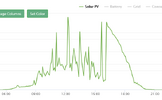 means one could not run a washing machine to run on solar without a battery filling the gaps. The trough was down to 656 watts, and this from a 6 kW array, the peak was 5.7 kW yesterday would not hold at that for long, as inverter rated at 5 kW, but to use the solar, you need one of three things. A) Less solar than homes base load. B) A battery. C) Payment for export.
The plug and play we assume no remote sensor to tell it how much the home is using. So its output has to be less than base load, it could use a battery to absorb peaks, and to maintain that base load for longer, it seems with some models you can set battery to discharge at a set rate, so if we had a base load of 200 watt, then 24 hours we are using 4.8 kWh so around 1.2 kWh of solar with around a 3 kWh battery and base load would be about zero with that arrangement, this is around the maximum size of plug and play, that a normal household could use without a large export.
But the question is still, what will the law say? If 800 watt, is that array size, amount back fed through a 13 amp plug, or the amount exported? And also will everyone get paid for export? I was 20 months trying to get paid for export, it needed a second MPAN number to be paid, but British Gas were telling me I had filled in their forms in the wrong format, which seemed mad, it was their forms I was using, so how could they be wrong format. Moved to Octopus as sorted within 2 weeks.
But there must me 1000's in the same position as I was in, exporting solar, but not getting paid for it. If the government says all will get paid for export, that would be a massive change to how much electric is costing the providers, so there would need to be some change to the tariffs, and this is the main problem with solar, EV's, and heat pumps, at the drop of a hat the government can move the goal posts.
When solar first hit the main stream we got 25 years guaranteed payment from the government, and they made a mistake and was paying far too much. Now that has ended, people taking up solar are taking a gamble.
- Joined
- 27 Jan 2008
- Messages
- 29,240
- Reaction score
- 3,586
- Location
- Llanfair Caereinion, Nr Welshpool
- Country
It seems The Electricity Safety, Quality and Continuity Regulations 2002 is reason not permitted, it says
It must be installed, and plug and play is not installed.no person shall install or operate a source of energy which may be connected in parallel with a distributor’s network unless he (d)agrees specific requirements with the distributor who owns or operates the network.
It says "install or operate" - does not 'operating' include 'plugging in'?It seems The Electricity Safety, Quality and Continuity Regulations 2002 is reason not permitted, it says It must be installed, and plug and play is not installed.
Indeed, are you really suggesting that the Regulation (law) in question could be circumnavigated simply by installing a plug/socket in the feed from local generation?
- Joined
- 27 Jan 2008
- Messages
- 29,240
- Reaction score
- 3,586
- Location
- Llanfair Caereinion, Nr Welshpool
- Country
I asked what law stops them being used on another forum, and got the answer here it seems law wise it is a civil law not statute, and is down to the agreement one signs to get a grid supply in the main.It says "install or operate" - does not 'operating' include 'plugging in'?
It seems the main problem in Germany has been the rental agreement, which often states clothes etc, should not be hung from the balcony, and also home insurance. It seems even there not as straight forward as it seems.
I looked at it in relation to my own house, and remember the problem with a swing seat on the balcony in the wind, it had to go, and look how the handrails are attached, and could envisage solar panels and handrails taking off in the wind. Once I drop to ground level, then the trees get in the way.
ESQCR is a Statutory Instrument ( SI 2002 No 2665).I asked what law stops them being used on another forum, and got the answer here it seems law wise it is a civil law not statute

There is the need to avoid solar islanding when the network supply fails or is turned OFF
If just one of the plug in balcony generators continues to feed 230 V back into the network then the network will appear to be Live. Other plug in generators on the network will see 230 V on the network and not not shut down as they should if the network has failed.
Under normal network failure the 230 V from a single balcony solar will not be able to supply all the services connected to the failed network.
In almost all cases all solar generation will see less than the nominal 230 V on the network and shut down leaving the network safe for repare crews,
In worst case where there is no load on the network then all plug in generators will see the 230 V on the nework and will not shut down.
If just one of the plug in balcony generators continues to feed 230 V back into the network then the network will appear to be Live. Other plug in generators on the network will see 230 V on the network and not not shut down as they should if the network has failed.
Under normal network failure the 230 V from a single balcony solar will not be able to supply all the services connected to the failed network.
In almost all cases all solar generation will see less than the nominal 230 V on the network and shut down leaving the network safe for repare crews,
In worst case where there is no load on the network then all plug in generators will see the 230 V on the nework and will not shut down.
I suppose that's true but, in the real-world, is it 'ever' going to happen that there are absolutely no significant loads on the entirety of a local network?There is the need to avoid solar islanding when the network supply fails or is turned OFF
........ In worst case where there is no load on the network then all plug in generators will see the 230 V on the nework and will not shut down.
- Joined
- 27 Jan 2008
- Messages
- 29,240
- Reaction score
- 3,586
- Location
- Llanfair Caereinion, Nr Welshpool
- Country
As far as I am aware, under or over voltage will cause a shut-down, and so will out of frequency range. I would have thought there is a minium time that supply must be restored to allow inverters to grid tie again, and it should not matter if solar is installed or plugged in, the disconnection/reconnection criteria should be the same.I suppose that's true but, in the real-world, is it 'ever' going to happen that there are absolutely no significant loads on the entirety of a local network?
This is just smoke and mirrors, it does not make any difference if plug and play or installed, this is the same.
But at the moment only if installed do you need to apply for G98, and clearly the DNO needs to know how much microgeneration is on their system from each step down transformer.
There is little point completing a G98 for a system that can be move home to home, and this is the whole idea of plug and play, when you move house, you can take the plug and play generator with you. So we are looking at a unit like this
As it stands the G98 is for installed equipment only. And you have so many day the submit the G98 once installed, where if not installed you could unplug and plug back in every 28 days, and reset the clock.
So I could buy a battery pack and solar panels, and use the battery to extend how long the battery lasts in the winter, and in the summer use it as a portable power supply for BBQ etc. Fix the solar panels to my wall or balcony to boost the solar production when not using it as a portable power pack. At the moment I use this
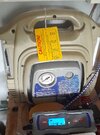 it has a 13 amp plug and a 300 watt inverter, but a 2 kW inverter would be clearly better.
If not used as a multi-tool the installed battery would be better, but the idea of multi-tool so I could take it out with me, by simply unplugging does clearly have an advantage.

DIYnot Local
Staff member
If you need to find a tradesperson to get your job done, please try our local search below, or if you are doing it yourself you can find suppliers local to you.
Select the supplier or trade you require, enter your location to begin your search.
Please select a service and enter a location to continue...
Are you a trade or supplier? You can create your listing free at DIYnot Local
Similar threads

- Replies
- 1
- Views
- 691

- Replies
- 10
- Views
- 464