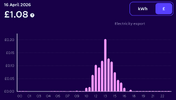
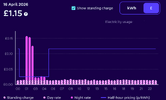
The solar software allows viewing per year, per month, or per day I have shown a whole year 2025, and in that year my production 6028.5 kWh exceeded my use 4947.9 kWh but clearly days when solar did and did not cover my use, so we have both import and export, the battery is both charged overnight, and during the day, without the battery the winter bill would be far higher, but my net bill is around zero including standing charge. What the picture does not say is the inverter is 5 kW and the panels are 6 kW. Also, the panels face WSW not to South, which works well as we gain more by the evening sun, and it is dusk to 00:30 when we are likely to run out of battery before the off-peak starts, the 05:30 to dawn we never run out of battery.
To start with the battery was too small, mainly as the max charge rate per battery is 2 kW and max discharge 3 kW so we were seeing export when battery not full, and with background use, often exceed 3 kW so doubled up, from 3.2 kWh to 6.4 kWh so now charge at 4 kW and discharge at 5 kW (inverter limit) but this when still not being paid for export was a problem also, as we were charging the batteries from the grid, and then having no room for the solar, but now I get 12p/kWh for export, and off-peak is 6.5p/kWh so it does not matter if the battery is full and I export.
My daily use is between 10–15 kWh. And I have been using my electric use to base comments on the plug and play solar. One more thing I have, is an iboost+ for domestic hot water, in hindsight an error, as off-peak is cheaper than solar, so better off heating DHW with off-peak, however the unit has been talked about in some of the discussions, as a way to stop exporting solar, but use it instead. But two problems, one is it cuts in once the export exceeds 100 watt, and when one is producing 5 kW (rare over that limit) that's far enough, but at 800 watt, once the 200 watt back-ground and 100 watt before it kicks in is taken into account that means running at 0–500 watt, which is not really going to heat a 40 gallon tank, and the second is the £300 price tag, one would never recover the installation cost, and the whole idea is plug and play and these units are hard-wired.
The main problem is we still have no idea what will be permitted, it seems you could hang 2.5 kW of panels on the balcony fed into a battery pack, which will limit to supply into the socket to 800 watt, but also allow draw from the pack direct, and the iboost+ sensor
is battery powered, and easy to connect to the incomming talls, so a unit like that would allow one to adjust the solar battery unit output to match the homes use. But at the moment the packs on the market use Shelly sensors
which are not really plug and play, and it seems unclear what the 800 watt refers to, it does seem this may be maxium export limit, not the limit through the plug and socket, so as long as some unit like the ones shown limit the export to 800 watt, one could produce more, but also it would mean you could not plug in multi-units, so the wording of the law is rather important, so as it stands nothing can go into production as we don't have a clue what will be permitted.
We saw the Blagdon out door electrics system designed to get around the Part P law, which allowed the use of prefabricated units, without notification, in England the law changed, as garden no longer a special location, so we are looking at the same with plug and play solar, some small point in how it is worded can completely change how packages need to be marketed.
It would seem the main aim is to allow the rental sector to use solar, in Germany the rental sector is far larger percentage to here, and the idea is when one moves home, you can take it with you and use in the new home, so the base unit must be plug and play, needing no access to consumer units or meters.
Nevertheless, as a homeowner, some of the devices on offer as a result, have dual-purpose uses, the idea of unplugging a power pack used to control solar and taking it with one on a picnic does seem a good idea, so in the winter it can extend the life of the existing batteries transferring more energy from off-peak to peak times, and in summer used when we go out. To some extent they already exist, just they don't put power back through the plug. But what can be produced depends on the wording of the law. So we need the law to be released ASAP if we are going to use these units to combat problems with oil and gas supply.
At the moment gas and electric are tied, this is a legacy from when we had a load of gas power stations, but even then we do extract our own gas, as well as importing it, so there are calls to remove the tie, if this happens, both gas and electric prices could change, and all the hype on plug and play solar could be for nothing.
The same goes for the standing charge, I personally would love to see it go, but that would really hurt those without micro generation, and we should pay to be connected, even if we don't use any power. The problem is we look at years to pay back investment, then the goverment moves the goal posts in a matter of months. I am crossing my fingers that my solar pays for its self before the goverment moves the goel posts again.