Has plug and play solar now been passed, I see adverts?

@morqthana link says:-
"UK wiring regulations effectively banned them without an electrician’s sign-off, but the government’s intervention changes all that." I have not seen any wiring regulations which stipulates what can be plugged in.

There may well be supply regulations which stop it, or HSE regulations, and we need to see exactly what is going to be changed, Plug and play basically points to a single item which plugs in, without any CT coils etc, at the meter. And what we want to know, is will those without the second MPAN number already, get something which allows them to be paid for export, and what will be the export limit?
 
.... Plug and play basically points to a single item which plugs in, without any CT coils etc, at the meter. ...
Probably true, but even if it did include clamping sensors onto meter tails, that's something which countless 'ordinary people' already do in the name of 'monitoring', isn't it?
And what we want to know, is will those without the second MPAN number already, get something which allows them to be paid for export, and what will be the export limit?
I suspect that it is not really 'intended' that these mini-PV thingies be used to export?
 
I suspect that it is not really 'intended' that these mini-PV thingies be used to export?

Isn't that inevitable, if the capacity exceeds the demand of the house? If I fitted one, our demand is 100 to 300w, an 800w panel, on a good sunny day would generate a surplus of 500 to 700w, where would that go, assuming no storage.
 
Isn't that inevitable, if the capacity exceeds the demand of the house? If I fitted one, our demand is 100 to 300w, an 800w panel, on a good sunny day would generate a surplus of 500 to 700w, where would that go, assuming no storage.
Well, my thinking was that the sort of things one bought from Lidl would probably rarely, if ever, produce anything like 800 W for appreciable periods in the UK and that many people's background demand is a lot more than your 100 W. Taken together, that suggested that, numerically, it was probably unlikely that there would be appreciable scope for significant export - in other words, as I wrote, they are "not really 'intended' to be used to export".

As for your "inevitable" suggestion, to respond to that in technical terms would require me to understand more than I currently do about these things. For example, do 'we' know what voltage the inverters produce?
 
if ever, produce anything like 800 W for appreciable periods in the UK and that many people's background demand is a lot more than your 100 W.

None-the-less, the times when they do produce the 800w, will be during the day, when many homes are empty, and so their base load will be at a minimum. I would suggest my 100 to 300w, is not far from normal, when a gas option is used.

As for your "inevitable" suggestion, to respond to that in technical terms would require me to understand more than I currently do about these things. For example, do 'we' know what voltage the inverters produce?

Obviously, to pick up the house load, the inverter would need to output at a slightly higher voltage than the mains voltage, otherwise it would not be contributing at all. Unless it were to somehow lead the mains sine wave slightly?
 
None-the-less, the times when they do produce the 800w, will be during the day ...
If they ever do (produce 800 W)!
If I know marketing people, a product labelled as "800 W" will just about be able to produce 800 W for a few minutes around midday GMT on the sunniest day of mid-Summer and with the panel optimally located and orientated - and probably, in practice in the real world, quite probably well under half that for most of the time. Given the international nature of the market, it's even possible that the quoted 'output' relates to Southern Europe, rather than UK :-)
... when many homes are empty, and so their base load will be at a minimum. I would suggest my 100 to 300w, is not far from normal, when a gas option is used.
There will obviously be consdierable variation between houses/households but, for what it's worth ...

... although my house is large, I don't think it's appreciably different in terms of 'electrical loads' from any 'average house'. The below graph shows one fairly typical day in mid-Summer last year for the phase which covers the standard 'living areas' (ground floor) and, as you can see, the total demand was hardly ever significantly less than 300 W. [I presume that the nocturnal burst of usage was probably a dryer (rare in Summer) and the one around midday probably a washing machine or dishwasher]. I presume that most of my 'baseline load' (most often 300-500 W) is accounted for by a couple of fridges and a couple of freezers - things which obviously would be 'running' even when the house is unoccupied.
As above, I would suspect that that 300-500 W was probably at least as much as one could, in the real world, really expect to be getting for significant periods of time from an "800 W" panel.
1776458430496.png

Obviously, to pick up the house load, the inverter would need to output at a slightly higher voltage than the mains voltage, otherwise it would not be contributing at all. Unless it were to somehow lead the mains sine wave slightly?
As I said, without understanding more about these things, I would not attempt to comment on technicalities. However, in view of the above, that may be essentially unnecessary - since, if there is rarely a significant excess of PV generation over local demand, the technicalities of ex;port become moot.
 
@JohnW2 reading match my own.
I look at my own system
1776456700326.png
and it seems multiply the size in kW by 1000 gives the kWh per annum, so 800 watt = 800 kWh per annum. So looking at £96 at 12p/kWh or £200 at 25p/kWh depending on if stopping import or exporting.

And it does seem most the adverts are working on these figures. My baseline is 200 to 500 watt, with 4 freezers running, most people can work with one freezer, so will have half that baseline, so at 800 watts we can expect half the energy to be exported.

Of course, we don't know if 800 watt, if 800 watt with 16 amp outlet looking at 650 watt with a 13 amp outlet. If 800 watt limit is because of back feed into grid, then likely be 800 watt.

So we are at the moment no idea of what will be permitted, and one assumes neither do the manufacturers, only if it matches some other country will there be a fast appearance in the centre aisle. More to the point we are already seeing sales, before we have any idea what will be permitted.
 
Could you perhaps explain the arithmetic of that?
My baseline is 200 to 500 watt, with 4 freezers running, most people can work with one freezer, so will have half that baseline, so at 800 watts we can expect half the energy to be exported.
Similar to my baseline then, and for similar reasons - as I said, I have two fridges and two freezers on that phase.
 
Could you perhaps explain the arithmetic of that?
6 kW panel produces approx 6000 kWh per year, so 1000 kWh per kW panels size, so 0.8 kWh should give around 800 kWh per year.
Similar to my baseline then, and for similar reasons - as I said, I have two fridges and two freezers on that phase.
I would say most people don't have 4 refrigeration machines running, you and me are unusual.

I could buy plug in solar, and I would get paid for export, as no one would be able to show which solar array it was coming from. But this plug in solar is not aimed at you and me, it is aimed at people who can't for what ever reason fit what we have.

And I can see many people being disappointed unless payment for export is permitted.

Theory is great, we can get units which monitor export, and once over 100 watts use it to heat the domestic hot water, but these units cost nearly £300, so in real terms not worth it for an 800 watt panel. The same applies for battery units,
1776463407267.png
cheapest only designed to be used with a 200 watt, panels. Double the size £400 and still only 400 watt of solar they are designed for camping not balcony solar.
 
Last edited:
6 kW panel produces approx 6000 kWh per year, so 1000 kWh per kW panels size, so 0.8 kWh should give around 800 kWh per year.
That's not actually what I was asking about (see below) but your figures are quite revealing, so I'll deal with that first ...

... yes, I understood that part of what you wrote. There are 8,760 hours in a year, theoretically half of which (4,380 hours) are 'daylight hours' (between sunrise and sunset). You therefore seem to be saying (based on your figures) that a "6 kW" panel in the UK produces very roughly 1,370 W during each hour of daylight - or that an "800 W" one produces very roughly 183 W during each hour of daylight ... figures that do not particularly surprise me.

Those very rough figures implicitly assume that PV generation is constant throughout the period of daylight hours (from sunrise to sunset) and also with a constant peak in both Summer and Winter, both of which are far from the case - so, at least in Summer, the reality probably is 'more Watts' than I have suggested but for a lot less than the full hours of daylight. What that might mean in terms of any 'excess generation' available for export is difficult to estimate, but I suspect that the periods of time when there was anything available for export would (with one 800W panel) be very limited (and very possibly non-existent in Winter)

However, as I said, that's not what I was asking about. Rather, I was asking about these figures you posted ...
1776474986123.png

What I was asking was what the various figures relate to, and how they relate to one another. In terms of what would seem to be the obvious interpretation, I would expect that:

Consumption = Solar Production + Battery Output + Import - Export - Battery input​

... but (Solar Production + Battery Output + Import - Export - Battery input) appears to evaluate to 5,599.9 kWh, rather than the 4,947.9 kWh 'Consumption' that it says. What am I missing?
I would say most people don't have 4 refrigeration machines running, you and me are unusual.
Agreed, but I would imagine than many houses have two such machines, in which case I imagine that their baseline demand could probably approach 300W, if not more.
But this plug in solar is not aimed at you and me, it is aimed at people who can't for what ever reason fit what we have.
You're speak only for yourself, not 'we' - I don't have, and am never likely to have, any PV.
And I can see many people being disappointed unless payment for export is permitted.
Yes, they might well be disappointed but, as above, if they have just one so-called "800 W" panel, I suspect that most of them would have very little to export.
 
1776504796197.png
The solar software allows viewing per year, per month, or per day I have shown a whole year 2025, and in that year my production 6028.5 kWh exceeded my use 4947.9 kWh but clearly days when solar did and did not cover my use, so we have both import and export, the battery is both charged overnight, and during the day, without the battery the winter bill would be far higher, but my net bill is around zero including standing charge. What the picture does not say is the inverter is 5 kW and the panels are 6 kW. Also, the panels face WSW not to South, which works well as we gain more by the evening sun, and it is dusk to 00:30 when we are likely to run out of battery before the off-peak starts, the 05:30 to dawn we never run out of battery.

To start with the battery was too small, mainly as the max charge rate per battery is 2 kW and max discharge 3 kW so we were seeing export when battery not full, and with background use, often exceed 3 kW so doubled up, from 3.2 kWh to 6.4 kWh so now charge at 4 kW and discharge at 5 kW (inverter limit) but this when still not being paid for export was a problem also, as we were charging the batteries from the grid, and then having no room for the solar, but now I get 12p/kWh for export, and off-peak is 6.5p/kWh so it does not matter if the battery is full and I export.

My daily use is between 10–15 kWh. And I have been using my electric use to base comments on the plug and play solar. One more thing I have, is an iboost+ for domestic hot water, in hindsight an error, as off-peak is cheaper than solar, so better off heating DHW with off-peak, however the unit has been talked about in some of the discussions, as a way to stop exporting solar, but use it instead. But two problems, one is it cuts in once the export exceeds 100 watt, and when one is producing 5 kW (rare over that limit) that's far enough, but at 800 watt, once the 200 watt back-ground and 100 watt before it kicks in is taken into account that means running at 0–500 watt, which is not really going to heat a 40 gallon tank, and the second is the £300 price tag, one would never recover the installation cost, and the whole idea is plug and play and these units are hard-wired.

The main problem is we still have no idea what will be permitted, it seems you could hang 2.5 kW of panels on the balcony fed into a battery pack, which will limit to supply into the socket to 800 watt, but also allow draw from the pack direct, and the iboost+ sensor
1776506969959.png
is battery powered, and easy to connect to the incomming talls, so a unit like that would allow one to adjust the solar battery unit output to match the homes use. But at the moment the packs on the market use Shelly sensors
1776507175287.png
which are not really plug and play, and it seems unclear what the 800 watt refers to, it does seem this may be maxium export limit, not the limit through the plug and socket, so as long as some unit like the ones shown limit the export to 800 watt, one could produce more, but also it would mean you could not plug in multi-units, so the wording of the law is rather important, so as it stands nothing can go into production as we don't have a clue what will be permitted.

We saw the Blagdon out door electrics system designed to get around the Part P law, which allowed the use of prefabricated units, without notification, in England the law changed, as garden no longer a special location, so we are looking at the same with plug and play solar, some small point in how it is worded can completely change how packages need to be marketed.

It would seem the main aim is to allow the rental sector to use solar, in Germany the rental sector is far larger percentage to here, and the idea is when one moves home, you can take it with you and use in the new home, so the base unit must be plug and play, needing no access to consumer units or meters.

Nevertheless, as a homeowner, some of the devices on offer as a result, have dual-purpose uses, the idea of unplugging a power pack used to control solar and taking it with one on a picnic does seem a good idea, so in the winter it can extend the life of the existing batteries transferring more energy from off-peak to peak times, and in summer used when we go out. To some extent they already exist, just they don't put power back through the plug. But what can be produced depends on the wording of the law. So we need the law to be released ASAP if we are going to use these units to combat problems with oil and gas supply.

At the moment gas and electric are tied, this is a legacy from when we had a load of gas power stations, but even then we do extract our own gas, as well as importing it, so there are calls to remove the tie, if this happens, both gas and electric prices could change, and all the hype on plug and play solar could be for nothing.

The same goes for the standing charge, I personally would love to see it go, but that would really hurt those without micro generation, and we should pay to be connected, even if we don't use any power. The problem is we look at years to pay back investment, then the goverment moves the goal posts in a matter of months. I am crossing my fingers that my solar pays for its self before the goverment moves the goel posts again.

 
My 100 to 300w, is comprised of

1 modern upright freezer
1 not quite so modern upright, fridge freezer
4x modern TV's scattered around the place, usually one on at a time, during the day.
router
3x Alexa
6x smart plugs
3x Raspberry Pi
Laptop, on most of the time; desktop rarely; plus various chargers.
4x wireless landline phone bases
All lighting is LED, except garage, workshop, hut, and summerhouse, which are fluorescent, and only turned on as needed.
1x 9.5Kw electric shower

Our largest single load, which would be on for an extended period, is a 3kw immersion heater. That is only there, to cover for boiler breakdowns, but I have recently made use of it during Octopus's free hour or two, of power.

We find the two fridge/fridge/freezers, more than adequate capacity for our needs - a couple, so I don't understand Eric, needing 4x freezers.
 
I don't understand Eric, needing 4x freezers.
Neither do I, but not brave enough to tattle my wife.
1 modern upright freezer (inverter controlled three-phase motor)
1 modern upright, fridge freezer (inverter controlled three-phase motor)
1 chest freezer
1 not quite so modern upright, fridge freezer
6 x modern TV's scattered around the place well one not plugged in.
1 x SkyQ box + 3 satellite skyQ boxes around the house.
1 x direct satellite box
8 x Google Nest mini speakers does same as your Alexa.
10 x Smart plug in socket adaptors. One is 4 way.
10 x I will guess smart bulbs and lighting strips and relay.
6 x wireless phone bases
1 x laptop
Once I move into the kitchen, two microwaves, stand-alone cooker, air frier etc, but the clocks use so little, as base load not worth talking about, two 8 kW I will guess showers, a heater for my beer brewing, battery chargers for drills and garden tools, and 2 e-bikes, but the solar software makes it easy to see back-ground use.
1776513821983.png
1776513848060.png
1776513873101.png
1776514140529.png
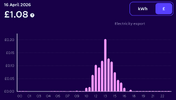
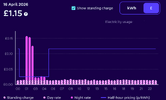
So when exporting 1732 watts, I am not really worried about back-ground use. I have a graph which when hovering a pointer over it, I can see what I was using. But this does not really help the plug and play solar panel user. He does not have a CT coil connected to software to tell him how he is doing. How does this help?1776514609827.png1776514730133.png It shows I charged my battery, and when I exported solar, but ½ hour slots are not really much help. This
1776514956881.png
shows average 258 watts for a ½ hour slot during off-peak,
1776515119062.png
if looking at cost, 0.8p big deal. For a homeowner, a battery will allow one to use off-peak 24/7 OK miss out cooker and shower, but you can with around 12 kWh of battery use all power at 6.5p/kWh not need for any solar, so we will allow for losses so call it 8p instead of 25p so a £125 monthly bill drops to £40 and also no worry about power cuts. Most power cuts are for 3 hours or less. So can save £1020 a year, with just a battery.

If you then add solar, then you can reduce it further, but a battery helps both you and the country more than the solar. Problem is it is not in the main plug and play. It needs some hard-wiring.

We can however select items like freezers and use just them off a battery, but the rub comes when looking at tariffs. An off-peak tariff means you also pay more for peak. So you need to move enough to off-peak, to be worth it. And even if the government offers some incentive, we are seeing now how they are changing their mind with EV cars. And we are looking at less 2 years payback time, with some systems more like 10 years, so while the government charge their mind with no warning we will not see many take the gamble.
 
View attachment 412959The solar software allows viewing per year, per month, or per day I have shown a whole year 2025, and in that year my production 6028.5 kWh exceeded my use 4947.9 kWh but clearly days when solar did and did not cover my use, so we have both import and export ....
Yes, I obviously understand that that's what the figures are saying, but that doesn't alter the fact that, as I illustrated, I cannot get the presented figures to 'add up'. As I asked, what am I missing?

I admit that the 'discrepancy' is not massive, but, if I were you, unless/until I could understand those figures I would be wondering how seriously I could take any of them!
 

If you need to find a tradesperson to get your job done, please try our local search below, or if you are doing it yourself you can find suppliers local to you.

Select the supplier or trade you require, enter your location to begin your search.


Are you a trade or supplier? You can create your listing free at DIYnot Local

 
Back
Top