Is it just me

My son, I was proud of, when he passed his RAE and got his amateur radio licence at 14, I am sure his teacher knew he had passed it, so one would have thought he would have been wary. However, my son comes home laughing at his teacher, who had said there were two types of transistor could anyone name them? Son answered bipolar and field effect, and was told wrong, it was PNP and NPN.

Teachers, are themselves, only taught just enough to be able to teach what they teach. They so rarely have any real, deep understanding of what they are teaching, or how things actually work. I did the RAE course, not because needed it, but to ensure I wouldn't be caught out by the exam. There were numerous points, were the lecturer was expressing wrong information, and I took him to task over, lugging a copy of the RSGB manual in, but I was wasting my time. One point he was confusing, was the working/design différance, between a 'noise blanker', and a 'noise limiter'. His information suggested they were one and the same thing.
 
The problem is often teachers have never had a job which needs their training, so any errors in the training they are unaware of, and the syllabus often changes, without them being retrained. We have allied trades, where both trades do some of the same work, the same happens with teachers, my last physics course was taught by a chemist, and in the main he had the knowledge, but he did lack some of the electrical knowledge.

But secondary school is a limited time, and there is a limit at what can be taught in the time. So I was never taught how to use a computer at school, not even a calculator, so if that is taught, something else has to be missed, some things can be dropped, how to use knotts or castles log tables for example, but I was not taught boolean logic at school.

I did need to do 'games' and got in trouble when found playing chess in the game's lesson, I was just as pedantic back then. I really could not work out why I had to learn to throw a javelin? Or how to kick a ball, or hit one with a stick, or bat, seemed a waste of time, I would never have a job needing those skills.

So most of us at 16 specialised in some subject, be it an apprenticeship, collage, university, or some other vocation, and in the main by 21 we were trained, the apprenticeship had been shortened to just 5 years, it was 7 in my dad's day, but he left school at 14, so 2 extra years in school, meant 2 less years training for one's job, with my children it was 18, so apprenticeship reduced to 3 years, and to cram in the knowledge is less time, we also spent more and more time in collage and gone was the journeyman.

Collage courses assumed one had some background knowledge, how to use log tables for example, but this background knowledge can be lacking, and when I went to University I was given an exam to find out if I had the background knowledge. And I thought knowing logs, was how to use log tables, or a slide rule, oh was my maths lacking.

But some of the bits we were taught have changed, it was red to red, yellow to yellow and blue to bits. Does not work with grey to bits. I was taught L was for live, now L is for line, and both line and neutral are live, any wonder people get confused, and red is for danger, so if you see danger you press the red button not the green! How did that happen. If for personal safety a switch or relay is yellow or red, seems good, until someone does not follow the rules, and uses a black one.

 
But secondary school is a limited time, and there is a limit at what can be taught in the time. So I was never taught how to use a computer at school, not even a calculator, so if that is taught, something else has to be missed, some things can be dropped, how to use knotts or castles log tables for example, but I was not taught boolean logic at school.

No such thing as computers, when I was at school - it was all valves, until transistors appeared. I got myself interested in electronics, after school, then when the very early computers came along, they really grabbed my interest. It cost me many thousands.

I did need to do 'games' and got in trouble when found playing chess in the game's lesson, I was just as pedantic back then. I really could not work out why I had to learn to throw a javelin? Or how to kick a ball, or hit one with a stick, or bat, seemed a waste of time, I would never have a job needing those skills.

I wasn't athletic, at all. Whilst in secondary school, at the local library, I happened across a book on chess, it caught my interest, and I began in earnest studying it. Next thing, I was teaching lots of others at school, to play. We would end up playing during the break times.
 
Teachers, are themselves, only taught just enough to be able to teach what they teach.
In general academic terms, that's not quite true. As far as I am aware, it has always been the case that teachers are expected to be 'qualified' to at least one 'level' higher than they will be teaching - i.e. that O-Level teachers had to have at least an A-Level in the subject concerned, A-Level teachers had to have at least a first degree, teachers of undergraduates had to have a 'higher degree' etc.

It's obviously a bit different with things like the RAE, since there is no direct 'higher level qualification' that could be asked for.
 
It just happened it was teacher / parent night that night. And I was told by his teacher how Mark my son when getting a question wrong in the class had just burst out laughing. I told him Mark had already told me, and all it needed was for the teacher to apologise, Mark did realise school text books may not give the full answer
If my son burst out laughing at a teacher, it would not be the teacher apologising. Do you never make a mistake? If you did, would you be happy being laughed at? It's called respect.
 
If my son burst out laughing at a teacher, it would not be the teacher apologising. Do you never make a mistake? If you did, would you be happy being laughed at? It's called respect.
I think 'it depends'.

As you say, we all make mistakes, but some are so 'funny' that it's hard to avoid 'bursting out in laughter' in response - and without intending any disrespect. Indeed, one might hope that when someone has made a 'funny' mistake, they would also burst out laughing when it was brought to their attention :-)
 
If my son burst out laughing at a teacher, it would not be the teacher apologising. Do you never make a mistake? If you did, would you be happy being laughed at? It's called respect.
Well, one of our science teachers insisted Volts = Watts * Ohms (it may have been a different error) and yes we did laugh as we'd already learnt the corner of the page paper triangles method.
 
No such thing as computers, when I was at school - it was all valves, until transistors appeared. I got myself interested in electronics, after school, then when the very early computers came along, they really grabbed my interest. It cost me many thousands.
I left school in1971 . Valves were still the King of electronics. OK we had tranny radios and the Sinclair Micromatic was a must have to some kids.
The IC were the new kids on the block.
We had a computer club after school that was with the Dep Head.
All of the logic gates were with diodes or transistor, not an IC in sight.
Exciting times at 15 and 16 years old.
The bees knees of computing or calculating was log tables/napiers bones/slide rules and ho the school had 4 of those very expensive adding machines (£40 ish each a skilled mans wage £35 a week gross a foreman got £40 wow) ) like a small version of a cash register the handle one way to add and the other way to subtract, move on one click at a time for tens hundreds etc then wind as required.
for nine times something move over one click to wind ten than back one click to subtract and that was a shortcut instead on nine winds etc etc.
The electronic calculator had not took off yet for a couple of years and the Sinclair Cambridge lead the way and prices went down from 2 or three weeks wages for a calculator.
It might surprise some that for years and years after the death of the almighty valve there was one valve survived a life in modern tech - TV transmitters carried on with valves for a number of years.

Bring back the abacus - you never know when it might prove useful.
 
I left school in1971 . Valves were still the King of electronics. OK we had tranny radios and the Sinclair Micromatic was a must have to some kids.
The IC were the new kids on the block. ... We had a computer club after school that was with the Dep Head. ... All of the logic gates were with diodes or transistor, not an IC in sight.
I left school in 1967. Valves were certainly still king, although I'd been playing with transistors for a few years by then - initially germanium 'red spot'/'white spot', later the likes of OC70/71 and even OC170/171 (for 'VHF'!) - then onto silicon ones such as BC107/8, BCy70, 2N706/8 etc.. I probably hadn't even heard or ICs at the time, and I don't think the word 'computer' had hardly ever uttered at school, let alone there being a 'computer club'!
The bees knees of computing or calculating was log tables/napiers bones/slide rules and ho the school had 4 of those very expensive adding machines (£40 ish each a skilled mans wage £35 a week gross a foreman got £40 wow) ) like a small version of a cash register the handle one way to add and the other way to subtract, move on one click at a time for tens hundreds etc then wind as required. ... for nine times something move over one click to wind ten than back one click to subtract and that was a shortcut instead on nine winds etc etc.
Even during my first couple of years at uni (1967-69) all we had were those totally mechanical 'cash register' things. I remember our being proud that, during a whole-afternoon (about 2 hours) 'practical class', we managed to calculate the standard deviation of a modest pile of numbers using such a machine!

By then, mainframe computers existed, and it was thought to be a good idea that we should be given some introduction to 'programming'. Once a week we would have an afternoon session during which we attempted to write (handwriting) code in FORTRAN on 'coding sheets'. An army of people then transferred our handwritten code onto punched cards, which would be sent by taxi to the uni's 'computing centre' down the road, and run on their mainframe. When we turned up the next week, we would each be presented with a bit of fanfold paper which, certainly for the first few weeks, usually bore a message such as "syntax error in line 3" or "divide by zero error in line 5", whereupon we wold try to correct our code and then go through the whole process again - and so on, and so on, for a number of weeks! It took most of us a whole term to end up with a small programme which actually 'worked' :-)
The electronic calculator had not took off yet for a couple of years and the Sinclair Cambridge lead the way and prices went down from 2 or three weeks wages for a calculator.
It was in 1973-75, during my first couple of years of working (my initial spell at uni lasted 6 years), that I bought my first (expensive!) 'electronic calculator (a Sinclair).
It might surprise some that for years and years after the death of the almighty valve there was one valve survived a life in modern tech - TV transmitters carried on with valves for a number of years.
... and, as we know, to this day at least one BBC transmitter is still using valve(s) in its output stage. Furthermore, amongst 'audio buffs' there seems to be resurgence of interest in (very expensive) valve amplifiers, which they believe can achieve a 'quality of sound' which cannot be achieved with solid-state electronics (which I personally find hard to believe - but it's their money :-) ).
 
I left school in1971 . Valves were still the King of electronics. OK we had tranny radios and the Sinclair Micromatic was a must have to some kids.
The IC were the new kids on the block.
We had a computer club after school that was with the Dep Head.
All of the logic gates were with diodes or transistor, not an IC in sight.
Exciting times at 15 and 16 years old.
The bees knees of computing or calculating was log tables/napiers bones/slide rules and ho the school had 4 of those very expensive adding machines (£40 ish each a skilled mans wage £35 a week gross a foreman got £40 wow) ) like a small version of a cash register the handle one way to add and the other way to subtract, move on one click at a time for tens hundreds etc then wind as required.
for nine times something move over one click to wind ten than back one click to subtract and that was a shortcut instead on nine winds etc etc.
The electronic calculator had not took off yet for a couple of years and the Sinclair Cambridge lead the way and prices went down from 2 or three weeks wages for a calculator.
It might surprise some that for years and years after the death of the almighty valve there was one valve survived a life in modern tech - TV transmitters carried on with valves for a number of years.

Bring back the abacus - you never know when it might prove useful.
Although I sympathise with your comments I'm not sure about some of your dates.
Transistors were abundant in mid 60's (I was already repairing dropped transistor radios at the age of 9 (1964),
My Phillips Electronic engineer sets were before I started senior school (1966).
Digital IC's were certainly in use at the start of the 70's, my Sinclair Cambridge was well and truly in use prior to my Sister marrying in July 1974 (it was used for various associated calculations) and the nixie tube desktop calculator which preceeded it by a number of years contained a significant selection of IC's.
The radio club I belonged to 1970-1972 had piles and piles of disused computer boards which we stripped for the components but no data was available for the unmarked IC's.
I left school in 1972 and I'd been using the schools terminal from the colleges mainframe (A donation from Elliot Brothers [later Marconi / BAE systems]) for at least 3 years.
Our school had 8 mechanical calculators you describe to suit 3 to a machine and classes of 24, including one left handed- except being a tech school we averaged 33% southpaws per class so someone got the calculations wrong :unsure:.

Valves are still going strong in all sorts of places, as you mention transmitters and some were still in use after digital switchover (I think I recall all TV TX's now solid state) however at least one radio TX is still valve - Radio 4 (ex radio 2) on 198KHz although the final official closedown date was 31st March 2026:cry:.


EDIT: I started writing this over an hour ago and didn't see Johns reply.
 
It was in 1973-75, during my first couple of years of working (my initial spell at uni lasted 6 years), that I bought my first (expensive!) 'electronic calculator (a Sinclair).

And then, was roughly when I built my first 'computer'. All I remember of it was a rather crude display, and a crude hex keypad, but a computer, you could program with instructions. What I built later in that decade, was very much more advanced, and ended up as an S100.
 
Our school had 8 mechanical calculators you describe to suit 3 to a machine and classes of 24, including one left handed- except being a tech school we averaged 33% southpaws per class so someone got the calculations wrong :unsure:.

I never got to 'play' with it, but my uni had an absolutely magnificent beast of an analogue computer, in a large, polished wood case. I'm not even sure anyone there, knew how to 'drive' it.
 
No such thing as computers, when I was at school - it was all valves, until transistors appeared. I got myself interested in electronics, after school, then when the very early computers came along, they really grabbed my interest. It cost me many thousands.

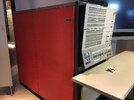
IBM 360 was introduced in 1964.

By the 1970's there were enough around to be well known.

Not in schools or homes, of course, but universities had access


IBM_System_360_model_30_profile.agr.jpg
 

If you need to find a tradesperson to get your job done, please try our local search below, or if you are doing it yourself you can find suppliers local to you.

Select the supplier or trade you require, enter your location to begin your search.


Are you a trade or supplier? You can create your listing free at DIYnot Local

 
Back
Top