
SWA across concrete footpath

Yes, you'd obviously need some sort of post to attach the catenary wire to at the fence end of the overhead run. However, I imagine that with a bit of thought, it could probably be part of a 'garden feature', and hence not too bad aesthetically!
I'm sure the mrs wouldn't complain about another 'garden feature' :)

On that train of thought, someone had mentioned to me before about putting a header over my side access gate (pictured), and I could then run the cable around that. I guess that would be very similar concept...
 
Last edited:
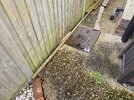
If you can clip it to the wall under the render as far as the corner it will be a lot easier to then cut a channel acoss the concrete with an angle grinder to the fence and break it out with an SDS chisel. If you are going to fix it along the base of the fence then the exit won't need to be square and the angle grinder should give a nice curve to bring the cable up. But it should not be too difficult to bury it a reasonable depth behind the shrubs.
Ok, that's interesting, thanks. to make sure I'm picturing this right, do you mean corner of the house towards the back garden? and is keeping it as low down as the render to make sure it goes under the door?

As its 16mm, its got quite wide bend radius.

Attached a pic that shows the bottom corner of the house next to the fence in question.
 

Attachments

  • 20260514_140004.jpg
    20260514_140004.jpg
    1.2 MB · Views: 18
Last edited:
Answer is in my second post (post #3). I confirmed the requirement with a sparky and also used a calculator online , both said 16mm would be safer with that length of run due to drop-off.

What’s your maximum design load and the length of the cable?
 
Yes that corner.
I meant under the render for aesthetic reasons, it won't look as obvious.
It might also be worth looking inside the inspection chamber of the drains and see if it's viable that you can simply drill a sloping hole at the end of the channel through the side of it below the frame of the lid and than clip it inside around the side of the chamber and come out again along the fencee line via another hole. To be honest I am am not sure if there are any regs preventing that but hopefully someone more knowledgable will tell you if there is.
Just a suggestion but it would save channelling as much concreteif that is difficult for you.
 
Looks like you are considering volt drop and want the highest proportion of the expensive electricity to be available at the appliances you are anticipating using. Not always the most economical method but does have its merits.
 
52m length. Consumer unit on the other end, items hanging off of it as described in post #3. The other half of the room may end up being a workshop.

Maximum design load is different to items connected to it …. Need more detail of said items really
 
So you reckon you’ll be drawing 13kW+ for extended periods?
Honestly, I was content just knowing that someone who worked in the industry said to get 16mm as a precaution for future loads. Didn't really question it and figured better to have too big a cable than too small anyway.

Appreciate the concern of me possibly overspending and having too chunky a cable now but... 10mm or 16mm, my primary question was around getting the cable across that concrete...
 
Yes that corner.
I meant under the render for aesthetic reasons, it won't look as obvious.
It might also be worth looking inside the inspection chamber of the drains and see if it's viable that you can simply drill a sloping hole at the end of the channel through the side of it below the frame of the lid and than clip it inside around the side of the chamber and come out again along the fencee line via another hole. To be honest I am am not sure if there are any regs preventing that but hopefully someone more knowledgable will tell you if there is.
Just a suggestion but it would save channelling as much concreteif that is difficult for you.
Thanks, thats an interesting idea, I'll look into that. Turns out the simple answer of channeling out a bit of the concrete is a no go, as the space is too small. I could lift the fence is guess?
 
Honestly, I was content just knowing that someone who worked in the industry said to get 16mm as a precaution for future loads. Didn't really question it and figured better to have too big a cable than too small anyway.
Other than for cost and a little more difficulty in installing it, there's never anything wrong (and at least some 'benefit') with having cables (any cables) which are 'too big', and there is always the benefit of 'future proofing' - so I don't think you should worry about those who are questioning your choice of cable size rather than trying to help with your actual question!
 
Other than for cost and a little more difficulty in installing it, there's never anything wrong (and at least some 'benefit') with having cables (any cables) which are 'too big', and there is always the benefit of 'future proofing' - so I don't think you should worry about those who are questioning your choice of cable size rather than trying to help with your actual question!
Thanks @JohnW2. Appreciate them trying to help, but like you said, the primary question that I was hoping the focus would be on
 
Last edited:
Thanks @JohnW2. Appreciate them trying to help, but like you said, the primary question what I was hoping the focus would be on


Thing is you’ve asked for help and got a variety, as is the way of random internet advice. Given you’ve stated you’ve got a spark why not ask them as they are the one who will be putting their name on the certificate

Thing is volt drop can only really be calculated if you state the maximum load you expect. Saying you are going to plug in IT and maybe add a workshop isn’t really specific enough

When I installed sub mains to out buildings I always stated the maximum design load on my quote.
 

If you need to find a tradesperson to get your job done, please try our local search below, or if you are doing it yourself you can find suppliers local to you.

Select the supplier or trade you require, enter your location to begin your search.


Are you a trade or supplier? You can create your listing free at DIYnot Local

 
Back
Top