Paint drying time?

Joined
27 Jan 2008
Messages
28,784
Reaction score
3,512
Location
Llanfair Caereinion, Nr Welshpool
Country
United Kingdom
Where I volunteer we have a load of benches for use by the general public, we would pull in the bad ones each winter and repaint, and we had experimented with plastic instead of wood, so no need to repaint, just one done to date, and it is working well, but to use plastic we have to put angle iron underneath, or it will droop over time, so it is a big job to replace with plastic.

This year we could not use the space normally used to repaint in, so we have around 3 benches needing either plastic or repainting.

Using oil based paint, some bits can remain transferable a month after painting, in general the paint is dry in a day or so, but any drips missed etc, can stay wet for a month, when we have painted wood before fitting like with a signal box refurbishing, we have found paint on our hands, two weeks after painting, so to repaint in summer, can't be sure safe to put back in use until a month after last coat.

So my thought is water based paint, which seems to dry faster, to a safe level where it will not transfer, idea is just to do the very bad benches, and over winter will start using plastic again, but the question is, why was water based paint not used before?

I know not as good preserving wood to oil based, but looking at a stop gap, not to last for years. So what is wrong with fast drying water based paint?
 
Oil based paints are so different to old formulas. Many of the chemicals VOC have been banned now.
You could add harder and driers to the paint you have as that will help greatly. Maybe try that
 
My only experience of fast drying paint is that's it's a pain in the arse, it dries so bloomin quick that if you need to over-brush an area that is beginning to dry, you can never get a good finish. Horrible stuff. That said I've only ever done paneled doors with it so perhaps if you're doing slats(?) then you can do one slat at a time from one end to the other so less need to over paint anything.

That said when you see benches painted out and about they're only taped up with wet paint notices for a day or two, then the weather/people can get back at them so is this really an issue?
 
Last edited:
I'd use the cheap HVLP from Screwfix and spray it because of the slates.
Stuff trying to coat them with a roller and brush..
With waterbased you have to be quick ISH as after 5 mins it starts to skin.
You need to get plenty on and let it settle.

Often people apply around 40 microns when you need to be around 100 microns or more thickness.
When you are shown its a wow and a lightbulb moment.
 
Well trying water based paints, two benches done, it was intended to be a stop gap. The two benches were very bad, so wanted to tart up until end of season.

No attempt made to get them spot on, just flapper disc on angle grinder to take off the worst, then quick repaint. Silk rather than gloss, but done in a day rather than 3 to 4 weeks, this was why done in winter as would be doing 4 or 5 benches together, but this winter the building we were using has been re-roofed, and so not available for painting in, so normal winter refurbishment has not been done.

So waiting to see how the water based paint lasts.
 
You can add terebene to oil based paint to speed up the curing process. That said, yeah, drips will stay soft for ages.

Waterbased paints are the path of least resistance in your case. They are however less durable.

As a general rule of thumb, drips/etc aside, waterbased fully cures in 5 days, oil based (without additives such as terebene) about a month. Curing times are however a function of the thickness of the paint, heat, and or, air flow.

@Wayners suggestion about using a cheap HVLP gun will reduce the risk of runs. You will have overspray to deal with though. HVLP- about 70% of the paint ends up on the item, 30% becomes atomised and floats around. Sounds pants, but old skool compressor paint guns had a 60-70% paint bounce back rate.

I used to use 2k paints in my turbine based HVLP. They use isocyanate based catalysts. Really bad for your lungs, but, boy do they cure quickly, approx 2 days to full hardness. Lungs aside, the overspray was dust when it landed. Spraying with oil based, the overspray is tacky for a few hours. I have little experience of spraying waterbased paint in my HVLP.

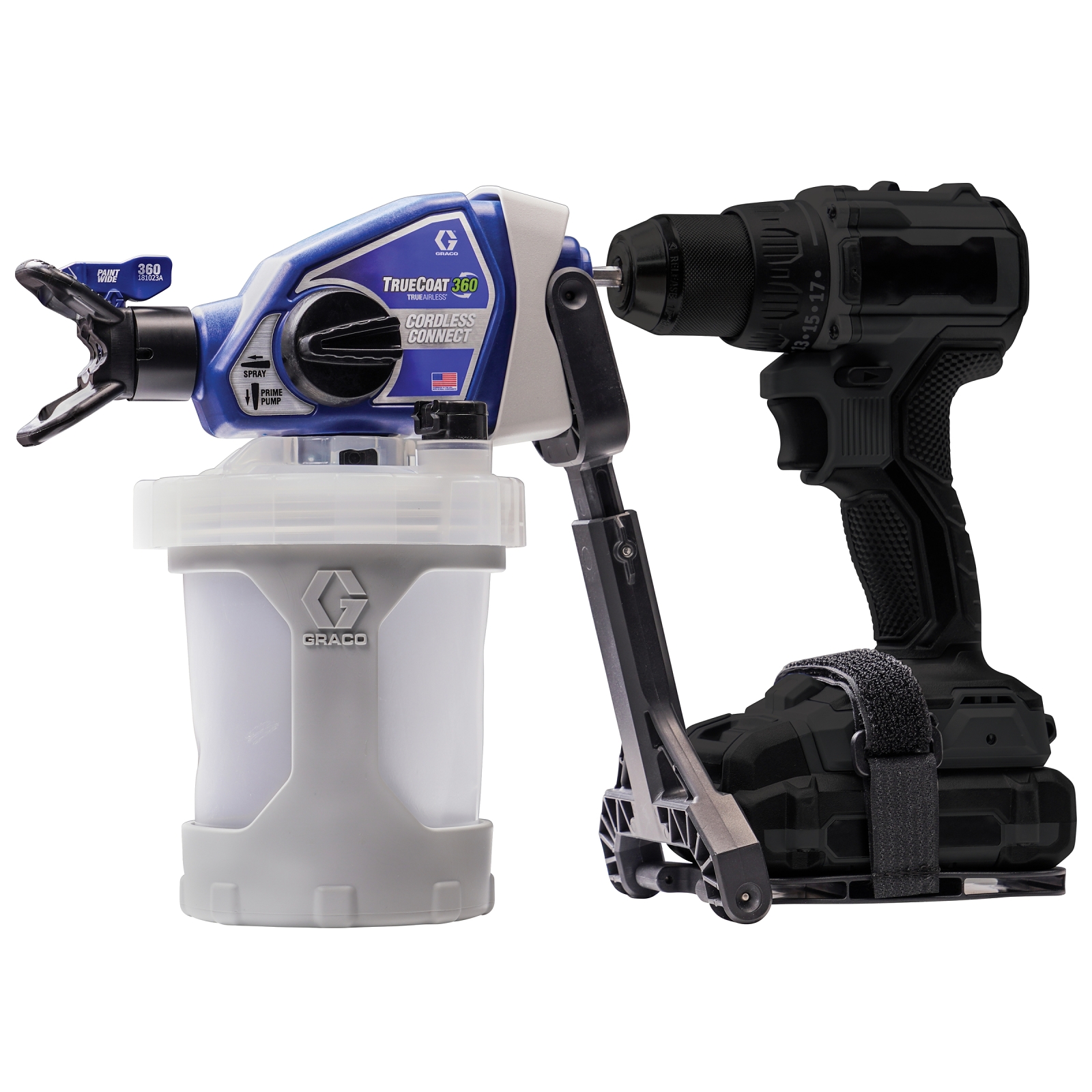
HVLP atomises the paint. An airless sprayer, I believe, has the lowest degree of airborne particles. They tend to be more expensive and you need to work faster. As an aside, I have just noticed that Graco (a reputable firm) has an airless sprayer, which bizarrely, powered by a cordless drill.


RRP is about £190, excluding the cost of the drill.
 
That spray gun looks good, it would depend on health and safety if we are allowed to use it.

I don't know if it is any good. Please research it. The company is totally legit. The battery powered (non-drill version is about £500+). At some point, I might purchase the battery version. Other airless options tend to use long hoses to supply the paint. On the upside, it makes the spraying part lighter, but then you have to clean the pipes after each use.

Health and safety- If using water based paints- I "think" a "basic" face mask might be OK. Take into account the weight of the paint gun and cup, and then factor in the weight of the drill. For occasional benches, I don't think that the weight will be to much of a chore- day in day out, it would be a horse of a different colour.

Before purchasing it, contact Graco- tell them what you want to spray (waterbased etc). I would guess that each nozzle is about £30.

It might be the case that you could try to explain that you are working for a non profit charity and that as a long standing member of this site you will recommend them. Worth a try- but you will need to contact them rather than a reseller. If someone in you group has some kind of social media following, it will help.

Best of luck
 
We have never sprayed paint in the past, because we don't have a spray booth, it has been suggested many times, back in the 70s I would have hot sprayed the paint without a bat of an eyelid, but today everyone is so safety aware.

Two weeks ago I got into trouble as I used a flapper wheel to remove old paint on the platform, this it seems, was not permitted where there was public access. In the past used a belt sander, but mine is mains powered, and the angle grinder is battery powered, so there was no need for mains leads.

But in the main bench painting is a winter job, but this winter new roof was being fitted to where we used as a workshop, and to transport the benches 8 miles to other end of the line, and use running sheds was not really what we wanted to do. We had a signal box to do, and that was taking up all our time.

Plastic to replace the wood seems the best option, but that's a big job, and the repaint was a quick one-day job. Now we much wait and see how it survives, if it does OK then likely we will use water based for more and more, if not, then likely plastic.
 

If you need to find a tradesperson to get your job done, please try our local search below, or if you are doing it yourself you can find suppliers local to you.

Select the supplier or trade you require, enter your location to begin your search.


Are you a trade or supplier? You can create your listing free at DIYnot Local

 
Back
Top