I disagree, as you said,
Some people do not agree that the world is roughly spherical.
Some people do not agree that the trails left at altitude by aircraft are just condensation from jet engine exhaust.
Some people do not agree that it was planes flying into them which caused the World Trade Center towers to collapse.
Some people do not agree that Apollo astronauts landed on the moon.
Well, I wouldn't have said that you disagreeing that they wrote nonsense was on a par with disagreeing that the world is roughly spherical, etc, but if you want to identify yourself as being on that level I can't stop you.
Absolutely and demonstrably not. Look it up, it is something completely different to what you imagine it to be.
1) Apart from in the phrase "shared upstream RCD", the spec does not contain the word "shared".
2) As I didn't redefine it, or reference any official definition, my use of the word "shared" can only be that of the everyday, dictionary meaning, and by that, two independent dwellings with one incoming DNO cable and one CU have to be sharing the supply, and the CU. Neither has, in the everyday, established, agreed, dictionary, definition of "own" (and no other definition maybe used, as the spec does not provide one) its
Instead of trying to interpret something on the basis of forcing it to mean what you want it to mean, try using normal language to read what it actually says.
My neighbour and I share the driveway between our two houses. Do we each have our own driveway? No.
If I lived in a flat in a block with communal grounds, would I have my own garden? No.
If I lived in a US-style apartment block with a shared laundry in the basement, would I have my own washer or dryer? No.
Even if you persist in trying to claim that only a looped supply counts as a shared one, neither of the dwellings in Eric's building has its own CU. It's functions are shared between the two dwellings.
"A ‘looped’ electricity supply is where two (or more) properties
share a single electricity service cable from the main network. These are typically found in older semi-detached or terraced houses. The electricity cable enters the first house, usually underground from the mains in the footpath or road outside. A second cable, the looped service, then runs from the meter in the first house to the meter in the second house."

www.enwl.co.uk
Your huge problem there is assuming that a definition can be reversed and that because the definition of "looped electricity supply" is where two (or more) properties
share a single electricity service cable from the main network", a shared supply necessarily has to be a looped one.
English does not work like that.
Eric's building has one DNO supply cable, one cutout, one meter, and one CU. All the facilities that that infrastructure provides are shared between two dwellings. Neither dwelling therefore has its
own supply cable, its
own cutout, its
own meter, or its
own CU.
[ASIDE] - I have a looped supply, so does that mean that neither I nor my neighbour may have plug-in solar? - [/ASIDE]
From the flat consumer unit, that doesn't make it an electrical supply. I have already given you a legal definition of an electrical supply, which you now choose to ignore and much up your own definitions.
I'm making up nothing. That will be you.
I'm not arguing with the definition of "supply".
I'm trying to get you to see that using the meaning that everybody understands, as in
"Do you have your
own driveway?" "Do you have your
own garden?" "Do you have your
own car?" "Do you have your
own bedroom"
neither of Eric's dwelling has its
own electricity supply and consumer unit.
I agree with what you said previously,
Now you are objecting because some words are included that don't have an official, legal meaning. I asked you what the words qualified and electrician meant but you choose not answer.
I've always objected to that where those words are used in a pre- or proscription. I chose not to answer your question because it was pointless - the answer would be to repeat that there is no official, legal, meaning of "qualified electrician". The two words cannot be separated as they are combined in a term which the idiots who wrote the spec think defines a particular class of persons.
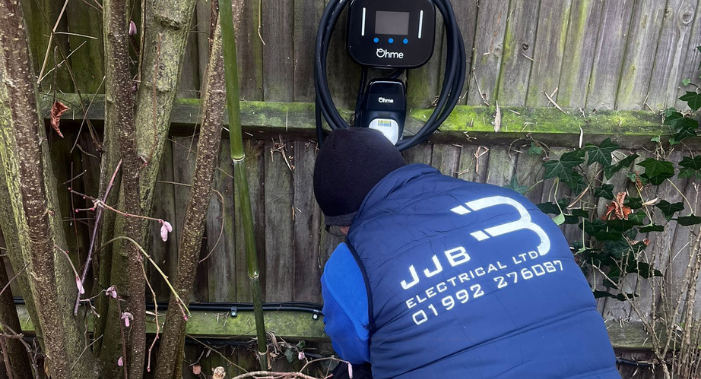
Like this competent scheme member?
Many homeowners search for the best electricians in Cheshunt and see the phrase “fully qualified” used frequently.

www.jjb-electrical.co.uk
"A fully qualified electrician understands BS7671"
"Qualified electricians know how to carry out correct electrical testing, not just basic checks."
"Fully qualified electricians are typically registered with recognised bodies and carry appropriate insurance."
"Qualified electricians are trained to find the root cause of electrical issues rather than applying temporary fixes."
"A properly qualified electrician will investigate thoroughly instead of simply resetting breakers or replacing accessories."
"Fully qualified electricians understand how to balance circuits safely and ensure systems can handle current and future use."
"If you are planning electrical work or want reassurance about your existing system, speaking to a fully qualified electrician is the safest step. "
Who also says, "Every job is certified, Part P compliant, and registered with your local authority." A scheme member plonker I'd say.
The fact that some people who are competent scheme members are plonkers does not invalidate the suggestion that there was a better way to define a particular class of persons than saying "qualified electrician".
It's an instruction on the type of things that should be included in user/installations instructions for the DIY uninformed user. There are many other examples of instructions referring to a qualified electrician. It doesn't bother me.
It really should do if it is part of an official standard.
I could say the same thing below,
You seem to be failing to spot a major difference between you and I.
I don't
WANT the spec to mean, or not mean, anything in particular, and I am reading it through the lens of "
what does what they have written mean?".
You do want it to mean something in particular and therefore you are reading it through the lens of "
how should this be interpreted in order to make it fit with what I want it to mean?".