Plug in solar

Agreed, but it is nearly what one would expect to find in a kit.
Yes, and he says he's happy with the set up as it producing what it should, so nothing wrong with the "kit". Whether it's worth it means different things to different people.
 
August was my first full month with my (illegal) kit. Generated 169kwh, exported 123kwh. Used 27% and saved £12.

We have the advantage of being home all day, so can use the washing machine / dishwasher / hoover sequentially, and I was a little surprised to only be able to use 1.5kwh a day of what was generated. Now the weather has started to turn I think we’ll use a greater percentage with the tumble dryer and eventually the lights & heating.

I reckon it’ll pay back in 2-4 year, but I appreciate I haven’t had to pay the premium for the all-in-one kit. When there are some competitively priced kits on the market I think it’ll make sense for some households.
 
It says it might not provide individual circuit protection, i.e. circuits may be grouped together and protected by one fuse. I don't see what's wrong with saying that?

Of course you don't.

And why should you? It is 100% impossible and 100% unheard of for circuits to be grouped together and protected by one MCB or RCBO - it simply cannot be done.
 
Of course you don't.

And why should you? It is 100% impossible and 100% unheard of for circuits to be grouped together and protected by one MCB or RCBO - it simply cannot be done.
Then lobby your MP or something, nothing I can do about it.
 

Except when it comes to the word "own", then you no longer agree.


So am I. The definition of household, with regard to this technical specification only, is given. You think that because it doesn't mention people it is wrong, but I don't. It doesn't matter how many people there are, it is irrelevant to plugging something in safely, so they focus on the number of electrical supplies and consumer units, to stop the possibility of overloading.

I'm not sure why you are going on about "household". I accept that in that spec they have redefined it to give it a meaning which is different to the real one. I don't know why (although I suspect it's because they started from a position of ignorance in which they thought that "household" in some way meant "property" and thought they had to tighten up on the definition), but they didn't have to. They could have used a more appropriate word.

But my big complaint is that they f'd-up the definition. They did not do it properly.
No, there is only one CU, in the flat. The flat owns it. A means of providing power to the house isn't sharing a CU. In my view.

Your view is totally flawed. And you know it is, but you have dug in, and you simply refuse to accept the truth.

If you share a bedroom with your brother, you do not have your own room.

If you go with someone else to a restaurant and you order a sharing platter, you do not have your own plate of food.

Imagine checking into a cheap / old fashioned hotel/B&B/whatever, and stipulating that you wanted a room with its own bathroom. Then on finding that you were sharing it with the occupants of the room next door you go down to reception to complain. How impressed would you be if they argued "the bathroom is in your room sir, so the fact that you are sharing it with another guest is irrelevant. Because it's in your room you do have your own bathroom."?

The concept of "own" meaning "not shared" is so widespread, so long established, that it beggars belief that you can think you can dispense with that in the context of this spec even though it is not redefined.


I am not insisting anything of the sort.

Then why do you keep insisting that "own consumer unit" doesn't mean an unshared one?


Words either have a legal meaning or, if not, a dictionary meaning, you said as much. You object to the definition of household they use,

I object to them having redefined it, as I think there was no need. I'm also as certain as I can be that they did that because they were ignorant, and I find ignorance like that unacceptable in people who are being paid to write official specifications.

Mostly though I object to the incompetence, ignorance, and illiteracy which characterise the whole document.
 
Thank-you @morqthana sometimes one feels as if you are banging ones head on a brick wall.

It would have been so easy to say one solar inverter per DNO meter, but that would also cause problems, as some multi-occupant properties the supply is split by the landlord, not the DNO.

I suppose per metered supply would work.
 
Sorry, I'm not quite sure what the issue is with that example.

Modern electrical installations typically have configurations with RCBOs providing overcurrent
and residual current protection for individual circuits, or miniature circuit breakers (MCBs) per
circuit with residual current protection provided by shared upstream RCD. These protective
devices are operated with individual switches that can be turned on and off. Modern protective
devices allow individual circuits to be identified and are required to support safe installation of
plug‑in solar devices.

Older installations use wired fuses that may not provide individual protection for each circuit.

It's positing the idea that you can have a topology of multiple "circuits" originating from a wired fuse, and that said fuse is not providing "individual protection" to each "circuit", but if you were to simply replace the wired fuse with an MCB, but leave the "circuit" wiring completely unchanged then that MCB would be providing "individual protection".

Is there some electrical engineering theory behind that?

Is there an official definition of "circuit" somewhere which means that, say, two radial cables originating at an MCB is one circuit, but the exact same two cables originating at a wired fuse is not?

This specification should be read in conjunction with:
.
.
The IET Wiring Regulations BS 7671 which sets out the national standard for electrical
installations in the UK.4

How do the IET Wiring Regulations BS 7671 define "circuit"?

Seems like a simple typo/wrong word to me, they happen unfortunately.

They do happen. Especially when careless illiterates are employed to write things.

But...
I find it highly unlikely that such a glaring error would get past all of the detailed stages of writing and proof reading for things like this.

OK - you were talking about a different error, but the generic problem is the same. Somebody wrote a sentence which would get marks docked in GCSE English, so clearly either it was not subjected to any proof reading, or it was proof-read by someone just as incompetent as the writer.
 
The spec mandates that the assembly instructions include this:

Where connection of the product requires modifications to the final circuit of the
domestic installation, this shall be clearly stated and identified as work that can only be
performed by a qualified electrician, e.g. replacement of the overcurrent protection
device of the concerned electric circuit in accordance with BS 7671 Section 551.7.2 for
the connection of a plug-in solar device;

Where can a customer go to find out the definition of "qualified electrician" so that they may be sure that whoever they engage is one?
 
suppose per metered supply would work.
What if you then fit a meter to each room, as someone was advised to do on a different, current, thread?

Could you then fit one in each room?

Laws are written by professionals in a certain way for a reason.
 
If you share a bedroom with your brother, you do not have your own room.

If you go with someone else to a restaurant and you order a sharing platter, you do not have your own plate of food.

Imagine checking into a cheap / old fashioned hotel/B&B/whatever, and stipulating that you wanted a room with its own bathroom. Then on finding that you were sharing it with the occupants of the room next door you go down to reception to complain. How impressed would you be if they argued "the bathroom is in your room sir, so the fact that you are sharing it with another guest is irrelevant. Because it's in your room you do have your own bathroom."?

The concept of "own" meaning "not shared" is so widespread, so long established, that it beggars belief that you can think you can dispense with that in the context of this spec even though it is not redefined.
You are slipping the word sharing again, but I think I see where you are going wrong.

1788331005649.png


1788331145971.png

1788331338444.png
 

Attachments

  • 1788331066243.png
    1788331066243.png
    16.9 KB · Views: 2
You can stop claiming that there is nothing wrong with what they wrote.
Then you'd still be left with the document. Complain about it to whoever can get it changed and push for an amendment. Or will getting some random person to agree with you just be enough?
 
No I own the consumer unit, inverter, solar panels, everything after the DNO meter. I could fit separate consumer unit for each ring final and in my last house I had two old Wylex fuse boxes fed from two RCDs powering the house.

But we all know the new law has selected to use words like household, in order to allow occupants multi-occupancy houses to fit solar panels even if some other occupant has already fitted one.

But it all makes no never mind, as the solar panels without batteries give half of what they produce away, but this is nothing new, many homes have had solar panels without batteries. Why anyone would do that, the only reason I can think of, is the panels were fitted for free, so any small gain is still a gain. It is very like the rent a roof schemes which at one time were so popular.

So we have to look at the home, where it is feasible to run an array of sockets around the home to power items direct off a battery pack, that must be better to plug in solar.

We all hope batteries will in the end be included, which leaves us with the cost of the inverter which are not expensive 1788339822509.pngbut will the battery systems when permitted, also have to be bought as a kit. So two years and you have got back the cost of the inverter, but if your not permitted to replace it with a battery pack, without also renewing the solar panels, that's not good.
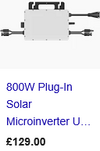
But then we get to the who will know question, and if you buy a fully legal system, then once registored with a G98, you alter it, who will know?

Be it the inverter has failed so needs replacing, or you want to increase on what you have, if there is no registored installer doing the work, then it is basic a free for all.

How many will tell the DNO when they remove a solar array? Or when it breaks? Within a couple of years, the DNO will not have a clue, likely they don't have a clue now, or there would not have been any worries with the solar eclipse, they would have known what effect it would have.

Octopus told us we could registor and if we used less during the eclipse, we could have some reward, I did not look into it, as it seemed unlikely I could use less than zero.

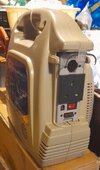
But the uncertainty of supply, points to batteries. Mine is rather old, Back-up-power.jpg and only a 300 watt output, I think a 20 Ah battery, which would run an up lighter for the night at least, the new versions can have up to around 3 kW output, and in the main fitting solar has multi benefits not just one, so the main solar array will maintain a 6.4 kWh battery, so with a power cut, my central heating continues to work.
My car uses petrol, so with a power cut it still works, and from caravaning days, I have loads of 12 volt stuff, gas hob, gas bottles etc.

Very few will have a use for plug in solar as it stands, so hardly worth talking about.

 

If you need to find a tradesperson to get your job done, please try our local search below, or if you are doing it yourself you can find suppliers local to you.

Select the supplier or trade you require, enter your location to begin your search.


Are you a trade or supplier? You can create your listing free at DIYnot Local

 
Back
Top