What “smart” heating control features do people actually use?

That sounds like a contradiction?

Not heating an empty house and not pre -warming, so returning to a cold house ?
Yeh I pop the heating on when I get in. By the time I have my coat and shoes off or whatever faff that I faff on my return then the rads are hot and job done.
The beauty of an efficient gas powered heating system.
 
Quite the opposite, I want to not be heating parts of the house that are not occupied.

How will you stop the unheated rooms from sucking the heat out of the heated rooms? This is something that people tend to forget about and then wonder why the heating is on more often than expected, the few "on" heat sources are trying to heat the whole house.
 
How will you stop the unheated rooms from sucking the heat out of the heated rooms? This is something that people tend to forget about and then wonder why the heating is on more often than expected, the few "on" heat sources are trying to heat the whole house.
I've said that on numerous occasions. Heat loss calculations are done which assume a certain heat input from neighbouring rooms, depending on their location. I'm not a fan of micromanaging things, particularly for that reason.

That is different to things like weather compensation and opentherm of course, which do help.
 
How will you stop the unheated rooms from sucking the heat out of the heated rooms? This is something that people tend to forget about and then wonder why the heating is on more often than expected, the few "on" heat sources are trying to heat the whole house.

closing the doors doesn't stop all heat loss, but it reduces it.
 
How will you stop the unheated rooms from sucking the heat out of the heated rooms?

Some people seem to imagine that having an unheated room "sucking the heat out of" a neighbouring heated room means that you'll use more energy in total than if you constantly heated all of your rooms. This is false.

To answer your question: if you have permanently unheated rooms, you can consider insulating the internal walls between them and neighbouring heated rooms. Otherwise, you just let the thermostat in the heated room do its thing and put enough heat in to balance the heat lost to both the outside and the adjacent unheated rooms (and to upstairs and into the ground).

In my case, some rooms are so far away from others, in thermal terms, that they might as well be different buildings. For example, between my office and my living room there is a metre-thick stone wall in contact with the ground, an unheated hall, and another metre-thick wall, this one with a bit of insulation. There is absolutely no doubt that heating different rooms at different times of the day is the right thing to do here.
 
Geo-fencing failed to restart early enough. But I did not intend to move to smart heating when I started, I was trying to cure a problem.

So the main room, (living room) was cold when the heating was running, so the aim was to cure this. Third house where I was controlling what was fitted. First was an open-plan house, and simple TRV upstairs and single thermostat downstairs between the two main rooms.

The move from tungsten lighting to compact fluorescent resulted in the rooms were too cool in the evening without the inferred from bulbs, so a programmable room thermostat was fitted. The fan assisted radiator helped to keep both rooms even temperature.

Moving to mothers house, which had doors, and bay window, the big problem was sun in the bay window, so the weather could entirely change the percentage of heat each room required, so Energenie TRV heads were used, the wall thermostat in the hall would only switch off the boiler on warm days, as the hall TRV would turn down first, it worked well, used the TRV read out to set the lock shield valve Heating not keeping up.jpg the current should never exceed target on a cold day, well maybe in theory, but in practice, the sun would cause living room to overheat, but nowhere near as bad as when using mechanical TRV heads. The boiler would modulate, so radiators would just remain warm, and all worked well.

This house, tried the same as worked with others, it failed, the main problem was: The hall cooled too slowly. So needed some thermostat in the main living room, but as with mothers house, sun through the windows was also a problem, so the only option was to have multi boiler activating thermostats, so went for three, a TRV in wife's bedroom, and wall thermostats in hall and living room.

Over temperature is stopped, with 10 electronic TRV heads. As to if this is "smart" control I don't know. Including the flat adds another 4 TRV's and a thermostat.

The whole idea for me, is not to heat unused rooms, or at least not as hot as rooms in use.
 
How will you stop the unheated rooms from sucking the heat out of the heated rooms? This is something that people tend to forget about and then wonder why the heating is on more often than expected, the few "on" heat sources are trying to heat the whole house.
wish i had a quid for everytime i have pointed this out to people over the years
 
Comes on at 6.00 in the morning, goes off at 10.00 at night. We turn the temp up or down as required, turn it down if we go out, turn it back up again by the phone when on our way home and don’t worry about it. Hot water on 24/7.
 
How will you stop the unheated rooms from sucking the heat out of the heated rooms? This is something that people tend to forget about and then wonder why the heating is on more often than expected, the few "on" heat sources are trying to heat the whole house.
This is true to an extent, but it is limited to what extent. I did notice with a semi-detached house, when the neighbour moved out, our heating bill went up, as party wall not well insulated.

However, setting heating to 17°C in unused rooms, and 20°C in used rooms, will unquestionably reduce heating bills.

Heat raises, so we have found, once heating is turned off, upper rooms stay warmer longer, so my bedroom above the living room stays warm longer than wife's bedroom above the dinning room which is hardly used so set to 16°C.

This leaves me with a real problem, not helped by the radiator and so TRV being against the outside wall, so the TRV is actually colder than the room in general.

The question is, how far to go? I know if I fit a wall thermostat linked to the TRV in my wife's bedroom, it will stop the boiler being turned on prematurely, but if I fit one, will it save the cost of the wall thermostat?

OK, we all know now, putting radiators on an outside wall is not best practice, but to fit linked sensors/thermostats, or move radiators is expensive, so is it worth it?

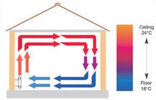
The diagram circulation.jpg looks good, but it takes no account of energy transferred room to room, it shows how the bottom of the radiator monitors temperature of return air, so the TRV is likely in the best place to monitor the whole room.
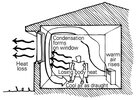
The textbook loves diagrams circulation2.jpgbut in real life, place thermometers around the room, and it quickly becomes clear, it is not that simple, we get a cool zone around the windows, if we don't circulate the air too much, specially with curtains drawn.

So the big question, was my fan assisted Myson radiator good or bad? Not a simple yes or no, as the Myson did heat the room up fast once central heating was turned on, and the heat curtains used in shop entrances clearly do work.

I think in the main it is the boiler size which messes it all up. As a child in a house with no double glazing, and fire places which allowed draft, I know any room in the house could be heated with a 4 bar electric fire. (750 watts per bar) and most rooms once warm could remain warm with one or two bars, so 1500 watts to maintain any room in the house.

The house had three up and three down, so even allowing for transfer room to room, 6 x 1.5 = 9 kW, so the big question, why was a 35 kW gas comb-boiler fitted? Even fully modulated it could not go down to 9 kW, so it was running using a mark/space ratio, i.e. turning off and on.

So it would not matter what control was used, being so grossly over sized, it would not run efficiently.

And sorry to say, many homes are the same. My house today, three floors, with a 20 kW on/off boiler, it will take 20 minutes to heat the water in the system, but no radiator is over 2 kW, so with all radiators on (15 in all) it would be unlikely to ever be able to put 20 kW of heat into the house, within 2 hours the boiler is using a mark/space ratio.

So turning off a block of 4 radiators (what we call the flat under the main house) means even with all electronic TRV's wide open, it can't sink what the boiler produces, so if I only want to heat living room, I would guess around 4 kW if both TRV heads have opened the valves wide open, plus maybe another kW on the hall and landing plus a kW on the kitchen, looking at 6 kW from a 20 kW boiler. Less once the TRV heads start to close.

And this is the real problem, a 20 kW boiler when really a 12 kW boiler would be ample, which is why, when a 6 kW heat pump is fitted instead of a 20 kW boiler it seems to be doing so well. But if a 6 kW oil boiler was fitted, it would also seem to be doing well.

So if we accept that a 3 kW electric fire will heat any single room in the house, and in the main we only use one room at a time, then any condensing boiler needs to be able to modulate down to at least 3 kW if not lower.

And unless the boiler can modulate down to 3 kW, then using 'smart' or at least electronic TRV heads, can end up making the boiler run inefficiently.

I bet most reading this could heat their house with 3 x 3kW (4 x 750 watt) electric heaters, OK would need to move room to room as required, but in essence using 9 kW to heat whole house as and when rooms are used.

My Google hunt, only found 9kW electric boilers, not a single 9 kW gas, it seems most are 20 kW or more. Same results with oil, it seems you simply can't buy small 230 volt control oil boilers, 12 and 24 volts for use in narrow boats yes, but these don't comply with regulations for a building, so can't be used in a house.

I am sure there are some, but failed to find them, so the question is, when used to produce a fraction of their rating can gas or oil boiler run in an efficient way?
 
sure there are some, but failed to find them, so the question is, when used to produce a fraction of their rating can gas or oil boiler run in an efficient way?
Yes, modulating boilers with appropriate controls do that easily.
 

If you need to find a tradesperson to get your job done, please try our local search below, or if you are doing it yourself you can find suppliers local to you.

Select the supplier or trade you require, enter your location to begin your search.


Are you a trade or supplier? You can create your listing free at DIYnot Local

 
Back
Top