
You are using an out of date browser. It may not display this or other websites correctly.
You should upgrade or use an alternative browser.
You should upgrade or use an alternative browser.
Cooker circuit.
- Thread starter DP
- Start date

Why would you want to?

Spose you could if you really want.
You would need a low current supply for the control circuit though.
Would an MK 1 gang 45A DP switch not be just as neat, and a lot less fuss?
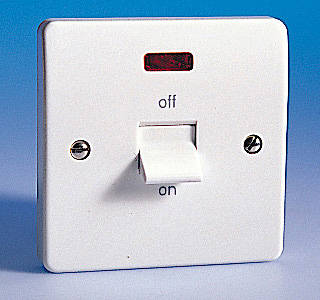
You would need a low current supply for the control circuit though.
Would an MK 1 gang 45A DP switch not be just as neat, and a lot less fuss?
How many 'not strictly corect' in-cupboard isolators have we fitted in the past say 5 years?
My answer - a few.
Not sure if I'd want to fit a 45A+ cooker isolator out of sight tho.
My answer - a few.
Not sure if I'd want to fit a 45A+ cooker isolator out of sight tho.
or put the switch in a cupboard, not strickly correct but probably alot safer than using a control circuit.
How?
Hiding a switch in a cupboard leaves you with no readily accesible point of isolation, and does not comply with BS7671.
Although it is a little unorthodox, using a contactor and control circuit does.
Thanks to all those posted.
When the kitchen cabinets are £3.5k, worktops £3.0k, appliances another £2.5k, I want things to look right.
The reason for asking about the cooker circuit mainly based on using grid switches being used and fitted within easy reach for sake of isolation and tidyness to control the final (Inaccessible) circuit that will be powering the appliance. Gridswitches will be able to power all appliances except cooker (45 amp). Contactor powered from a gridswitch lets me do that. Furthermore, gridswitches will each have printed signage indicating appliance controlled.
When the kitchen cabinets are £3.5k, worktops £3.0k, appliances another £2.5k, I want things to look right.
The reason for asking about the cooker circuit mainly based on using grid switches being used and fitted within easy reach for sake of isolation and tidyness to control the final (Inaccessible) circuit that will be powering the appliance. Gridswitches will be able to power all appliances except cooker (45 amp). Contactor powered from a gridswitch lets me do that. Furthermore, gridswitches will each have printed signage indicating appliance controlled.
Fair comment.
I have seen this type of arrangement with gridswitches and contactor for the oven and hob, and it does give a very tidy, easy to use solution.
I have seen this type of arrangement with gridswitches and contactor for the oven and hob, and it does give a very tidy, easy to use solution.
H
holmslaw
..
A contactor does not constitute and should not be used as a means of local isolation. You should use the switch shown in rf's post.
Care to explain why ??
H
holmslaw
..
Do you class a switch which operates an all poles contactor as automatic switching then?
H
holmslaw
..
BS7671 said:460-01-01 : A means shall be provided for non-automatic isolation and switching to prevent or remove hazards associated with the electrical installation or electrically powered equipmen and machines. Such means shall comply with the apropriate requirements of this chapter and of sections 476 and 537
I can't see anything in chapter 46, section 476 or section 537 which precludes the use of a contactor for this purpose. That is why I asked if you class a switch which operates an all poles contactor as automatic switching, as this is the only possible thing I can see for you to mis-interpret.
The dictionary said:au·to·mat·ic Audio Help /ˌɔtəˈmætɪk/ Pronunciation Key - Show Spelled Pronunciation[aw-tuh-mat-ik] Pronunciation Key - Show IPA Pronunciation
–adjective 1. having the capability of starting, operating, moving, etc., independently: an automatic sprinkler system; an automatic car wash.
2. Physiology. occurring independently of volition, as certain muscular actions; involuntary.
3. done unconsciously or from force of habit; mechanical: an automatic application of the brakes.
4. occurring spontaneously: automatic enthusiasm.
5. (of a firearm, pistol, etc.) utilizing the recoil or part of the force of the explosive to eject the spent cartridge shell, introduce a new cartridge, cock the arm, and fire it repeatedly.
You need to phisically operate a switch to make or break the contactor, so this is non-automatic switching.

DIYnot Local
Staff member
If you need to find a tradesperson to get your job done, please try our local search below, or if you are doing it yourself you can find suppliers local to you.
Select the supplier or trade you require, enter your location to begin your search.
Please select a service and enter a location to continue...
Are you a trade or supplier? You can create your listing free at DIYnot Local
Similar threads

- Replies
- 1
- Views
- 1K

