
Floor level 40mm high on one side of room over 4.0m Help me please!

Joined
12 Oct 2022
Messages
10
Reaction score
0
Country
United Kingdom
Hi everyone, Looking for help please .... builder left my friend in a mess.


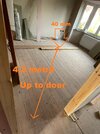
The floor is 40mm higher in one corner of the bedroom than at the door/landing. (Issue due to unlevel steels)


It gradually drops from 40mm towards the entry door/landing area.

We
can’t just raise the landing by 40mm because it would affect the stairs.

The subfloor is 18mm T&G pine,

Joists are 8x2 (3.7m length) spaced at 350mm centres.

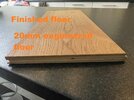
The finished floor will be 20mm engineered wood.

Thank you for any guidance! We are really stuck on solutions
 

Attachments

  • WhatsApp Image 2025-10-21 at 12.44.03.jpeg
    WhatsApp Image 2025-10-21 at 12.44.03.jpeg
    501.5 KB · Views: 47
  • WhatsApp Image 2025-10-21 at 12.44.04.jpeg
    WhatsApp Image 2025-10-21 at 12.44.04.jpeg
    509.6 KB · Views: 49
Hi everyone, Looking for help please .... builder left my friend in a mess.


The floor is 40mm higher in one corner of the bedroom than at the door/landing. (Issue due to unlevel steels)


It gradually drops from 40mm towards the entry door/landing area.

We
can’t just raise the landing by 40mm because it would affect the stairs.

The subfloor is 18mm T&G pine,

Joists are 8x2 (3.7m length) spaced at 350mm centres.

The finished floor will be 20mm engineered wood.

Thank you for any guidance! We are really stuck on solutions
Is it noticeable? Apart from aesthetics, why does it need to be level?
Skirts, pelmets, cornice and the like can deal with fitted items of joinery.
 
Lay the engineered boards in the other direction (longways) otherwise they may open up
 
Mine was out by 40mm over 5 metres and it doesn’t notice except the skirtings etc had to be scribed: that was on the builder. The lady fitting the curtain cursed a bit but managed to get the drop right.
 
Is it noticeable? Apart from aesthetics, why does it need to be level?
Skirts, pelmets, cornice and the like can deal with fitted items of joinery.
its a new build house hence trying to get it right 40mm just feels like to much of a diiference
 
It's 1 in 100. Probably somewhere around the point where it becomes noticeable.

I'd make the skirtings follow the floor rather than scribing them, which would just emphasise it.

But it's definitely not a good situation. There's no shortcut, you just have to choose whether to reconstruct the entire floor or just accept it.
 
That's the builder's problem...
Unless your friend has already paid him and he disappeared.
Didn't they realise their mistake???
 
You'll get away with 22mm chipboard on the landing without people falling down the stairs so that's a big improvement. Ask on the flooring forum for what self leveling product you'd need to do 0 to 22mm on timber.
 
You'll get away with 22mm chipboard on the landing without people falling down the stairs so that's a big improvement. Ask on the flooring forum for what self leveling product you'd need to do 0 to 22mm on timber

I wouldn't put any sort of step anywhere near stairs. There isn't a way of levelling it other than making the far end of the room lower.

I'd look into it. It may not be as terrible as you fear. Re-use the joists, screw-in hangers. Perhaps a decent carpenter should have a look if you're not into DIY.
 
I'm not suggesting a step near the stairs, I'm suggesting 22mm chipboard on the landing including the part forming the top step with a new nosing.

In theory there should be no variation in stair riser height but in practice (most common at the bottom of a staircase when a floor has been screeded) you don't notice less than a inch.

I've just redone the landing in my 1920's house (because the house has settled and the floorboards have been smashed to bits by countless plumbers and electricians and we are replacing carpet with LVT) and have improved it from 17mm over only 1.4m to about 5mm - my top step is now 12mm higher than it was (but still 5mm lower than the highest point on the landing). You don't notice it when using the stairs but the visible slope we had before (even with carpet) has now gone.

The 5mm is an acceptable compromise to avoid messing too much with the thresholds of the 3 rooms that open onto the landing.

40mm across a bedroom of that size in a modern house would not be acceptable to me.
 
Ah, I see now. That's a pretty big job, then you'll need extra height across all the rooms.

I'd start with looking at what's involved in correcting it. It may be less involved than the potential workarounds, with someone caring about what they're doing.
 
As I answered on the other forum where you asked this, if it's just the one corner that is high, you have a slope in 2 different dimensions, and your chances of fixing a click-system engineered wood-plank floor over this successfully are somewhere between zero and nil.

I've never tried, but with a glued down parquet wood floor made with individual small blocks, I suspect you can pinch quite a bit of non-flatness the same as you can with smaller wall tiles by tweaking on each joint, - but a difficult and skilled install.

If it was me, in a bedroom, I'd just choose a carpet and be done with it......
 
I see your point - there will be a twist in the surface, which planks will not bend to conform to.

Better to fix it rather than find a workaround though. I think 1 in 100 will be perceptible.

NHBC standards are 3mm per 1m, i.e. 0.3 in 100. So it's below modern newbuild standards.
 

If you need to find a tradesperson to get your job done, please try our local search below, or if you are doing it yourself you can find suppliers local to you.

Select the supplier or trade you require, enter your location to begin your search.


Are you a trade or supplier? You can create your listing free at DIYnot Local

 
Back
Top