I obviously can't disagree with that statement - but, as I said, virtually none of the general population have a meter with which they can test an RCD, so the Utopia you seem to seek is clearly totally unattainable.Nothing it’s just to confirm operation you have to test with meter before going near the button ... Otherwise you don’t know if it’s working properly

You are using an out of date browser. It may not display this or other websites correctly.
You should upgrade or use an alternative browser.
You should upgrade or use an alternative browser.
Bidirectional and data sheets.
- Thread starter ericmark
- Start date
- Joined
- 17 Mar 2011
- Messages
- 577
- Reaction score
- 170
- Country

I mostly learn from you not the other way roundI obviously can't disagree with that statement - but, as I said, virtually none of the general population have a meter with which they can test an RCD, so the Utopia you seem to seek is clearly totally unattainable.
I'm pleased and flattered to hear that.I mostly learn from you not the other way round
However, one thing to be learned is the need to be 'realistic', and that no matter what might be ideal in a perfect world, one has to consider what is (sensibly or at all) attainable in the real world!

- Joined
- 27 Jan 2008
- Messages
- 28,956
- Reaction score
- 3,543
- Location
- Llanfair Caereinion, Nr Welshpool
- Country
The whole point of testing with the test button, is to alert one if the mechanism has got glued up with dust etc, and to test with a meter will alert one if the device has stuck, better than the button, which in general sends more than 30 mA. It does not test speed or ½, full, and 5 times, with positive or negative cycle or a ramp test. Nor are we also testing the back-ground leakage. So also need the clamp-on meter as well.
Since the device can warp as the terminals are torqued up, it needs test after all cables and bus bars are terminated, so without the clamp-on you don't know what it should trip at.
But this is going a bit silly, today we are told no need to do the + and - tests, not sure why? But we don't test a MCB at all, so be it a full-blown RCD tester, a socket tester with a RCD test button, or the built-in test button, it does show likely it will work.
The MK socket the test button must have gone to earth, as pressing it on the 10 mA version would also take out the 30 mA and 100 mA RCDs feeding it. It did show the earth was present, where most the built-in buttons are line to neutral, so even with no earth they would show as OK.
But as to using the machine before using test button or the other way around it makes no never mind.
Since the device can warp as the terminals are torqued up, it needs test after all cables and bus bars are terminated, so without the clamp-on you don't know what it should trip at.
But this is going a bit silly, today we are told no need to do the + and - tests, not sure why? But we don't test a MCB at all, so be it a full-blown RCD tester, a socket tester with a RCD test button, or the built-in test button, it does show likely it will work.
The MK socket the test button must have gone to earth, as pressing it on the 10 mA version would also take out the 30 mA and 100 mA RCDs feeding it. It did show the earth was present, where most the built-in buttons are line to neutral, so even with no earth they would show as OK.
But as to using the machine before using test button or the other way around it makes no never mind.
All true - but, as I keep saying, that does not alter the fact that 99%+ (or whatever) of householders are not equipped (and/or don't have the knowledge/skill) to do anything other than 'press the test button'.The whole point of testing with the test button, is to alert one if the mechanism has got glued up with dust etc, and to test with a meter will alert one if the device has stuck, better than the button, which in general sends more than 30 mA. It does not test speed or ½, full, and 5 times, with positive or negative cycle or a ramp test. Nor are we also testing the back-ground leakage. So also need the clamp-on meter as well.

Yes - the "ordinary person" those without RCD testers etc have no way of knowing if an RCD is working to any extent.withinI often press test buttons, and much less frequently reach for my 'proper RCD tester'
A simple test button performs a simple function, it tests that the RCD will trip (or not trip) under some condition.
It will not tell us if it trips within the correct time or at the correct currents but it purely tells us it trips today at some current therefore it can be our first rough indication against it never working at all.
The other benefit it can have is to give the switch components therin a wipe therefore aiding in avoiding or reducing the amount of "stiction" , a sort of cleaning type of action.
I always recommend the test button is pressed at least quarterly, I do find that most folk never test at all or never test at all after the first 12 months.
Not totally true.Q
Test with meter first
You can’t confirm correct operation after pressing button
Once you`ve pressed the button and it trips (in time unkown) then you have probably reduced "sticton" wheras if you test with the meter first then your first test might reflect fairly accurately how it perform if actual fault causes that trip.
But once you have tripped it you have wiped it so probably improved performance for the remaining tests.
4 tests should trip it are rated current +ve and rated current-ve and x5 rated current +ve and x5 rated current -ve, you might also ramp test at both +ve and -ve so add another two tripping tests to the tally - that`s if intended for personal protection.
You`d also test both +ve and -ve at half rated current and get no trips!
- Joined
- 17 Mar 2011
- Messages
- 577
- Reaction score
- 170
- Country
Hmm that makes no sense to me
My understanding was that you don’t press any text buttons prior to testing with rcd tester
The tester shows how rcd will operate under fault conditions “as is” without prior freeing it up
My understanding was that you don’t press any text buttons prior to testing with rcd tester
The tester shows how rcd will operate under fault conditions “as is” without prior freeing it up
Last edited:
- Joined
- 27 Jan 2008
- Messages
- 28,956
- Reaction score
- 3,543
- Location
- Llanfair Caereinion, Nr Welshpool
- Country
I know the test procedure has changed, there was it seems a problem with some special RCDs when tested as we were originally taught. I will hold up my hand and admit I have not got a copy of the latest guidelines, but they are guidelines, and some skill is required when working out how to test RCDs as in the main they are in circuit when tested, to touch the terminal screws, means it needs retesting after, and it is rare there is an isolator after the RCD, So working out the order of testing, the ½ test, I suppose should be after the RCD has tripped once, but testing at full rating either the + or the - will be done after it has tripped once, so it makes no sense to require the tester to be used first.Hmm that makes no sense to me
My under was that you don’t press any text buttons prior to testing with rcd tester
The tester shows how it will operate under fault conditions “as is” without prior freeing it up
In the main, I use the RCD tester because a RCD has been tripping, so I want to know if it is oversensitive, so the ramp test, and the clamp-on tell me if oversensitive or if a high back-ground leakage, and I can't understand why the EICR, Minor Works, and installation certificates do not record the back-ground leakage? Yes we know with a 30 mA RCD this should be 9 mA or less (30%) but seeing a rise would alert one to a fault, rather than it being normal.
I know the whole supply with nothing running, but items left plugged in with my own house is around 8 mA.
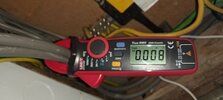 So I can see if there is something causing a problem, as I have a base line to work off. As it stands only 2 of the 14 RCBOs are double pole switching, so turning them off does not test the neutrals, but normally even with single pole switching you will see the back-ground leakage drop, so showing which circuit has a likely fault developing.
But the ramp test also helps
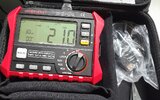 to work out what the real value is, one needs to add the clamp-on reading, but clamp-on was for all circuits getting the clamp around a single circuit means taking the cover off the consumer unit, the RCD test at 30 mA will tell you tripping time, but it does not show it will trip at 30 mA, with a background leakage of 9 mA it will only show it will trip at 39 mA.
But does it matter? If it fails to trip at ½ and trips at full, on 30 mA setting, then we know it will trip at between 30 and 45 mA if clamp-on not used.
I think on ramp test, my RCD tester uses 3 mA stages, I have seen 21, 24, and 27 mA but not any valve between them. But in the main we want the RCD to trip before we touch any live part, not within 40 mS after touching the live part, so being spot on 30 mA does not really matter.
We do the tests, but look at a schedule of test results, and we see 30 mA, what is the point of that? It may as well be a tick.
Indeed - but, as I keep saying, one has to realise and accept that your "ordinary persons" actually equates to 'virtually everyone' - even including those who would have the knowledge/skill to use an RCD tester but don't have one.Yes - the "ordinary person" those without RCD testers etc have no way of knowing if an RCD is working to any extent.
Well, it depends on what one want to 'test'.Hmm that makes no sense to me ...
That would make sense if one wanted to determine (accurately, with a meter) how the device would perform IF the test button were never pressed. However, if it is a household in which the buttons are regularly pressed then it can be argued that what one wants to determine ('accurately') how the device performs given that 'normal' real-world situation' (for the household concerned).My understanding was that you don’t press any text buttons prior to testing with rcd tester ... The tester shows how rcd will operate under fault conditions “as is” without prior freeing it up
Maybe you are thinking of a situation in which one pressed the test button immediately before planned testing with a meter, which would make little sense. The much more likely scenario is (as per my practice) to 'press the buttons'roughly every 3 months but then, once per year (or 5 years or whatever) undertaking a 'proper test' instead of the scheduled button press. The test with the meter then reflects the 'worst case' (3 months after last button press) of the real-world situation.
Pressing lots of buttons every 3 (or 6, 12 or whatever) months is not very arduous. Testing sockets circuits (and perhaps lighting ones) with a meter (if one has one) is also pretty straightforward and quick. However, the testing of devices protecting 'hard-wired' circuits (cookers, showers, immersions, boilers, alarms etc.) is less straightforward, more time-consuming and even less 'safe' - so to do that every 3 (or whatever) months would not necessary be regarded as realistic.
- Joined
- 27 Jan 2008
- Messages
- 28,956
- Reaction score
- 3,543
- Location
- Llanfair Caereinion, Nr Welshpool
- Country
It is the Sky app stopping working as when the router rebooted it assigned it a different number, and the microwave and cooker clocks needing resetting, and bulbs auto switching one when power returns.Pressing lots of buttons every 3 (or 6, 12 or whatever) months is not very arduous.
I hate turning the power off, as so many things can mess up when you do, so if the power needs to go off for some other reason, then I will turn it off by pressing test button so doing a RCD test at the same time. But pressing button just to test it, no thank you, too much hassle after turning it back on again.
Yes, it's a nuisance, but if one is going to 'test' RCDs by any method, it is unfortunately an inevitability we have to live with.It is the Sky app stopping working as when the router rebooted it assigned it a different number, and the microwave and cooker clocks needing resetting, and bulbs auto switching one when power returns.
Despite the 'nuisance value', I do try to remember to 'press the buttons' at least once or twice per year, not so much to 'test' but, rather, 'to exercise', hopefully reducing the risk of 'stiction' and hence increasing the chances of the device functioing as desired if/when it ever has to 'in anger'.I hate turning the power off, as so many things can mess up when you do, so if the power needs to go off for some other reason, then I will turn it off by pressing test button so doing a RCD test at the same time. But pressing button just to test it, no thank you, too much hassle after turning it back on again.
I`ll go along with that, but I would prefer everyone to press test every 3 months or so, but they never do!Yes, it's a nuisance, but if one is going to 'test' RCDs by any method, it is unfortunately an inevitability we have to live with.
Despite the 'nuisance value', I do try to remember to 'press the buttons' at least once or twice per year, not so much to 'test' but, rather, 'to exercise', hopefully reducing the risk of 'stiction' and hence increasing the chances of the device functioing as desired if/when it ever has to 'in anger'.
In my mind the "Stiction" is the most important as failures are usually failure to trp within parameters rather than failure to trip at all (although sometimes they do fail completely) and I reckon "stiction" often a cause.
I was just attempting to be honestI`ll go along with that, but I would prefer everyone to press test every 3 months or so, but they never do!
 . like you, I previously wrote about 'roughly every 3 months', but in my latest post has indicated that, in reality, I often only remember do do so only once or twice per year!
Agreed. I would suspect that, other than for the 'test button issue' (combined with current flow 'in the wrong direction'), it is probably extremely rare for anything to go wrong with the electronics of an RCD - so that when they go out of spec (or even completely stop working), it's probably nearly always going to be the result of 'mechanical' issues - of which 'striction' is the most obvious, and probably the most common.In my mind the "Stiction" is the most important as failures are usually failure to trp within parameters rather than failure to trip at all (although sometimes they do fail completely) and I reckon "stiction" often a cause.
If people test an RCD and find it to be out of spec, they will probably nearly always just replace it. However, if they 'exercised' it a bit by causing it to trip several times more, it's quite possible that that would get it back 'in spec'. That's pretty consistent with what we'd do with a 'mechanical' component that had got stiff/sticky over time - clean and/or lubricate it, and only replace it if we couldn't get it back 'to normal'?
Kind Regards, John
Agreed John, however there are those (including some very technical engineers who insisted it should have a test before deliberately freeing the switch whether by test button or manually) who insist it should be failed and replaced.
Myself I prefer to test then test again and see what shows - I used to test with (if brand new and unconnected to current using equipment) the circuit would remain connected, the reason being you are testing the RCD itself in the installation it was connected to therefore anything in the installtion itself causing effects would show up. One you connect appliances etc then they could and have skewed the results.
We were told only to test the RCD in situu bit with no outgoing circuit attached and not anything else.
I thought that my way was about as good as you could get.
On the other hand on an existing ciruit with the risk of unknown things connected I would disconnect the circuit before teting the RCD only then I would reconnect the circuit (I had already tested) and tested again and make a mental note of any difference and think "why"
Myself I prefer to test then test again and see what shows - I used to test with (if brand new and unconnected to current using equipment) the circuit would remain connected, the reason being you are testing the RCD itself in the installation it was connected to therefore anything in the installtion itself causing effects would show up. One you connect appliances etc then they could and have skewed the results.
We were told only to test the RCD in situu bit with no outgoing circuit attached and not anything else.
I thought that my way was about as good as you could get.
On the other hand on an existing ciruit with the risk of unknown things connected I would disconnect the circuit before teting the RCD only then I would reconnect the circuit (I had already tested) and tested again and make a mental note of any difference and think "why"

DIYnot Local
Staff member
If you need to find a tradesperson to get your job done, please try our local search below, or if you are doing it yourself you can find suppliers local to you.
Select the supplier or trade you require, enter your location to begin your search.
Please select a service and enter a location to continue...
Are you a trade or supplier? You can create your listing free at DIYnot Local
Similar threads

- Replies
- 26
- Views
- 455

