
New ceiling lights fitted by Electrician - questions?

Joined
15 May 2026
Messages
5
Reaction score
0
Country
United Kingdom
I was contemplating fitting new light fittings upstairs, but after research about how fiddly these new modern light fittings are, limited space to contain the connections within the light fitting to be compliant, hence not stuffing choc boxes back up the hole in the ceiling which I've read is a safety issue, so I decided to leave it to the professionals and paid a Sparky to do the work this morning!

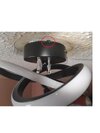
The light in our bedroom was a pain apparently, so he said to me he couldn't use the preferred Wago method and did it with choc blocks. There was only room for 3 of them within the light fitting, so he taped up the block with the 3 lives and said he'd rested them in the space where the wires comedown at the level of the plasterboard, that being 18mm thick and the 11mm choc block would mean it "fits within the fitting base, is accessible and compliant". He showed me I could see part of the yellow/green taped choc block in the small gap between the top of the light fitting and the ceiling. I took a photo (attached) after he'd popped some filler around it (less said about that the better!) and you can make it out.

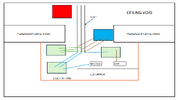
My question would be is it contained in the fitting base or in the ceiling void - I've attached a diagram hopefully to make more sense.

The red box with no wires is not part of this fitting, I'm assuming it's not compliant as it's in the ceiling void, purely for demonstration on my part if it were connected?
The other filled boxes (3x light green, 1x blue) are choc blocks for this fitting, with the 3 green and 1 blue being how this light fitting is set up, the three green ones (earth, neutral and switch) are compliant as they are within the fitting base.
The blue choc block (live) is the one in question as to whether it is housed within the fitting base and compliant?
Obviously it's not to scale, but there isn't enough room for all 4 choc blocks below the hole/plasterboard to be enclosed fully within the light fitting, mainly due to the LED driver.

So should I worry about this and get him back or am I just playing on semantics and being a ****? I'm also aware that taping around the choc box is not normal practice, but is that really an issue?
 

Attachments

  • Choc Block Diagram.png
    Choc Block Diagram.png
    24.4 KB · Views: 56
  • IMG_20260515_115159976.jpg
    IMG_20260515_115159976.jpg
    90.9 KB · Views: 52
I was contemplating fitting new light fittings upstairs, but after research about how fiddly these new modern light fittings are, limited space to contain the connections within the light fitting to be compliant, hence not stuffing choc boxes back up the hole in the ceiling which I've read is a safety issue, so I decided to leave it to the professionals and paid a Sparky to do the work this morning!

The light in our bedroom was a pain apparently, so he said to me he couldn't use the preferred Wago method and did it with choc blocks. There was only room for 3 of them within the light fitting, so he taped up the block with the 3 lives and said he'd rested them in the space where the wires comedown at the level of the plasterboard, that being 18mm thick and the 11mm choc block would mean it "fits within the fitting base, is accessible and compliant". He showed me I could see part of the yellow/green taped choc block in the small gap between the top of the light fitting and the ceiling. I took a photo (attached) after he'd popped some filler around it (less said about that the better!) and you can make it out.

My question would be is it contained in the fitting base or in the ceiling void - I've attached a diagram hopefully to make more sense.

The red box with no wires is not part of this fitting, I'm assuming it's not compliant as it's in the ceiling void, purely for demonstration on my part if it were connected?
The other filled boxes (3x light green, 1x blue) are choc blocks for this fitting, with the 3 green and 1 blue being how this light fitting is set up, the three green ones (earth, neutral and switch) are compliant as they are within the fitting base.
The blue choc block (live) is the one in question as to whether it is housed within the fitting base and compliant?
Obviously it's not to scale, but there isn't enough room for all 4 choc blocks below the hole/plasterboard to be enclosed fully within the light fitting, mainly due to the LED driver.

So should I worry about this and get him back or am I just playing on semantics and being a ****? I'm also aware that taping around the choc box is not normal practice, but is that really an issue? Cool Games
The taped choc block isn't the best practice. Personally, I'd ask the electrician if a small Wago/junction box solution could be fitted instead, for a cleaner, more future-proof install.
 
I've since queried with the Electrician and he is coming round next week to "rectify". I suggested at the time of fitting to pop a wago/choc box into the ceiling void by cutting out a bit of the ceiling (there's enough room not leave a hole exposed around the fitting) but was told it wasn't necessary - now he is saying popping a junction box into the ceiling void from the loft.
 
Wagos help if there is limited space in the light fitting, if it’s metal it will need earthing. If accessible from above consider a separate lighting junction box, wago and Hager do good ones, the latter is more spacious
 
Wagos help if there is limited space in the light fitting, if it’s metal it will need earthing. If accessible from above consider a separate lighting junction box, wago and Hager do good ones, the latter is more spacious
I have a Class 2 Fitting with no earth with the correct logo on the driver inside and that has a metal casing. I've read that earthing it isn't a great idea?
 
If the ceiling is plasterboard and space allows then if it feaseable to cut in for a dry lining box (perhaps a circular one and put the wagos in before popping the luminaire back in place)? Keeps it in a back box that is only exposed once the light fitting is removed
 
If its metal class 2 then non of the connections should be inside the base.

2 options

Junction box above and 1 flex into the crappy provided connector block thing.

Earth the metal.
 
If its metal class 2 then non of the connections should be inside the base.

2 options

Junction box above and 1 flex into the crappy provided connector block thing.

Earth the metal.
If it's a plastic Class 2 (had one of them fitted) then the connections are ok within the light fitting enclosure? The Class 2 Metal fitting is an existing fitting that was fitted 4 years ago!
 
Just to update on the Class 2 metal fitting with the wires connected by Wagos and enclosed in the fitting, long story which isn't really relevant, I had another Sparky come round this morning to do something else and when I booked him I told him I wanted that Class 2 fitting "made safe".

He had a look and said it was safe to keep all the cables in the enclosure of the fitting but he'd tape up the live Wago connections because sometimes the levers become loose! I said to him that it was good practice to have the wires out of the fitting enclosure (as per you good people) so he said he'd tape them all up and pop them into the ceiling void FFS. Pushed him on a boxed enclosure and a Wagobox appeared, he had to cut a little bit of plasterboard and five mins later, all wires concealed in the Wagobox in the ceiling void and he even filled the small gap that created.

Is it me, or do Sparky's just want to take the easy option, whether that be time or a cost of a Wagobox and an obsession with tape for permanent jobs? That's two different Sparks saying the same thing - I did say to this morning's Sparky that although the other methods may be deemed "safe" which I would question, the Wagobox solution was the "safest" and he agreed.

Yes I'm a pain in the arse, but I want jobs done properly - is that wrong?
 
I remember the good old days of no wago boxes and just insulation tape and blocks.....
 

If you need to find a tradesperson to get your job done, please try our local search below, or if you are doing it yourself you can find suppliers local to you.

Select the supplier or trade you require, enter your location to begin your search.


Are you a trade or supplier? You can create your listing free at DIYnot Local

 
Back
Top