On the Falklands the farms would only run the generator twice a day, that was enough to keep chest freezers frozen, the morning run allowed vacuum cleaning and evening run lights and radio, there was no TV.
They would have a battery to run the ham radio, which was their phone, and heating was by burning peat. No central heating.
And I think that is the main thing we would notice without electric, no way to control the heating in our homes, and if I think back, in the 50s/60s the fire in the room would heat the room far hotter than required, and we would only realise how hot, after leaving the room and returning.
So electric resulted in being able to control the home's temperature automatically. However, even today, many homes work with near enough heating. Likely the heating system is the biggest waste of energy in the home.
OK in an old peoples home, we want every room at say 20°C 24/7. But in most homes we have unused rooms, and little used rooms, and the way to reduce cost, it to only heat when required, but this does not line up with heat pumps, heating with gas, oil, or even solid fuel, the availability and cost does not change throughout the day, so at midnight we are likely maintaining the bedrooms at quite a low temperature of say 16°C all other rooms at around 5°C to stop freezing, and in real terms that means the other rooms are not heated.
In the morning, we want the bathroom warm, and it depends on the household as to if kitchen, dinning room or living room is required before we go out, then again back to 5°C, and as home time approaches, we likely need the rooms re-heating in sequence, possibly kitchen first, then dinning room, and finally living room.
However, one the rooms don't cool to 5°C even if that is the setting, and also it takes time to reheat, so likely we use 16°C instead, so it can reheat to 20°C faster, once we settle down for the night likely want room at 22°C, however to do all this, we need programmable TRV heads, and multi methods to fire the boiler.
So we look at the available controls, and the likes of EvoHome and Wiser seem ideal, however the central heating was installed in the 80s, before double glazing when for some reason I have never really got my head around, we put radiators under the window, may be as no furniture in the way?
So the TRV is cooled by the outside wall, and turns on the heating too soon, OK there is a way around this, we fit linked sensors on the inside walls, so it is controlling room temperature not the outside wall temperature, but the cost to do all this, is silly.
We know what we should do, but still control the boiler by one wall thermostat in the hall. And we still have non-programmable TRV heads, which stop the room getting to a silly heat, but the *123456 on the dial does not really relate to the heat of the room, and we still waste loads on heating, because if I take wiser as an example a programmable TRV at window and wall thermostat on opposite wall, £40 + £65 so over a £100 per room, and that does not include the hub at another £60, so this house (not flat) would cost at least £1000 just for the controls. That's more than it costs for a tank of oil, so no one is likely to do the whole house. And even if they did, in the main the boiler would be far too big to run just two radiators at a time.
Our central heating is so inefficient a heat pump can be fitted, and we are hood winked into thinking it is better, because they have fitted better controls, and also downsized it to a more appropriate size.
This house 7 rooms, and each could be heated with a 2 kW fan heater, so 14 kW maximum, so why was a 20 kW boiler fitted? It is reasonable to expect only half the house will need heating at any point in time, so the sum of radiator sizes should be at least twice the size of the boiler, but that is not the case, when fitted, in the 80s with single glazing the boiler may have been the right size, but today we waste so much because no one thought oh homes don't need half the heat to what they did in the 80s, so the boiler can be half the size.
But once fitted, that's it, it would cost too much to change my 20 kW boiler for a 15 kW, so we keep going with old outdated central heating.





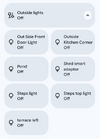 I can select which outside lights I want, or click on all, and come home to a lit drive, once inside the house, hey google turn off outside lights turns them all off again. Before I had PIR lamps which seemed to have a mind of their own, switching off at most inopportune moments, and turning on when the wind shakes the trees.


