
• Looking for a smarter way to manage your heating this winter? We’ve been testing the new Aqara Radiator Thermostat W600 to see how quiet, accurate and easy it is to use around the home. Click here read our review.

120,000 ft dive

Assuming Joe K's data to be correct ... I am not sure exceeding the speed of sound is impossible by a falling person...
Speed of a Skydiver (Terminal Velocity) This draws together some relevant stuff, note, about halfway down the page Joe K and his 0.9 times the speed of sound.... Note also skydiving velocities 'safe' at 110 mph -- Record at 320 mph... two very different 'terminal velocities'.

Falling in the atmosphere, NASA ...
"...Comparing two objects. The higher velocity occurs for greater weight, lower drag co-efficient (more streamlined), lower gas density (higher altitude), or smaller area..."

Comparing a theoretical attempt upon the 'falling man max velocity' with Joe K's achievment .. A good plan might be, to :-
Go higher than Joe's 'float' height (102,800 feet), do more to reduce his 'negligable drag'. ie head first, wearing streamlined hemet, slippery suited body, limbs in line astern...
If all that resulted in a velocity 12% greater than Joe K achieved then the the speed of sound would be exceeded.
Here's Joe K... Hardly assuming the position of least drag... (did it matter at his altitude?)
kittinger-jump1.jpg

And a little later, not much change...
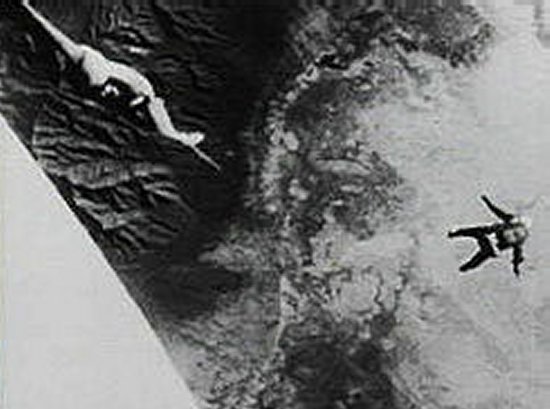
kittinger-jump2.jpg


-o-
 
Quoted from the Wiki......
:roll:

It was probably added by someone with limited knowledge like you.

I can't believe how many people on this forum routinely quote information from Wikipedia and the like ... Don't you realise it is totally unauthoritative?

If you attempt to understand the words you have so eloquently quoted from your fountain of all knowledge ...

To pass through the "sound barrier" requires no more thrust than at any other point in its acceleration, before or after.
This is true nowadays but to pass through the sound barrier does require a significant acceleration curve across the threshold i.e. BEFORE and AFTER and the ability to have a linear acceleration curve is only made possible because of the design of the aircraft.

Take a look at Concorde wing sections if you want to see what I'm talking about, it isn't an aerofoil it has a diamond cross-section and is primarily that way to streamline the shock waves during supersonic transitions and extended supersonic flight.

Aircraft with normal aerofoils which fly supersonic (primarily jet fighters) require a much higher thrust curve to break the sound barrier.

As the science of high-speed flight became more widely understood, a number of changes led to the eventual disappearance of the "sound barrier
Are you sure you've not been reading the kiddies section? This is quite clearly untrue as anyone with half a brain would realise ... Yes, advances in technology have made the threshold an inconsequential phenomenon (from the aircraft's perspective) but it is still there and always will be as it is a factor of the environment ... Ever heard a modern aircraft break the barrier WITHOUT the sonic boom?

No, neither have I

To reiterate the original point ...

As I've said, an object will not break the speed of sound under the force of gravity alone it needs propulsion to overcome the increase in drag which becomes significant the closer you get to the barrier.
The acceleration curve BEFORE and AFTER the barrier.

Amen ... Until you Wiki up some more cr*p.

MW
 
Empip: Irrespective of how high or how streamlined the terminal velocity will never exceed the speed of sound if the only propulsive force is gravity (based on current thinking).

I would never say its impossible though as things are only impossible until they're not.

MW
 
The thinking is irrelevant if it means breaking an aerodynamic law - that's why laws of science are called laws - as they will never be broken.
 
megawatt......If you going to keep using insulting language, because someone disagrees with you, then you are poorer for it.
 
There used to be a law which said that the smallest molecular unit of measure was an atom but someone managed to split it Joe :wink:

Also, back in Ohm's days everything had a measurable resistance (it is the fundamental principle of Ohm's law ... V=IR) yet we now have supercooled materials which display no resistance to the flow of electricity whatsoever (that we are capable of measuring).

And these are probably just 2 of thousands of Laws which have become redundant based on new discoveries and knowledge.

Physical laws exist because we have discovered and proven them and they will remain valid until the hypothesis from which they were derived changes i.e. they are proved otherwise.

There is no such thing as an immutible law in physics IMO and, if we truly believe this to be the case, mankind would never have moved out of the dark ages.

MW
 
megawatt......If you going to keep using insulting language, because someone disagrees with you, then you are poorer for it.
If you want me to respect anything you post ... Stop Googling meaningless facts you don't understand and never quote Wiki's at me.

Wiki's are the modern day equivalent of the Encyclopedia Britannica and have credibility only with children who wish to appear intelligent.

MW
 
Can you have a sonic boom in a rarefied atmosphere? I would have thought the bow wave wouldn't be there.
 
megawatt......If you going to keep using insulting language, because someone disagrees with you, then you are poorer for it.


MW has got grotty with me in the past as he couldn’t accept he was wrong...so he resulted to personal insults.

I guess it’s the only way to make himself feel anywhere near adequate.
 
Yes, I remember Luke ... It was when you posting nonsense ... Strange parallel don't you think.

Responding to total cr*p must bring out the ignorance in me I guess.

Joe: The speed of sound varies with altitude but the shock wave still exists ... In space would be a different story though :wink:

MW
 
Joe: The speed of sound varies with altitude but the shock wave still exists ... In space would be a different story though :wink:

MW

So if the guys falls faster due to rarefied atmosphere, then the speed of sound will be greater than in the thicker air - so the chances of him breaking it would then be negligible?
 
So if the guys falls faster due to rarefied atmosphere, then the speed of sound will be greater than in the thicker air - so the chances of him breaking it would then be negligible?

In thinner air the speed of sound will be slower.
Generally the thicker the medium, the greater the speed of sound, as in water.
 
I think I must have confused you somewhere along the way here because the speed of sound is lower at altitude not higher.

As a guide, the SOS at sea level is around 760 mph whilst at 45000 feet it is around 660 mph.
 
The important thing regarding the falling man scenario is that as the altitude decreases so does the terminal velocity whilst the speed of sound is increasing ... Gravity, however, is a constant (unless Wiki knows different) ... Okay, so now I'm just being facetious but you get the drift :lol:

Key thing ... The SOS will never be exceeded without additional thrust.

MW
 
Back
Top