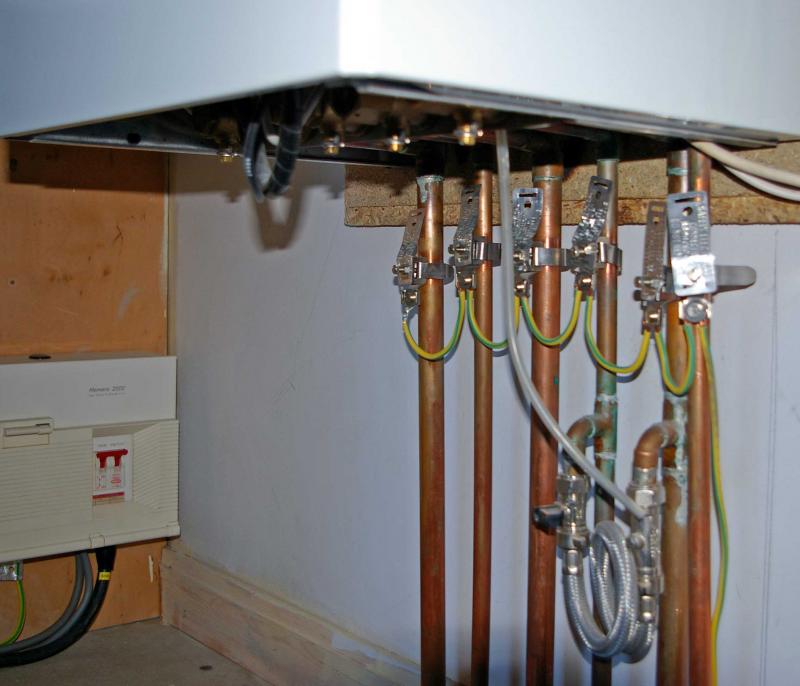
18th 544.1.2

It doesn't say that an "incompetent" person must garnish his pipework with whimsical cables.

I like that.

We now have 3 types of equipotential bonding.

  1. Main
  2. Supplementary
  3. Whimsical

Here's an example of #3:

full


https://www.diynot.com/diy/threads/no-bonding-to-my-gas-pipe-is-it-worth-adding-one.132003/

:mrgreen:
 
There is no secret about the answer, which is very well known here.

This is a DIY forum, not an electricians' forum, and the majority of the contributors (including many of the 'prolific' and regular ones) are non-electricians. I think only two of the contributors to this thread have been electricians (and one of those is retired).

I am one of those non-electricians. I am not, and never have been, even remotely 'connected' to the electrical industry, but (just as with many of the other non-electricians here) that doesn't mean that I don't know a good few things about electrical matters :).

Kind Regards, John
John only reason I asked was because you sounded so knowledgable. I used to do electrical installation work back when I left school as said around time of 13/14 edition but that was just to fill time and earn a crust whilst training as radio/tv engineer. I do still do the odd bit of electrical around my own property and a fair bit whilst repairing heating systems as a gas man.

I suppose it is a bit of a hobbyhorse this gas pipe earthing every time I hear it's not required! Now I'm a plain DIY er retired living of the state oh and council tax payers of Essex.
 
compliant with an error, you say?
I did say I would try to post up this evening why I think those who consider 'earthing' gas pipe is not necessary and that the image above which BAS considers 'Whimsical'. But image first.

Reg 413-7 of the Wiring Regulations (Edition 15) introduced that concept following the CENLEC Harmonised Documents.
413-7 Within the zone formed by the main equipotential bonding, local supplementary equipotential bonding connections shall be made to metal parts, to maintain the equipotential zone, where those parts -

(i) are extraneous conductive parts, and

(ii) are simultaneously accessible with exposed conductive parts or other extraneous conductive parts, and

(iii) are not electrically connected to the main equipotential bonding by permanent and reliable metal-to-metal joints of negligible impedance. NOTE - Where local equipotential bonding is provided in accordance with Regulation 413-7, metalwork which may be required to be bonded includes baths and exposed metal pipes, sinks, taps, tanks, and radiators and, where practicable, accessible structural metalwork.


From IET Wiring Matters:
Those far reaching changes, issued on 31st March 1981, are still being felt today with designers and specifiers still implementing the requirements for supplementary equipotential bonding from the 15th Edition. Much of the confusion can be attributed to the note of Regulation 413-7 which required the bonding of all metallic items, essentially, those within the designated equipotential zone. This led to the installation of supplementary equipotential bonding of general metallic items such as baths, ceiling grids, hand rails, kitchen sinks, radiators, pipework at boilers, etc. Thankfully, we have moved on from this general concept.

**********
Tho are the IET?

"The Institution of Engineering and Technology is a multidisciplinary professional engineering institution. The IET was formed in 2006 from two separate institutions: the Institution of Electrical Engineers, dating back to 1871, and the Institution of Incorporated Engineers dating back to 1884"

'IEE'
Institution of Electrical Engineers part of IET. Compile the Wiring Regs.
 
IT"S NOT EARTHING.

You have a hobby horse of not wanting to learn when and why you are wrong.

As far as Joe Public is concerned it is 'Earthing Wire' which I have agreed previously is a type, and colour of wire which can be put to more than one use.

My only 'hobbyhorse' is where others are insistant that a connection of, whateve nature you call it, connected to a gas consumer installation, preferably at/near point of entry is wrong yet nobody can give any legal document to say it is wong or could cause an added danger.
 
Last edited:
As far as Joe Public is concerned it is 'Earthing Wire' which I have agreed previously is a type, and colour of wire which can be put to more than one use.
The public might think that so, are you saying Joe Public should be the arbiter?

My only 'hobbyhorse' is where others are insistant that a connection of, whateve nature you call it, connected to a gas consumer installation, preferably at/near point of entry is wrong yet nobody can give any legal document to say it is wong or could cause an added danger.
What you refuse to accept is that sometimes these pipes need bonding and sometimes they do not.
It depends whether they are liable to introduce a potential to the premises.
Nobody has said it is always wrong but you are saying it is always right.

When you say no one can give any legal document, that might be because there isn't one.
It is not a question of the civil or criminal law but it is a question of the laws of physics.

Presumably the civil and criminal law doesn't care whether you bond your pipes or not.
What is certain is that if you don't bond when you should have Edit - or bond when you should not have , the laws of physics don't care if you get electrocuted or not.
 
Last edited:
413-7 Within the zone formed by the main equipotential bonding, local supplementary equipotential bonding connections shall be made to metal parts, to maintain the equipotential zone, where those parts -

(i) are extraneous conductive parts, and

(ii) are simultaneously accessible with exposed conductive parts or other extraneous conductive parts, and

(iii) are not electrically connected to the main equipotential bonding by permanent and reliable metal-to-metal joints of negligible impedance.
Seems fair enough.

NOTE - Where local equipotential bonding is provided in accordance with Regulation 413-7, metalwork which may be required to be bonded includes baths and exposed metal pipes, sinks, taps, tanks, and radiators and, where practicable, accessible structural metalwork
MAY - NOT MUST. Probably should be MIGHT but Joe Public won't know the difference

From IET Wiring Matters:
Those far reaching changes, issued on 31st March 1981, are still being felt today with designers and specifiers still implementing the requirements for supplementary equipotential bonding from the 15th Edition. Much of the confusion can be attributed to the note of Regulation 413-7 which required the bonding of all metallic items, essentially, those within the designated equipotential zone.
IT DOES NOT SAY THAT.

This led to the installation of supplementary equipotential bonding of general metallic items such as baths, ceiling grids, hand rails, kitchen sinks, radiators, pipework at boilers, etc.
Then the people who did that couldn't read properly.

Thankfully, we have moved on from this general concept.
It would appear that the people who wrote this "correction" could not read properly either.
 
Last edited:
I did say I would try to post up this evening why I think those who consider 'earthing' gas pipe is not necessary and that the image above which BAS considers 'Whimsical'.
I know that this angers some people, but I'm going to do what I can to use text attributes to highlight a salient requirement which you seem to keep missing, in the hope (probably vain) that you will at long last see it.

Reg 413-7 of the Wiring Regulations (Edition 15) introduced that concept following the CENLEC Harmonised Documents.
413-7 Within the zone formed by the main equipotential bonding, local supplementary equipotential bonding connections shall be made to metal parts, to maintain the equipotential zone, where those parts -

(i) are extraneous conductive parts , and

.
.
.
 
You say whimsical I say compliant with wiring regs! in fact required by wiring regs. Well maybe an inherited error of wiring regs.
Well, there's nothing in the 'current' (2018) or previous/transitional (2008) wiring regs that would make it non-compliant to install 'cross-bonding', but it certainly has not been required for compliance since 2008 - so what you probably should really say (if you don't like 'whimsical' :-) ) is "compliant with obsolete wiring regs)".

Kind Regards, John
 
John only reason I asked was because you sounded so knowledgable.
Thanks. As I said, being a non-electrician does not stop me 'knowing a good few things' about matters electrical!

There are other non-electricians here, at least one of who have been involved in this thread who know at least as much as I do, probably a lot more in some cases.

Kind Regards, John
 
That's why I wrote "certainly has not been required for compliance since 2008" - i.e. that's all I'm certain of. My knowledge/recollections of 16th are limited (and my knowledge of anything earlier essentially non-existent), but my understanding is that 16th did require all sorts of bonding and I thought, maybe wrongly, that that was what caused the 'cross-bonding craze' to happen. Do you perhaps have more knowledge of historical regs that I do?
 

If you need to find a tradesperson to get your job done, please try our local search below, or if you are doing it yourself you can find suppliers local to you.

Select the supplier or trade you require, enter your location to begin your search.


Are you a trade or supplier? You can create your listing free at DIYnot Local

 
Back
Top