A spokesperson said: "Turning the thermostat up higher does not make your home warm up any quicker." Really?

Joined
27 Jan 2008
Messages
27,673
Reaction score
3,349
Location
Llanfair Caereinion, Nr Welshpool
Country
United Kingdom
I found turning the thermostat (TRV) to 20°C at 7 am, would not get the room to 20°C until around 10:30 am, but set it to 22°C at 7 am then 20°C at 8 am and the room would be at 20°C at 8 am and stay there, as the anti-hysteresis software built into the TRV head (Energenie) was simply OTT.

The way to speed up heating a room, is to heat that room first, but the delay room to room can cause the boiler to modulate, so not a guarantee it will work.
 
Our new Honeywell room stat works in a similar fashion. If I remember correctly it's something to do with the smart function keeping you comfortable. I presume it's so that you get used to the rise in temp. gradually. Having said that I leave the heating on 24/7 and just turn it down to 16 at bedtime so perhaps that plays a part. It seems to be always comfortable so I've never questioned how it works.
 
I found turning the thermostat (TRV) to 20°C at 7 am, would not get the room to 20°C until around 10:30 am, but set it to 22°C at 7 am then 20°C at 8 am and the room would be at 20°C at 8 am and stay there, as the anti-hysteresis software built into the TRV head (Energenie) was simply OTT.

The way to speed up heating a room, is to heat that room first, but the delay room to room can cause the boiler to modulate, so not a guarantee it will work.

Can't really comment on the "smart" type but it certainly makes a difference on the simple TRV because even with a cold room the valve opening is less at 20C than at 22C, despite EPH, below, stating otherwise.

I presume the Energenie or likewise, being smart, start thottling down the flowrate to avoid overshooting the target temp even on the first boiler firing in the morning, it probably has some form of TPI function, it would be interesting to see if the time taken to rise to say 17C is the same for both settings,

1768202832041.jpeg
 
Last edited:
I have a digistat thermostat, it modulates the boiler firing up and down as the target nears to stop it from overshooting, so yes it takes longer to get to the target in very cold weather.
 
I have experienced with these types of smart thermostats that setting the setback temp no more than 2c below set temp is more comfortable and ensures a reasonable heat up time.
 
Last edited:
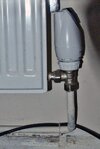
My point is, the report is clearly wrong, turning the temperature up on the thermostat, does have an effect to some extent. I would say even with a mechanical thermostat, the droop, (difference between on and off temperature) means turning up a couple of degrees above temperature required makes a difference, I would say the mechanical TRV has around 4°C between fully open and fully closed, so turning up 4°C will help heat a room, with analogue control, with digital (on/off) still around 1°C, the big problem is with multi-thermostats, the boiler failing to run, or modulating early, due to return water temperature being too high, or lack of communication between various thermostatic controls.

In my main house, to start with, I only had one on/off thermostat which measured the temperature in the hall, and it would turn off the boiler prematurely, adding linked thermostats in the living room and wife's bedroom kept the boiler running when other rooms were cool.

What I have realised is every home is different, there is no one set of instructions to suit all, and to make bold statements of how one should set up central heating systems runs the risk of leaving some groups in the cold.

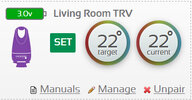
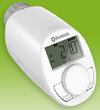
My thermostats all have the target set on them, but at least 6, do not show current, 61dmtMm13BL.jpg this head shows only the target, same with wall thermostats,
84067_P.jpg
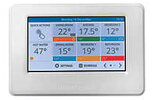
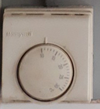
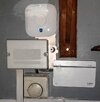
they rely on some other method of telling the occupants how well the heating is working. Even those which do allow us to see the current, IMGP8041.jpg one can only see the current TRV_report.jpg with a PC, tablet, or phone. There were HMI devices (Human machine interface) EVO-home1.jpgwhich did not need phones etc, to see what is going on, but these seem to have gone out of favour, being able to sit in one's chair and say hey google set living room to 22°C is all well and good for those who have the ability to use the new technology, but some people still use thermostats like this, 1768224958847.png one shown is actually in my flat, and no amount of talking to it will alter its settings. And located in the kitchen, that is not really the ideal place to control 4 rooms. Since the flat, where this is, is not used much, it has never been upgraded, it does seem odd, Thermostats_tonemapped.jpg to see the old unit, still used, nested between the Nest and Wiser hubs, but this is the problem when someone makes a broad statement, there will be so many homes where the statement is not true, and we risk leaving people cold by giving miss-information.

 
It continues This is how much it really costs to run an oil-filled radiator – and 5 ways to make that price even cheaper Oh really?
They offer impressive heat output, are portable enough to be moved from room to room, and are generally cheaper to run than the best electric heaters.
Come on, they are electric heaters.
Yes, if you’re one of the many homeowners or renters in the UK trying to keep their boiler working to a minimum, the best oil-filled radiators can be a welcome addition to the home.
I have an oil filled radiator for emergencies, should the oil central heating fail.
‘The units of oil-filled radiators can vary in size from 500 - 2500W.’ So how much it costs will depend on how powerful your oil-filled radiator is. For example:

  • A 500W (0.5kW) model would cost you 13.8p an hour to run.
  • A 2500W (2.5kW) model would cost 69.2p an hour to run.

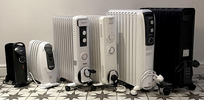
I had this talk with my daughter, she had a 3 kW oil filled radiator, but it is half the physical size of my central heating radiators which are rated at 2 kW, so best output one can expect is 1 kW very soon after switching on it is going to start cycling on/off, the picture shows 1768227326427.png an array of units, all with some thermostatic control, so that 13.8p and 69.2p per hour are pointless figures to quote, as set to say 20°C they will all use the same amount of power, OK less than the central heating, as central heating sends some heat out of the flue, but the fuel costs 5 times as much, to oil or gas.

It seems MSN are trying to get people to buy rubbish, it pops up on my PC when the mouse pointer goes over the weather report, and mixes fact and fiction so no one really knows which is which, and gets people to spend money they don't need to spend.
 

If you need to find a tradesperson to get your job done, please try our local search below, or if you are doing it yourself you can find suppliers local to you.

Select the supplier or trade you require, enter your location to begin your search.


Are you a trade or supplier? You can create your listing free at DIYnot Local

 
Back
Top