The transformer would be better called a power supply, they are 12 volt, but can be DC or AC output the latter 50 Hz to kHz some will take an LED lamps others will not, so the start point is to see what it says on the power supply.
The toroidal transformer, used in the early days,
will work LED lights without a problem. The electronic
often have both a lower and upper limit, one shown needs a load of 10 watt, as far as you need to know, watt and VA are the same. But the newer types
can run zero to rated output, most LED units are happy with AC or DC, but there are specials which are DC only, but these are really for boats and caravans and tend to be expensive.
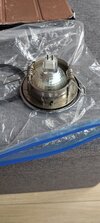
The lamp you show is often called a MR16, it stands for multifaceted reflector16 x 1/8 of an inch across, so technically both GU10 230 volts and the 12 volt version are both MR16, but the trade tends to call 12 volts MR16 even when LED, so there is no reflector.
With the quartz halogen, the connection socket is prone to failure due to over heating, but there is no real harm trying a 12 volt LED and see if it works.
The problem moving to 230 volts, is technically fixed 230 volt lamps need to have a terminal for the earth, often the terminal is missing, and the fitting is classed as Class II which does not need an earth, but the rules say unless suspended, and earth much be run and terminated at the lamp, and often the 12 volt units only use two core cable, it would not worry me, but a pedantic inspector doing an EICR could fail it if earth is missing.
Specially in a bathroom if there is no RCD protection.