

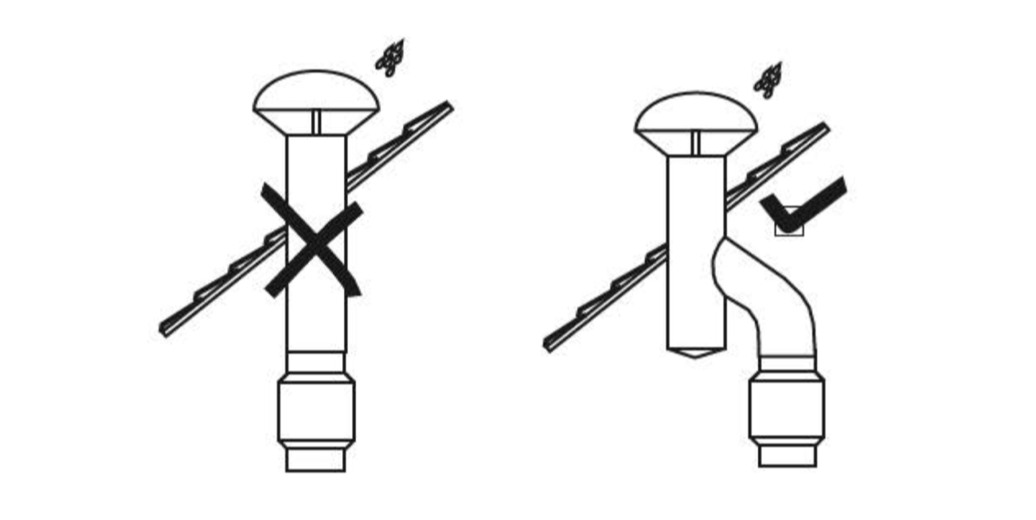
I have an existing bathroom ventilation system where the vent goes through the bathroom ceiling into the loft space, then into flexible insulated ducting, 100mm inline fan, more flex duct, then into a hard plastic pipe that goes vertically through the roof. I've included an image below that shows the kind of setup I'm working with, the one on the left, and I'm trying to achieve something like the diagram on the right.
When we first moved in there was water damage on the ceiling around the vent and investigating the loft I found a large amount of water in the flex ducting (non-insulated). At the time I replaced the ducting with insulated and routed it in such a way that no water could collect in the ducting. I promptly forgot about this as there was far more pressing tasks to be done. The flex ducting connects directly to the bottom of the plastic pipe so any rain water entering the pipe, or condensation, will run down the pipe, into the flex ducting and into the fan. Having opened the electrical connection box on the fan I can se water inside it. This obviously needs fixing...
Firstly, there is no possibility to change the routing of the ducting, the bathroom has no external walls so going into the loft is the only option. Doing any work on the roof is extremely difficult due to access problems so the scaffold cost is prohibitively expensive. There are no close by vertical walls in the loft space that the ventilation could be rerouted through as it would requite a run of about 20m or more with multiple bends. So using the existing vertical exit through the roof is likely the only option.
From researching a bit it looks like I need a T piece connector on the downpipe, and to connect the fan to the side, and then cap off the bottom of the vertical pipe. However I'm having trouble finding any 100mm plastic fittings that can cap off the pipe with, I've only found some on amazon which makes me think there could be a different solution due to no building supplies selling anything to do this.
I don't think there is a lot of water running back down the vent now as there is no evidence it's reaching the bathroom, just enough to get into the fan itself.
What parts would be best to use to stop the water from returning back down the pipe without changing the existing outlet though the roof? Do I need to worry about having some kind of condensate tube to take the water from the bottom of the vertical pipe and drain it somewhere? Again this will be difficult as it would need to be quite a long run to anywhere it could be drained.
Thanks
When we first moved in there was water damage on the ceiling around the vent and investigating the loft I found a large amount of water in the flex ducting (non-insulated). At the time I replaced the ducting with insulated and routed it in such a way that no water could collect in the ducting. I promptly forgot about this as there was far more pressing tasks to be done. The flex ducting connects directly to the bottom of the plastic pipe so any rain water entering the pipe, or condensation, will run down the pipe, into the flex ducting and into the fan. Having opened the electrical connection box on the fan I can se water inside it. This obviously needs fixing...
Firstly, there is no possibility to change the routing of the ducting, the bathroom has no external walls so going into the loft is the only option. Doing any work on the roof is extremely difficult due to access problems so the scaffold cost is prohibitively expensive. There are no close by vertical walls in the loft space that the ventilation could be rerouted through as it would requite a run of about 20m or more with multiple bends. So using the existing vertical exit through the roof is likely the only option.
From researching a bit it looks like I need a T piece connector on the downpipe, and to connect the fan to the side, and then cap off the bottom of the vertical pipe. However I'm having trouble finding any 100mm plastic fittings that can cap off the pipe with, I've only found some on amazon which makes me think there could be a different solution due to no building supplies selling anything to do this.
I don't think there is a lot of water running back down the vent now as there is no evidence it's reaching the bathroom, just enough to get into the fan itself.
What parts would be best to use to stop the water from returning back down the pipe without changing the existing outlet though the roof? Do I need to worry about having some kind of condensate tube to take the water from the bottom of the vertical pipe and drain it somewhere? Again this will be difficult as it would need to be quite a long run to anywhere it could be drained.
Thanks


