
Bodge fix to slow leaking radiator connection -better rad on or off and plumber mait? denso tape?

Joined
26 Sep 2006
Messages
459
Reaction score
14
Location
Fife
Country
United Kingdom
This is on the thermostat side where the feed enters the valve -so would need to drain to fix permanently/loosen nut etc. It is in an old hall where I work - so CH system is massive. Plumber is coming out to do a full service and fix this leak on Monday. We knew we had a very slight leak a few weeks ago, just weeping very slightly when cold.
However over the holidays the heating was off (just frost protection on) and since we turned it back on a few days ago and it got hot the leak got quite a bit worse, and now it it is leaking quite badly even when it is cold. I topped up the pressure just before the holidays and I have had to top it up a day or so ago and it looks like I will have to do it again tomorrow.
We have tried with the radiator turned off at the thermostat and it doesn't seem to make a difference -but difficult to tell. So first which is likely to be best to slow the leak - radiator on or off?
Secondly could I use plumbers mait or denso tape (I have both!) or? just to slow it down until plumber comes. I did try and nip it up but it seems quite tight anyway and I don't want to risk a disaster...I don't want to use epoxy resin as the plumber will do a 'proper' fix and I don't want to make it more difficult for him.
My main concern is it the pressure will go too low over night and it won't come on before we get there in the morning (8.30) -it takes a good few hours to get the hall warm - currently set to come on at 6am to get warm enough for 9am.
We look after small children so it needs to be warm enough when they arrive.
Any help/advice appreciated.
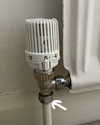
 
If tightening the joint where the supply pipe enters the valve doesn't stop the leak ,it will need taking apart to sort it out.
Plumbers mait is wholly useless for using as you suggest ,as is denso tape.
A picture of the joint may be helpful.
 
Hi
I can't post an image of the pipe just now (not at work) - I don't know if this helps but this image off the web is similar - with the white arrow showing where it is leaking from. (I was going to post one of my rads but I have microbore but like this image the ones in the hall are 15mm feeds)
It is definitely coming from the lower side of the nut, running down the feed pipe.
 

Attachments

  • temprad.png
    temprad.png
    589.9 KB · Views: 34
I have but I think it is tight enough - I put quite a bit of force onto it and it didn't move - I'm really wary of overdoing it and ending up making it worse/getting a flood.
I did think I could try loosening it a bit and then tightening it back, just in case it i didn't move because it is a bit seized anyway, I'm guessing it hasn't been touched for many many years....
(If it was in my house I would get supplies ready just in case and go for it ..but here it would effect lots of people if I messed it up)
 
Keep topping it up and wait for the plumber or see if you can call another plumber, or is there a parent of any of the children who is a plumber?

Andy
 
If you haven't any plumbing skills it hard to give you any advice as Herts says keep topping up till Monday and accept/ deal with the spillage. Friday the kids will have gone and you can leave it alone?
 
Hi
I can't post an image of the pipe just now (not at work) - I don't know if this helps but this image off the web is similar - with the white arrow showing where it is leaking from. (I was going to post one of my rads but I have microbore but like this image the ones in the hall are 15mm feeds)
It is definitely coming from the lower side of the nut, running down the feed pipe.
Standard 15mm compression. As it's below the valve I'd switch your boiler off (and pump if it's not integral to the boiler), chances are you can loosen the compression locknut without draining the system to drop the pressure, and wrap 4 or 5 turns of PTFE tape around the olive, or smear some jointing compound around it, like boss universal. Don't overtighten it.

If when you loosen the locknut water starts sperting out at pressure then you'll have to drain the system before you do the above.
 
Thanks - so no point trying plumbers mait or denso? Only trying to slow it down....
I do have some basic plumbing skills - I would sort this for my own home..and do it properly -be ready to redo the joint completely. Just don't want to make the situation worse.
I know if I overtighten it and squash the olive it will leak even worse or as I don't know the history and feed is a short length out of the floor if it has been bodged in the past (eg from experience the feed pipe is only just long enough, just hanging on and drops down as soon as disconnected although that was microbore not 15mm ) the valve could come off altogether and lead to a massive flood! Both of which would lead to us losing the heating altogether.
Draining this system (16x 2m radiators) would be a big job ...even isolating all the rads before draining so connecting pipework only would still contain a huge amount of water...sure it would take a couple of hours to drain, refill and get up to temp.
I suspect if a plumber does need to redo the joint if he can he will try and do it without draining - maybe try to freeze the feed or hel look at doing it quickly whilst being ready to drain if needed.
I guess I will just keep topping it up and keeping my fingers crossed...
thanks everyone....
 
I changed a TRV valve a few months ago, I just switched off the boiler and pump, drained the system a little bit to release a bit of pressure, then replaced the valve. The system water won't all run out when you undo the valve locknut if it's unvented, same as when you fill a straw with water then keep your finger on the top.
 
Last edited:
Thanks - so no point trying plumbers mait or denso? Only trying to slow it down....

If the pressure is not too high, you could try self-amalgamating tape, usually sold in electrical type outlets. It's like a stretchy rubber tape, which sticks and amalgamates to itself. You would need to stretch it tight, whist wrapping it round the pipe, building up the level, to the size of the nut, then continue wrapping up over the nut.
 
If the pressure is not too high, you could try self-amalgamating tape, usually sold in electrical type outlets. It's like a stretchy rubber tape, which sticks and amalgamates to itself. You would need to stretch it tight, whist wrapping it round the pipe, building up the level, to the size of the nut, then continue wrapping up over the nut.
Definition of not to high? Since the OP re pressurised I guess it's at least 1 bar and 1.5 bar when up to heat?
 

If you need to find a tradesperson to get your job done, please try our local search below, or if you are doing it yourself you can find suppliers local to you.

Select the supplier or trade you require, enter your location to begin your search.


Are you a trade or supplier? You can create your listing free at DIYnot Local

 
Back
Top